
April 28, 2026
6 min read

Key takeaways:
- Two studies highlight the potential of gene editing for sickle cell disease treatment.
- Despite increasing evidence of efficacy, high costs and manufacturing challenges have limited access to gene therapy.
Two papers published in The New England Journal of Medicine highlight the potential of gene editing for treatment of sickle cell disease.
In one study, renizgamglogene autogedtemcel (Editas Medicine) led to normalization of total hemoglobin levels and a higher level of fetal hemoglobin. In the other investigation, ristoglogene autogetemcel (Beam Therapeutics) resulted in rapid engraftment and durable expression of fetal hemoglobin.

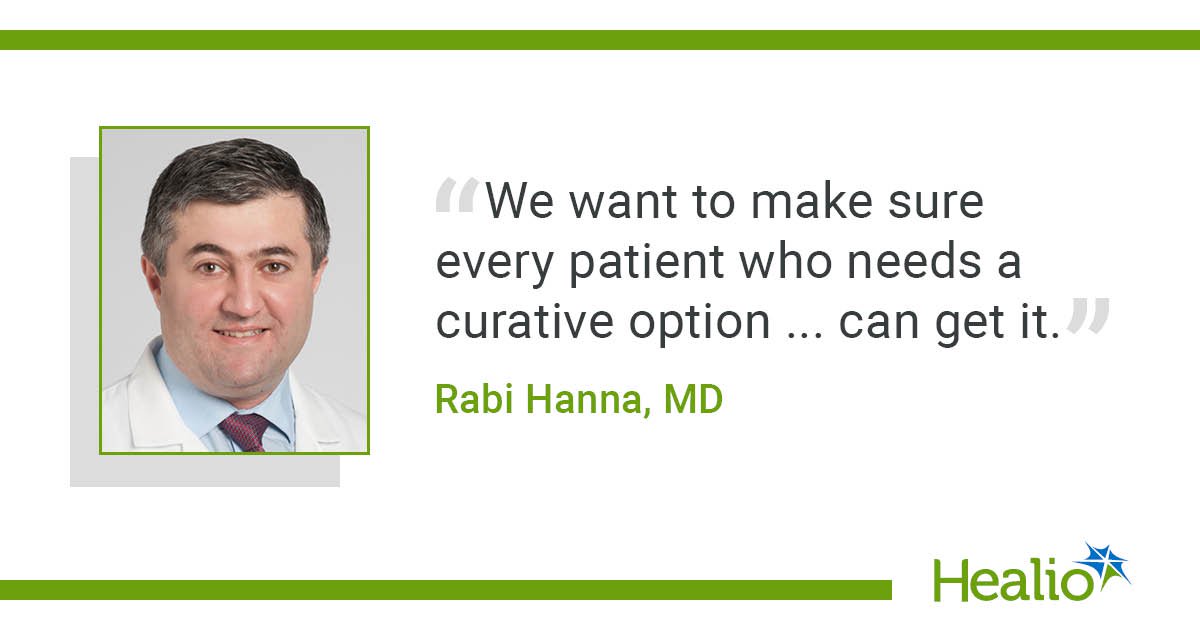
“I truly think what we are seeing truly amounts to a functional cure,” Rabi Hanna, MD, chairman of the division of pediatric hematology/oncology and bone marrow transplantation at Cleveland Clinic Children’s and an investigator on both studies, told Healio.
Gene therapy ‘2.0’
Approximately 100,000 Americans have sickle cell disease, according to CDC statistics. More than 90% of them are non-Hispanic Black or African American.
Disease-modifying therapies can alleviate symptoms — such as painful vaso-occlusive events and chronic hemolytic anemia — but they do not address the underlying cause of the condition, which can lead to multiorgan damage and death.
Allogeneic hematopoietic stem cell transplantation can be curative but its use is limited by a lack of HLA-matched donors, as well as risks for graft-versus-host disease.
Autologous HSCT gene therapies can overcome some of the limitations associated with allogeneic transplant.
The FDA has approved two such therapies for people with sickle cell disease aged 12 years or older with recurrent vaso-occlusive crises. Both use a patient’s own hematopoietic stem cells.
With exagamglogene autotemcel (Casgevy; Vertex Pharmaceuticals/CRISPR Therapeutics), CRISPR-Cas9 is used to edit the BCL11A gene, with modifications designed to produce fetal hemoglobin. With lovotibeglogene autotemcel (Lyfgenia, Genetix Biotherapeutics), a lentiviral vector is used to insert a functional, modified beta-globin gene into the stem cells.
“The whole community that takes care of people with sickle cell disease has been excited about these transformative gene therapies,” Hanna said. “However, in real-world settings, we do see challenges related to access, peripheral blood stem cell mobilization and collection, and manufacturing — whether using gene addition or gene editing. Improving these aspects will allow us to reach more patients effectively. This isn’t to take away from the great innovation and what we have available, but I call that gene therapy version 1. We need to move to version 2.0.”
RUBY study
Renizgamglogene autogedtemcel, often called reni-cel, is a CRISPR-Cas12a gene-edited autologous hematopoietic stem cell therapy.
Editing of CD34-positive cells at the BCL11A transcriptional repressor binding site in the HBG1/HBG2 promoters is performed to reactivate fetal hemoglobin expression.
“Patients who have a mutation in [HBG1 or HBG2] have a higher level of fetal hemoglobin,” Hanna said. “That tends to be protective because they don’t really have a severe phenotype. With reni-cel, the gene editing is trying to mimic what happens in nature.”
Cas12a typically offers greater gene-editing specificity than Cas9, with the goal to decrease off-target effects, Hanna said.
Hanna and colleagues conducted the phase 1/phase2 RUBY study to evaluate whether treatment with reni-cel could offer durable benefit to people with severe sickle cell disease.
The multicenter, open-label study included patients aged 12 to 50 years who had experienced at least two severe vaso-occlusive events in each of the prior 2 years.
Patients underwent myeloablative conditioning with busulfan, followed by a single reni-cel infusion. Researchers followed patients for 24 months to assess engraftment, hemoglobin-related measures, vaso-occlusive events, adverse events and allelic editing levels.
Investigators performed a nonprespecified analysis of efficacy and safety data from the first 28 adults who received treatment. Median follow-up reached 9.5 months (range, 0.7-25.2).
Twenty-seven patients had neutrophil engraftment — occurring after a median 23 days (range, 14-29) — and platelet engraftment, occurring after a median 25 days (range, 17-51).
Mean percentage of fetal hemoglobin — which reduces the likelihood that red blood cells will stiffen into a sickle shape and clog blood vessels — increased from 2.5% at baseline to 48.1% at 6 months.
Mean total hemoglobin — which minimizes sickle cell disease-related complications — increased from 9.8 g/dL at baseline to 13.8 g/dL at 6 months, a level within the normal range for people who do not have sickle cell disease
Fetal and total hemoglobin levels have remained steady over time, Hanna said, with median follow-up now reaching 17 months and follow-up for some patients exceeding 2 years.
“We saw promising efficacy,” Hanna said. “The number of stem cells produced was very good, as was engraftment. We are seeing red blood cells as truly functionally normal cells.
“We showed there is no pain, but we need more data to know whether there is improvement in end-organ damage,” Hanna added. “Hopefully in 5 or 10 years, we will be able to say this prolonged patients’ lives and gave them good quality of life.”
Adverse events appeared consistent with those typically reported after myeloablative conditioning with busulfan or autologous HSCT, according to investigators.
Twenty-seven of 28 patients had no vaso-occlusive events. One patient experienced two severe vaso-occlusive events after infusion.
Editas Medicine discontinued reni-cel development in December 2024 as part of a companywide reassessment of clinical priorities — which resulted in greater focus on in vivo gene editing — and the company’s decision prompted early termination of the RUBY study. Still, long-term follow-up of patients enrolled in Ruby will continue.
BEACON study
Ristoglogene autogetemcel, often called risto-cel, is an autologous hematopoietic stem cell therapy developed using base editing technology that avoids viral vectors.
CD34-positive hematopoietic stem and progenitor cells are base edited to target HBG1/HBG2 to increase fetal hemoglobin production. The precise single-strand gene editing approach allows for DNA modification without the introduction of double-strand breaks.
In the phase 1/phase 2 BEACON study, researchers evaluated risto-cel for people aged 12 to 35 years with sickle cell disease who had a minimum four severe vaso-occlusive crises in the 2 years prior to enrollment.
Thirty-one patients underwent myeloablative conditioning with busulfan, followed by one infusion of risto-cel.
Freedom from severe vaso-occlusive crises for 12 consecutive months — beginning later than 60 days after the final red cell transfusion — served as the primary efficacy outcome.
An unplanned interim analysis explored data related to the primary endpoint, as well as editing, engraftment, hemoglobin production and safety.
Mean follow-up reached 6.6 months (range, 0.3-20.4). Neutrophil engraftment occurred by a median 17.5 days, with platelet engraftment occurring by a median 19 days.
Researchers reported favorable outcomes at 6 months, with the mean fraction of on-target edited alleles in peripheral blood reaching 67.4%. The mean level of hemoglobin S — an inherited variant responsible for sickle cell disease — as a fraction of total hemoglobin was below 40%, with levels remaining steady with longer follow-up.
Investigators reported no severe vaso-occlusive crises more than 60 days after the final red cell transfusion.
All patients experienced at least one adverse event, with 27 (87%) experiencing a grade 3 or higher event and 12 (39%) experiencing a serious adverse event. One patient died due to idiopathic pneumonia syndrome.
Importantly, most patients completed stem cell collection after one or two cycles.
“The number of cycles required for other gene therapies is much higher — sometimes up to six cycles — so this is huge for our patients,” Hanna said. “Stem cell collection has been a challenge and it has prohibited many patients from getting access to stem cell-modified gene therapy. Some patients can’t have enough stem cells to be sent to the company. If we can produce the required number with far fewer cycles because of improved gene editing technology, that will advance the field.”
‘The ideal situation’
The findings from the RUBY and BEACON studies support the utility of gene therapy and offer broader proof of efficacy of the CRISPR platform, Hanna said.
“It not only works in BCL11A, but it works in [HBG1 and HBG2],” he said. “Gene therapy needs to continue to be refined. I would challenge regulatory authorities to think about how we can move away from potentially approving one medicine based on one indication and think about whether this can be approved as a platform.”
Even if new approaches make gene therapy safer and less time intensive, challenges related to its use for sickle cell disease remain. High costs and limited accessibility top the list, Hanna said. Less intense conditioning therapy that potentially has fewer side effects than busulfan — especially related to risk for infertility — also is needed, he said.
“As a health care system, we need a better model for regulatory approval that will enable innovation,” he said. “These therapies are quite expensive. If we have more innovation, we will have more competition. That would decrease the cost of these therapies and improve access.”
Additional efforts to improve manufacturing are needed, Hanna said. He also called for further research to identify strategies to reduce the toxicity of conditioning therapy and determine if gene therapy can improve vasculopathy, the key driver of stroke and end-organ damage in sickle cell disease.
“The ideal situation that we dream about is to have options for our patients,” Hanna said. “We want to make sure every patient who needs a curative option — whether it is allogeneic transplant or gene therapy — can get it.”
For more information:
Rabi Hanna, MD, can be reached at hannar2@ccf.org.
Sources/Disclosures
Source:
Hanna R, et al. N Engl J Med. 2026;doi:10.1056/NEJMoa2415550.
References:
Disclosures:
Editas Medicine sponsored the RUBY study. Beam Therapeutics funded the BEACON study. Hanna reports relationships with Editas Medicine and Vertex Pharmaceuticals. Please see the studies for all other authors’ relevant financial disclosures.

Ask a clinical question and tap into Healio AI’s knowledge base.
- PubMed, enrolling/recruiting trials, guidelines
- Clinical Guidance, Healio CME, FDA news
- Healio’s exclusive daily news coverage of clinical data
<










Leave a Reply