
April 21, 2026
4 min read

Key takeaways:
- The gut microbiome could help identify reasons for the increase in early-onset colorectal cancer.
- AI highlighted differences based on genetics, education and BMI within early-onset disease.
An AI-assisted analysis of the gut microbiome in colorectal cancer cases revealed substantial differences between early- and late-onset disease, including microbial diversity and associations with specific mutations.
The research, presented at American Association for Cancer Research Annual Meeting, also showed variations within early-onset colorectal cancer based on genetics and social determinants of health, including education and BMI.

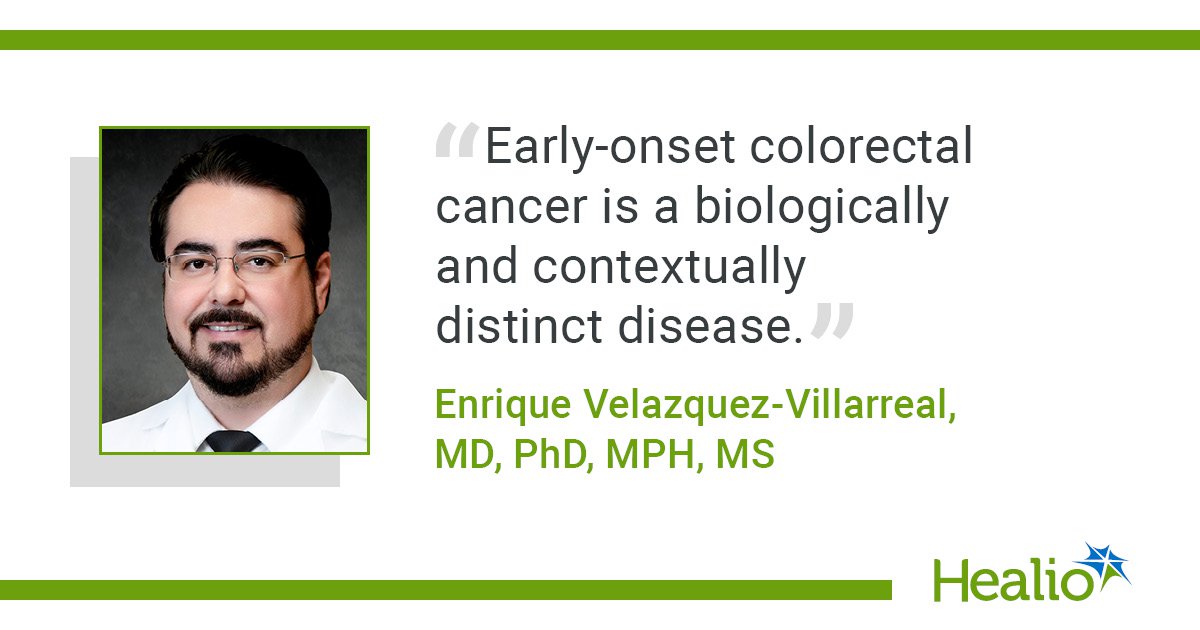
“Early-onset colorectal cancer is a biologically and contextually distinct disease, and we need to approach it differently,” Enrique Velazquez-Villarreal, MD, PhD, MPH, MS, principal investigator and assistant professor in the department of integrative translational sciences at City of Hope, told Healio.
“From a clinical standpoint, this means moving toward more personalized strategies that integrate not only genomic data, but also microbiome profiles and patient-specific factors such as social determinants of health. These findings suggest that future screening, prevention and treatment approaches may need to be tailored based on age, ancestry and environmental context.”
‘Alarming’ increase
Overall colorectal cancer incidence in the U.S. declined 0.9% annually between 2013 and 2022, but it increased 3% per year among those aged 20 to 49 years, according to data from American Cancer Society’s Colorectal Cancer Statistics 2026 report.
“Early-onset colorectal cancer is increasing at an alarming rate worldwide, particularly among populations already at higher risk, including underserved and minority groups,” Velazquez-Villarreal said. “While we’ve made significant progress in understanding the genetic drivers of colorectal cancer, we still don’t fully understand why younger individuals are developing this disease more frequently.”
Prior studies have found the gut microbiome could have a “critical” role in colorectal cancer development, Velazquez-Villarreal explained, noting the impact on immune response, inflammation and tumor biology.
“However, most studies have not integrated microbiome data with clinical, genomic and social determinants of health in a unified framework,” he added. “We felt it was essential to take a more comprehensive, systems-level approach, leveraging artificial intelligence developed in my lab here at City of Hope — we call it AI-HOPE — to better understand how these factors interact, especially in early-onset disease.”
Researchers evaluated tumor samples from 2,715 patients with colorectal cancer from the NIH Cancer Moonshot COPECC PE-CGS Network as well as public data repositories.
They also collected and analyzed stool samples from 23 patients from that cohort.
Microbiome differences between early- and late-onset colorectal cancer served as the primary endpoint.
‘Heterogenous microbial ecosystems’
Velazquez-Villarreal and colleagues observed early-onset samples had less microbial diversity than those of late-onset disease.
“This suggests a less diverse gut ecosystem that may reflect or contribute to tumor-promoting conditions, such as immune dysregulation or metabolic imbalance,” Velazquez-Villarreal said.
They also found differences in specific microbial taxa.
“Acidaminococcaceae, Veillonellaceae and Lachnospiraceae were among the most abundant taxa,” Velazquez-Villarreal said. “Notably, Prevotellaceae abundance was increasing in early-onset colorectal cancer, indicating potential age-specific microbial enrichment patterns. These heterogeneous microbial ecosystems may reflect differences in host genetics, environmental exposures and life factors.”
Additionally, certain microbiome compositions had associations with tumor mutations, including APC, TP53 and KRAS, copy number variations and gene fusions.
“These interactions extend further into the tumor microenvironment, where certain microbial patterns align with immune-related signatures and transcriptomic profiles derived from RNA sequencing, suggesting functional interplay between microbial communities and host gene expression,” Velazquez-Villarreal said.
Researchers found differences in microbiomes based on ancestry within Hispanic and Latino populations, as well as social determinants of health.
“For example, higher vs. lower education levels correlated with shift in the relative abundance of key bacterial taxa,” Velazquez-Villarreal said. “When we stratified by BMI, this revealed distinct microbial abundance profiles between individuals with and without obesity, which indicated that metabolic status may modulate the tumor-associated microbiome.”
AI-HOPE identified connections between microbial taxa, genomic alternations, tumor stage and treatment type, as well.
“AI-guided case-control analyses further identified taxa such as Fusobacterium and Parvimonas as potential microbial biomarkers linked to disease characteristics,” Velazquez-Villarreal said.
Velazquez-Villarreal described the research as “an important first step,” but noted several questions remained.
“First, we need larger, prospective studies to validate these findings and determine whether specific microbial signatures can serve as biomarkers for early detection or prognosis,” he said. “Second, we want to better understand causality: Are these microbiome changes driving cancer development, or are they a consequence of tumor biology? Third, integrating longitudinal data will be critical to understand how the microbiome evolves over time and in response to treatment.
“Finally, one of our major goals is to develop AI-driven predictive models that can combine clinical, genomic, microbiome and social determinants of health data to identify individuals at highest risk and guide early intervention strategies.”
Velazquez-Villarreal and colleagues also are attempting to identify microbiome in different tissues, which could further enhance AI models and better predict disease development or recurrence.
“By integrating microbiome science with highly autonomous artificial intelligence, developed from the ground up by our team of physician-scientists, genomic experts and computational specialists at the Velazquez-Villarreal Lab, and real-world patient data, we are beginning to uncover why colorectal cancer is rising in younger populations, while advancing our primary mission of developing early cancer detection tools to improve prevention and patient outcomes,” Velazquez-Villarreal said.
For more information:
Enrique Velazquez-Villarreal, MD, PhD, MPH, MS, can be reached at evelazquezvilla@coh.org.
Perspective
Back to Top

Disclosures: Biachi reports no relevant financial disclosures.
Sources/Disclosures
Source:
Manjarrez S, et al. Abstract 3993. Presented at: American Association for Cancer Research Annual Meeting; April 17-22, 2026; San Diego.
Disclosures:
The authors report no relevant financial disclosures.

Ask a clinical question and tap into Healio AI’s knowledge base.
- PubMed, enrolling/recruiting trials, guidelines
- Clinical Guidance, Healio CME, FDA news
- Healio’s exclusive daily news coverage of clinical data
<













Leave a Reply