
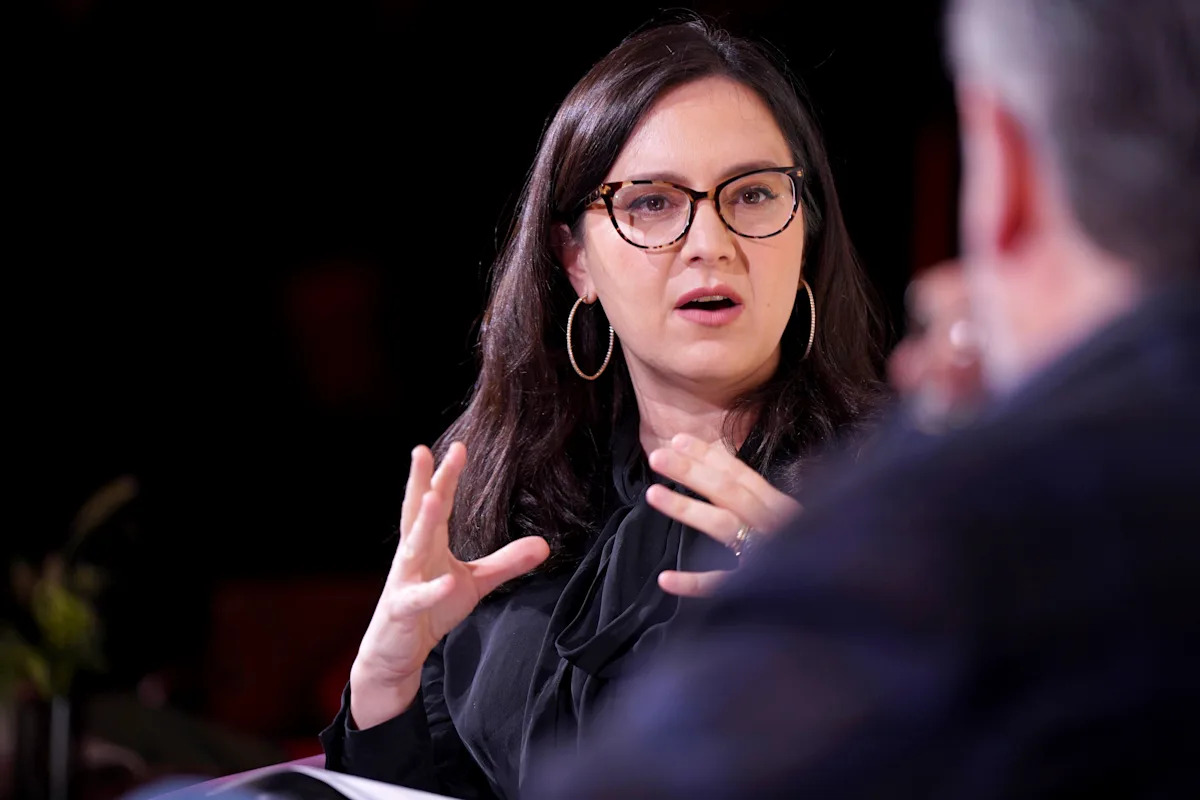
CBS News editor-in-chief Bari Weiss unveiled her strategy for the network’s news division, putting a heavy emphasis on restoring trust in the news media, while urging a shift to streaming and building brands around talent.
“Our strategy until now has been to cling to the audience that remains on broadcast television. If we stick to that strategy, we’re toast,” she told staffers in the town hall on Tuesday, according to her prepared remarks.
More from Deadline
Among other things, Weiss announced a new slate of contributors, a new masthead of newsroom leaders, and shifting to a “streaming mentality,” with CBS News 24/7 being “a lab for new formats and shows.”
She also said that the network would invest in brands like 60 Minutes, 48 Hours and Sunday Morning with podcasts, newsletters and live journalism.
She also talked about building brands around talent, what she called “Sorkin-ing,” a reference to Andrew Ross Sorkin, who is a New York Times print reporter, CNBC host and live event producer, among other things.
“Starting now, we all must focus on what we’re building, not on what we’re maintaining, on how we’re going to reach an audience exponentially bigger than the one we have now by marrying the journalistic principles that will never change — seeking the truth, serving the public, and ferociously guarding our independence, with the tools that are constantly are,” Weiss said.
She added that “if we are able to create a shared source of trust for the majority of people in America, I don’t think it’s too grandiose to say that we’ll be doing our part to fix this country we all love.”
Weiss also addressed ideological direction of the network, telling staffers that “our job is to present people with the fullest picture — and the strongest voices on all sides of an issue — and then trust them to make up their own minds.”
Weiss said that with the low trust in mainstream news organizations, “many people have retreated to news sources that protect them from conflicting narratives.”
She said that independents — a number “large and growing” — would be those who “have a home at CBS News.”
“That’s already our core audience,” she said, adding that the network is for the “mixed multitudes.”
She said that “to cover America as it actually is, we in this building need to reflect more of the political friction that animates our national conversation. That means recruiting and hiring editors, reporters, producer and correspondents about whom our viewers will say, ‘They understand me. They will give me a fair shake. They respect me.’”
“We need to commission and greenlight stories that will surprise and provoke — including inside our own newsroom.”
Weiss was hired last fall, a surprise to many news veterans as she had no television management experience. She was a former New York Times opinion writer until a high profile departure led her to launch The Free Press, the opinion site. Paramount’s new ownership, led by CEO David Ellison, also purchased the site.
Her tenure so far has been notable for scrutiny and upheaval. She’s already been the subject of profiles in The New Yorker and other publications, while the biggest controversy has been her decision to pull a 60 Minutes segment on Trump deportations, even though it had already been promoted. That led to Sharyn Alfonsi, the correspondent on the segment, to protest the move in a staff email, calling it political. Paramount is seeking to buy Warner Bros. Discovery, something that will need the approval of the Trump administration.
The news division also went through a round of layoffs, with more expected. Weiss did not address job cuts in her prepared remarks.
In her staff meeting, Weiss referred to the “noise around me taking this job.”
She told staffers, “I gte it. I also get why, in the face of all this tumult, you might feel uncertain or skeptical about me or what I’m aiming to do here.I’m not going to stand up here today and ask you for your trust. I’m going to earn it, just like we have to do with our viewers.”
Accompanying her presentation was a slide deck, including charts showing ever declining trust in mass media, declining ratings for nightly news shows, and a rising number of voters who define themselves as independents. She also showed a cartoon by Tim Urban, showing a stick figure on a chart measuring human progress. The figure, though, stands on the cusp a line showing an exponential increase in progress.
“That little stick figure? That’s us. If you’re the person on the graph things can [seem] normalish because you can only see the past, not the future.”
All linear networks are grappling with the shift in viewer habits to streaming and social media, but newsrooms have been set up around linear television, where many outlets still get a majority of advertising revenue. CNN, led by Mark Thompson, has been embarking on an effort to integrate the newsroom, with a heavier emphasis on digital and the recent launch of a new subscription streaming offering.
“Our competitors are not just the other broadcast networks. We are competing for the attention of anyone in front of a screen,” Weiss said.
Weiss said that Tom Cibrowski, president and executive editor of CBS News, will also help lead the network’s business team, with Sam Siegel as chief operating officer. Sophia Efthimiatou, former head of writer relations at Substack, is leading a new talent and brand team, with Angela Hunter as vice president of talent strategy and development, and Tori Asness, previously the head of talent at Vice. Kyra Noonan, former head of development at Free Press, is joining as vice president of development.
Weiss told staffers to view the news division as the “best capitalized start up in the world, and that if “we all do our jobs right, in a year’s time CBS News will look very different.” She also cautioned that if her plans are “not your bag” there are “so many exciting things to spend your career doing.”
More to come.
Best of Deadline
Sign up for Deadline’s Newsletter. For the latest news, follow us on Facebook, Twitter, and Instagram.









Leave a Reply