
April 17, 2026
1 min read

Key takeaways:
- Cemented and uncemented TKA had no differences in manipulation under anesthesia, minor wound complications or outcomes.
- The cemented group had more nonprogressive radiolucent lines vs. the uncemented group.
NEW ORLEANS — Cemented and cementless total knee arthroplasty with patella resurfacing yielded similar revision rates, reoperation rates and patient-reported outcome measures, according to results presented here.
“In this large, randomized controlled trial of cemented vs. uncemented knees with all patella resurfaced, we were unable to show a difference in clinical outcomes, but we showed an equivalent outcome between cemented and uncemented knees at 5 years for patient-reported outcomes, revision rates and radiographic outcomes,” Simon W. Young, MD, FRACS, from the University of Auckland, told Healio about results presented at the American Academy of Orthopaedic Surgeons Annual Meeting.

In the study, which received the Mark Coventry Award at the AAOS Annual Meeting Specialty Day, Young and colleagues randomly assigned 316 patients aged younger than 75 years undergoing primary TKA to receive either cemented (n = 158) or fully uncemented (n = 158) implants with patella resurfacing. According to the abstract, revision and reoperation rates, patient-reported outcome measures and incidence of radiolucent lines at 5 years were considered the primary outcome measures.
In his presentation, Young said both groups had one revision for periprosthetic joint infection and one patient in the uncemented group had an extensor mechanism failure. No patients in the uncemented group and one patient in the cemented group had progressive radiolucent lines at 5 years. He also said more patients in the cemented group had nonprogressive radiolucent lines vs. the uncemented group.
“These were largely minor lines that were probably not clinically relevant,” Young said. “Importantly, we did not see lines around the uncemented patellar component, which was perhaps the component we were most worried about.”
The researchers found no differences in manipulation under anesthesia, minor wound complications or patient-reported outcome measures between the two groups. Results showed a small difference in surgical time between the groups, according to Young.
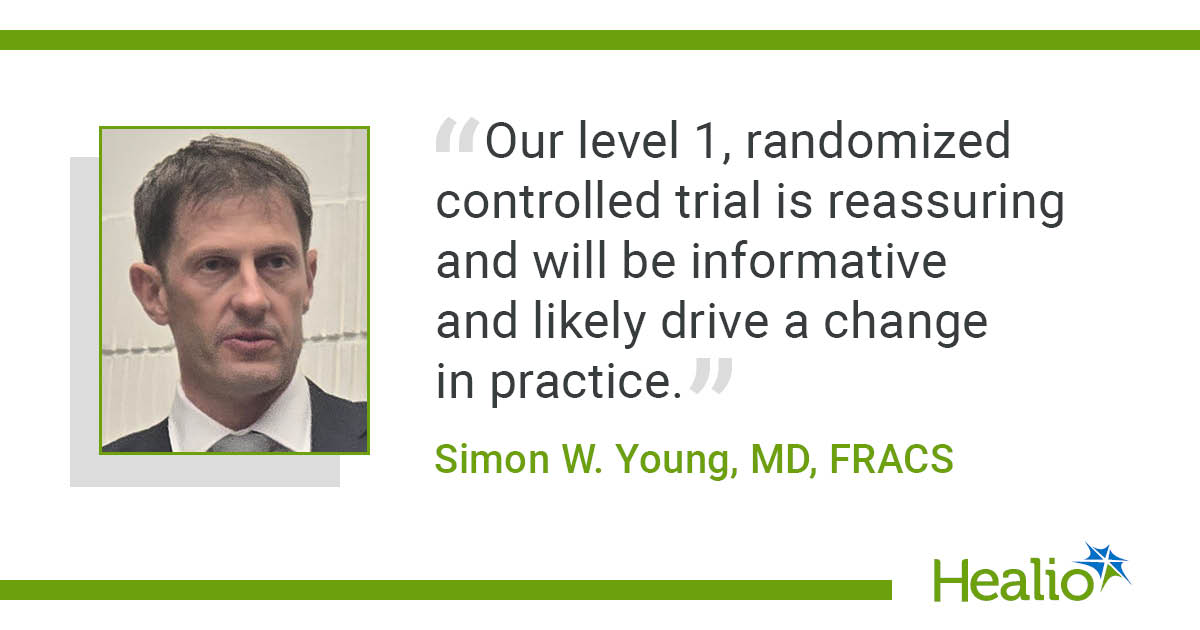
“Our level 1, randomized controlled trial is reassuring and, as long as registry data confirms these findings across the wider population, it will be informative and likely drive a change in practice,” Young told Healio.
For more information:
Simon W. Young, MD, FRACS, can be contacted at simonwyoung@gmail.com.
Sources/Disclosures
Source:
Tay ML, et al. Paper 381. Presented at: American Academy of Orthopaedic Surgeons Annual Meeting; March 2-6, 2026; New Orleans.
Disclosures:
Young reports being a consultant for Stryker.

Ask a clinical question and tap into Healio AI’s knowledge base.
- PubMed, enrolling/recruiting trials, guidelines
- Clinical Guidance, Healio CME, FDA news
- Healio’s exclusive daily news coverage of clinical data
<














Leave a Reply