
-
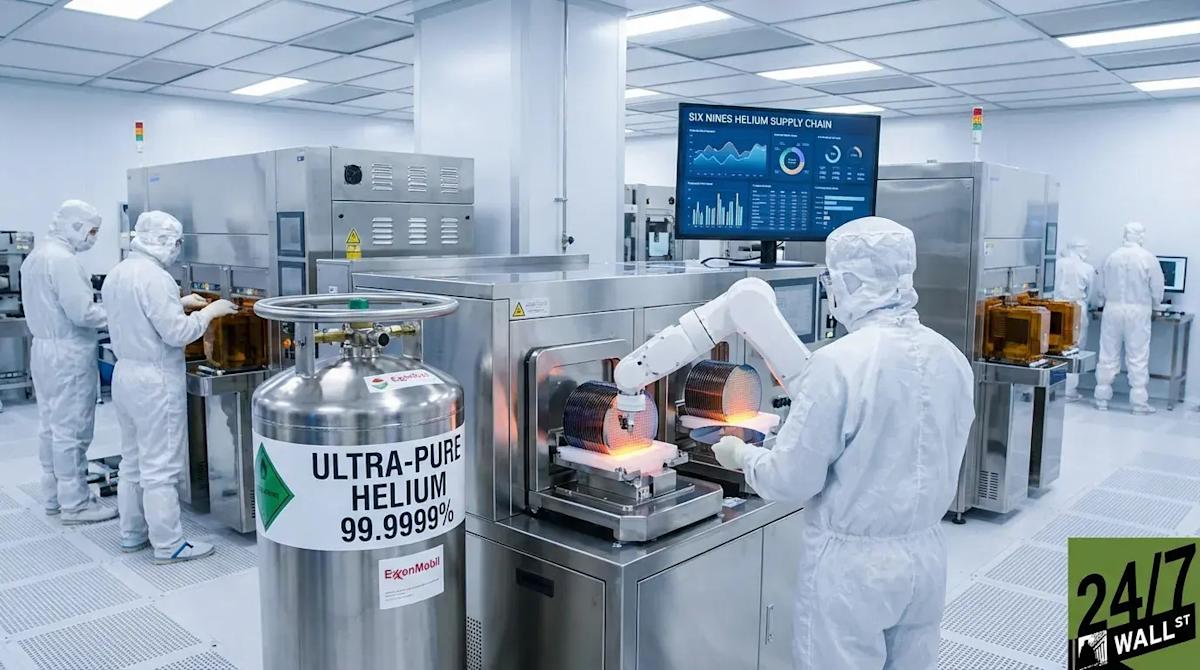
ExxonMobil (XOM) is the primary source of six-nines purity helium (99.9999% pure) required by leading-edge semiconductor manufacturers, positioning the oil giant as a critical materials supplier beyond its traditional energy business.
-
The gap between five-nines and six-nines purity represents a single decimal place, but in chip fabrication one stray molecule can ruin an entire wafer, creating intense demand for ExxonMobil’s specialized processing infrastructure.
-
ExxonMobil earned $28.84 billion in 2025 net income and has delivered 43 consecutive years of dividend growth, though the helium supply concentration risk to advanced chipmakers remains largely unrecognized by most investors.
-
The analyst who called NVIDIA in 2010 just named his top 10 AI stocks. Get them here FREE.
If you haven’t been reading every report on the helium supply chain for the past year, welcome to the club!
Most investors know ExxonMobil as an oil giant. Few know it sits at the center of a critical semiconductor supply bottleneck.
READ: The analyst who called NVIDIA in 2010 just named his top 10 AI stocks
The standard grade for liquid helium used across industrial applications is “A grade B” roughly five nines purity, or 99.999% pure. That sounds extraordinarily clean, and for most applications it is. But leading-edge chip fabrication has moved the goalposts.
Leading-edge semiconductor manufacturers now require six nines purity: 99.9999% pure helium. The difference between five nines and six nines is a single additional decimal place of cleanliness, but in a fab environment where a single stray molecule can ruin a wafer, that gap is enormous.
An industry expert recently stated: “The leading edge chip manufacturers are now looking for six nines purity and right now that primarily comes from Exxon’s facility. So all of a sudden you’ve got a big issue there.”
Exxon Mobil (NYSE:XOM) is not marketing itself as a semiconductor materials company, but that is effectively what its helium operation has become at the premium end. The company’s technology organization has developed a centralized capability set that spans multiple business lines, and its helium processing infrastructure is one of the few in the world capable of reaching six-nines output consistently.
Here is where the logistics get genuinely strange. Containers used for six-nines helium cannot be contaminated with five-nines helium. Even one molecule of hydrogen is a disqualifying event. As a result, these containers are kept entirely separate from standard helium containers and fiberoptic manufacturer containers, creating a parallel logistics infrastructure that is expensive to maintain and nearly impossible to scale quickly.










Leave a Reply