
April 22, 2026
2 min read

Key takeaways:
- Participants briefed on biological causes were more likely to believe that long-term medication can improve gout.
- The data highlight the importance of ensuring the accessibility of accurate information.
Emphasizing how biological factors, rather than lifestyle choices, cause gout can impact patients’ opinions on long-term treatment and improve medication uptake, according to data published in Arthritis Care & Research.
“Gout is the most common cause of inflammatory arthritis in adults,” Rachel Murdoch, MBChB, of the University of Aukland, in New Zealand, and colleagues wrote. “It can be treated effectively with long-term urate-lowering therapy (ULT) such as allopurinol, which decreases flares, tophi and disability. Despite this well-established clinical efficacy, urate lowering therapy is frequently under-prescribed when indicated and is often discontinued by patients after initiation; for example, a recent study found that about 63% of people initiating allopurinol did not persist with this therapy for more than a year.

Data derived from Murdoch R, et al. Arthritis Care Res. 2026;doi:10.1002/acr.80053.
“Despite the compelling evidence for biological causes of gout, it is a common belief in the community that gout is due solely to lifestyle factors,” they added. “When members of the public were asked about the causes of two identical diseases labeled ‘gout’ or ‘urate crystal arthritis,’ participants viewed ‘gout’ as more likely to be caused by diet, alcohol, and the person’s own behavior, and ‘urate crystal arthritis’ as more likely to be due to the effects of ageing.”
To examine how popular opinion regarding the causes of gout can impact patients’ beliefs about treatment, Murdoch and colleagues conducted a randomized study of 201 adults. Participants were recruited from June 2023 to April 2024 through advertisements on the University of Auckland trials website, as well as posters and a job search website. Advertising information about the study purposefully did not mention gout to avoid attracting a “disproportionate” number of patients with the disease. However, patients with gout were not excluded.
Participants were randomly assigned to watch one of two videos about gout. Both videos were 2 minutes in length and largely identical save for a 45-second section in which one video reviewed the biological causes of gout — including genetics, kidney disease, age, sex and diuretic therapy — while the other featured a lifestyle explanation, touching on diet, alcohol, sugary drinks and weight. In all, 99 participants viewed the video with the biological explanation while 102 were in the lifestyle video group.
Following the video, all participants completed a questionnaire about gout and gout management, in which they were asked, “How likely is it that long-term medications would help gout?” Answers were given in the form of an 11-point Likert scale rating.
According to the researchers, participants briefed on the biological causes of gout reported they were more likely to believe that long-term medication can improve gout, with a mean score of 7.6 vs. 6.5 (P = .001).
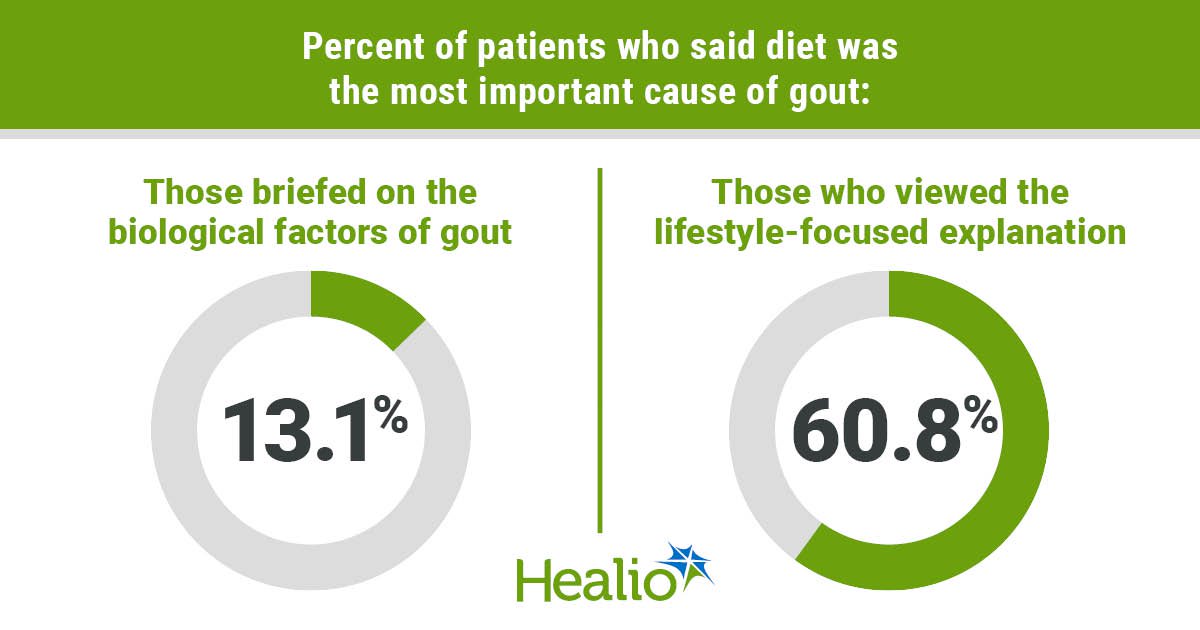
In addition, those who watched the biological explanation video ranked hereditary factors and age as more important than poor diet, alcohol use and lifestyle choices in the development of gout (P < 0.001 for all). In all, 13.1% of those briefed on the biological factors of gout said diet or a “specific dietary factor” was the most important cause of the disease, vs. 60.8% of those who viewed the lifestyle explanation, the researchers wrote.
“This study has demonstrated that a brief intervention describing the biological causes of gout affects views about the likely benefits and necessity of long-term medication,” Murdoch and colleagues wrote. “This confirms the importance of ensuring that accurate information about the biological causes of gout is accessible to patients and the wider community, and demonstrates that even a brief intervention targeting causal beliefs in gout affects views on its management.”

Ask a clinical question and tap into Healio AI’s knowledge base.
- PubMed, enrolling/recruiting trials, guidelines
- Clinical Guidance, Healio CME, FDA news
- Healio’s exclusive daily news coverage of clinical data
<















Leave a Reply