
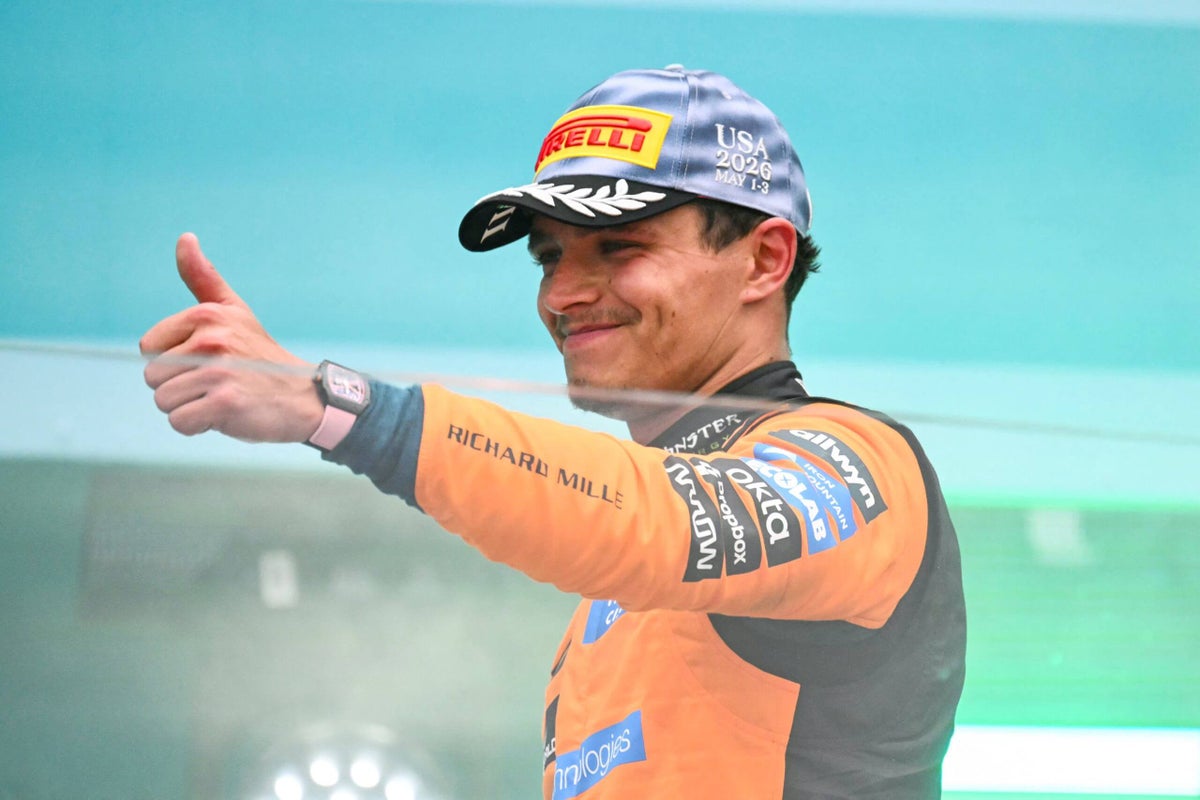
The papaya-shaded memories flashed across the Miami Grand Prix weekend.
Lando Norris topped qualifying for Saturday’s sprint and then won it, and on Sunday was one pitstop phase from a main-race victory that eventually went to Mercedes’ Kimi Antonelli.
So, is last season’s dominant team back?
The crushing nature of McLaren’s sprint 1-2 — with Oscar Piastri chasing his teammate home — certainly felt very 2025. But Mercedes, Ferrari and Red Bull then surged back in main-race qualifying.
Multiple complex factors combined to keep the orange cars’ Miami weekend turning. First, McLaren was among the leading competitors that brought a major update package to this race after the season’s enforced five-week break. It changed the front corner, engine cover and sidepod bodywork (which manages airflow) on the MCL40, and also added a revised floor and rear wing.
Though Ferrari brought more aerodynamic developments overall, McLaren’s efforts seemed to give it enough to leapfrog the Italians into position as chief-Mercedes-botherer at the front of the pack.
“The upgrade package is working,” Charles Leclerc said of Ferrari’s development work. “The thing is, others are pushing as well, and their upgrade package was a little bit better.”

McLaren’s MCL40 had a number of upgrades for the Miami Grand Prix weekend. (Clive Mason / Getty Images)
Mercedes, meanwhile, had only made minor tailpipe and brake design changes on the W17. It is waiting for Montreal at the end of this month to unleash its first major upgrade package of the year. That decision boosted McLaren significantly in Miami, as its downforce gains offset where Mercedes continues to be stronger in deploying the engine power the two teams share.
But this wasn’t the case in sprint qualifying, where another factor came into play.
On the season’s second sprint weekend, there was just one practice session for the teams to optimize their set-ups and engine energy deployment strategies.
The latter point centered on where best to spend energy — out of certain corners or down selected straights at the Miami International Autodrome — for the most efficient lap time.
FP1 was elongated by 30 minutes to 90 overall to help the drivers get used to the new, slightly different ways the engine energy systems work. But the absence of FP2 and FP3 from the traditional weekend structure meant optimizing was harder. Mercedes didn’t get this right, McLaren did.
This could be seen in the GPS trace data coming off the cars in sprint qualifying.
On his pole lap, Norris was 12mph quicker through Turns 3 and 4 — using extra energy there compared to Antonelli. He took the sprint pole by 0.2 seconds. Mercedes also slightly misjudged its car set-up in the relentless 87F (30C) heat. “It was just Mercedes not optimizing their potential,” said McLaren team principal Andrea Stella.
This locked Mercedes into a tricky sprint race, which was compounded by Antonelli’s poor start and his track-limits errors, dropping him from fourth to sixth in the sprint standings while Norris won with ease. But Antonelli and his team put things right later on Saturday afternoon, as he blitzed to a third GP pole in succession.
A day later, Mercedes team principal Toto Wolff credited his squad for identifying where it was losing out to McLaren on energy deployment and rectifying it for the second qualifying session.
“We overcomplicated our life with where we wanted to put the car and the power unit in terms of energy management,” said Wolff, in response to a question on the matter from The Athletic post-race.
“And we realized that we just needed to go back to something more conventional. We lost three to four tenths against McLaren (in sprint qualifying), and most of the others, in sector one. We fixed it, and that brought the performance back.”

Race winner Kimi Antonelli waves from parc ferme. (Chris Graythen / Getty Images)
The different conditions for GP qualifying also hurt McLaren.
The wind changing direction meant Norris and Piastri were grappling with a subsequent handling issue. Wind direction can transform how a car feels for a driver — if gusts come from a new angle and suddenly add understeer or oversteer, the car’s front end either won’t turn fast enough or the rear suddenly swings around too quickly as a result.
But the winds in Miami also played havoc with the engine energy deployment on the complex new designs, as correcting a handling change and using part-throttle at an unexpected moment meant McLaren’s engines suddenly deployed their energy in an unexpected way on the back straight.
This cost both drivers precious time. They would line up fourth and seventh for Sunday’s contest.
When the main race began, Antonelli and Max Verstappen aided Norris’ rise to lead the race for most of the first stint. The Mercedes was again slow away and fell behind Leclerc, while Verstappen dropped his Red Bull exiting Turn 1 — having brutally chopped off Norris’ good start.
Once ahead of Antonelli pre-safety-car period, and clear of Leclerc post-restart, Norris looked in command again. At one stage, he led Antonelli by over three seconds. “I feel like I’ve done a very good job the whole weekend, so there are a lot of positives,” he said afterwards.
But the day was far from won for Norris — and again, several factors combined to explain how this phase of the main race panned out as it did.
Stella felt Norris’ strong pace here was boosted by how McLaren seems “to have retained the characteristic of being consistent on the tires from last year, probably a little bit more than some of our competitors”.
At the same time, McLaren’s package has generally gone well in Miami since 2024. And even across car design-regulation changes — as has happened from 2025 to 2026 — teams can retain strengths and weaknesses at certain tracks. Their engineers just know how to dial in set-ups or tire treatment, with the latter point something drivers can feed into as well.
“We also know it’s a track that suits us,” said Norris. “I’m always that guy that looks at things on the slightly more glass-half-empty side, but this is a track that suits us and, in the past, has not suited the Mercedes quite so well.”
And yet, Norris would have had a strong chance of victory had McLaren stopped Mercedes undercutting Antonelli in the race’s sole pitstop phase — giving him fresher tires one lap early as Norris struggled on worn rubber.
It was close, though. Norris got out of the pits ahead of the Mercedes, but Antonelli blasted by a few seconds later. When explaining this sequence post-race, Stella thought his driver was powerless.
“Antonelli was coming with hot tires. He was on his ideal racing line,” Stella told The Athletic. “I don’t think there was anything we could have done.”
Stella revealed Norris had “a couple of moments” that cost him time, and there was a so-far-unexplained delay in his tire service. McLaren was adamant this was not Norris stopping ahead of his pit box marks and delaying his tire changes. Stella thought everything added up to around 0.7 seconds and would have given Norris “the possibility to retain the position”, because he would have had time to get his tires warm and grippy.
Antonelli had struggled in the hot air coming off other cars in the sprint race. And even though the inclement Sunday conditions meant the temperature was down 7F (4C) compared to the previous day’s sprint, that might’ve been enough for Norris to keep the Mercedes at bay to the finish.
“You always have to look at it and ask yourself the question, ‘Do you feel like you maximized everything today?’,” Norris said of his team’s collective Sunday. “And I’m unsure about that.”
McLaren did come away with a three-point gain on Mercedes — a small dent in the pre-weekend deficit of 89, a gap ballooned significantly by McLaren’s double DNS in China.
The race was reminiscent of many weekends in 2024, when McLaren let victories slip to Red Bull, Ferrari and Mercedes. Days when little things going awry added up to defeat. The difference now is that the Mercedes is clearly the fastest car and, although McLaren too will bring more upgrades to that next race in Canada in three weeks’ time, Wolff’s squad still has its first big development package to come.
That will make it harder for McLaren to overcome its deficits in “medium speed” corners, per Norris, and being “too weak in the high speed” turns, too.
No wonder Stella gave polite short-shrift to a post-race suggestion that McLaren might still be able to retain its drivers’ and constructors’ titles on the back of its strong Miami showing.
“We are just at the fourth race. We have just delivered our first upgrade,” he said. “We are in Miami, and McLaren traditionally has done very well in Miami. It could be that the way we develop our cars suits this circuit, so we will have to see more (circuit types).
“There’s really not much point in thinking so far forward. But definitely we want to defend the championship.”
Based on this showing, that will be very hard for McLaren. But it would be a stunning turnaround.











Leave a Reply