
Who remembers the holding midfielder? The no-nonsense anchorman who sat in front of the defence, protected that space, and contributed little in attack?
The current trend in the Premier League is for players in that mould to push up, to press, to make runs into attack, and to provide goalscoring qualities too.
The flip side, of course, is that the defence goes unprotected. And in Manchester United’s 3-2 win over Liverpool, the story of the game was all about both sides being exposed between the lines.
The opening goal came from a Manchester United corner, and was scored by Matheus Cunha at the second time of asking. Dead-ball situations are somewhat different from open play, but this is also a theme of the Premier League this season: teams are so scared of inswinging corners that they pack the six-yard box and leave space on the edge of the box.
Cunha’s first strike was blocked, and his second was essentially a shot from ‘between the lines’, if such a thing exists at a set piece. 1-0.

Liverpool have used a very fluid midfield since Arne Slot took over nearly two years ago, particularly because Ryan Gravenberch was converted from a No 8 to the deepest midfielder, and his game is about receiving the ball on the turn and dribbling into attack.
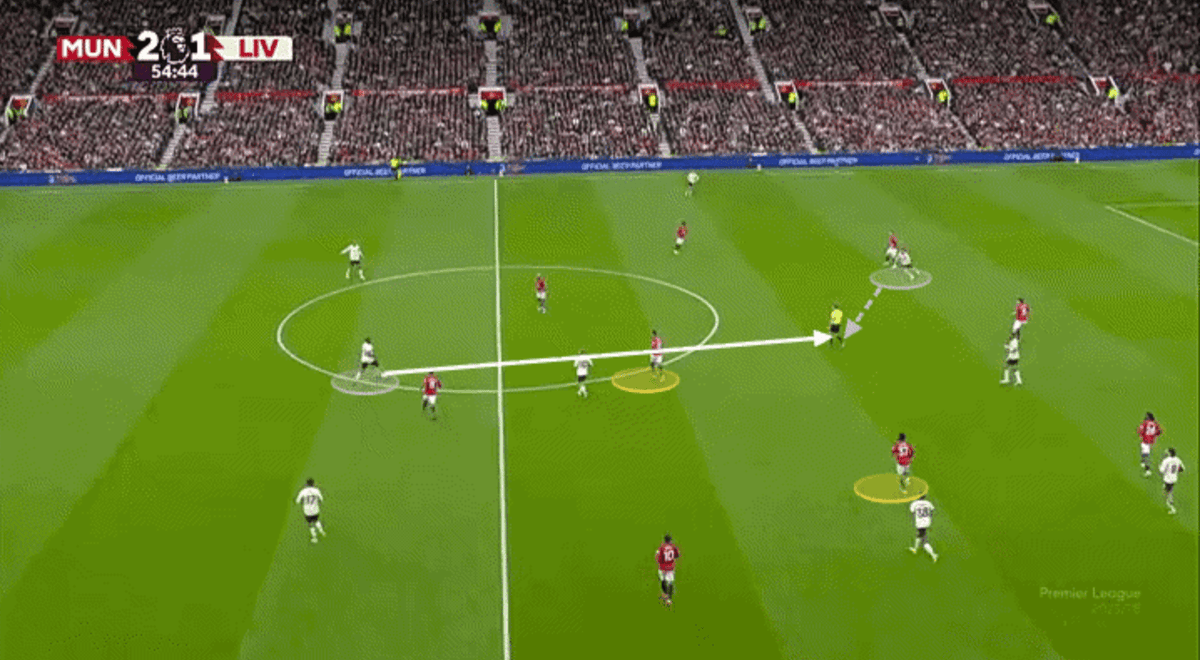
Below is a good example of him being found by Alexis Mac Allister, who is tasked with sitting in when Gravenberch goes forward. The Dutchman ends up playing passes from between the lines, while Mac Allister tries to make a run into a goalscoring position.

That system worked very well last season, so it would be unreasonable to criticise the theory behind it. But, like many Premier League midfielders this season, Mac Allister and Gravenberch looked tired, and they’re making mistakes.
Here’s an example of Mac Allister misplacing a fairly simple pass, and while he probably does the right thing in trying to close down Bruno Fernandes, United play a quick passing combination around him and are off on the break. The second wave of this counter-attack eventually resulted in Benjamin Sesko bundling the ball over the line to make it 2-0.

At half-time, Manchester United seemed in control. But they blew a comfortable lead because, yes, they were too open in front of the defence. When substitute Amad — just introduced as a substitute down the right flank — received a pass from Kobbie Mainoo, he retreated with the ball and found both Mainoo and Casemiro flying forward in advance of him.
Now, that doesn’t excuse Amad’s extremely sloppy pass, straight to Dominik Szoboszlai, who ran through unchecked to score. But really, there should have been a United midfielder positioned in front of the defence. That would have given Amad a simple passing option, or at least they might have been able to halt Szoboszlai’s dribble. 2-1.

And United — in terms of their midfielders getting bypassed easily — were even worse in the second half than Liverpool were in the first. For all Florian Wirtz’s struggles this season, he’s very much capable of finding space between the lines against a side as open as United.
Here, Ibrahima Konate has the simple task of poking the ball through United’s midfield, Wirtz swaps passes with Szoboszlai, and then has a decent attempt at goal. Incidentally, from the resulting goal kick, Liverpool equalised. Mac Allister pressed high up, won the ball, and Cody Gakpo put it into the net. 2-2.

United got the winner in a manner that was typical of the contest.
We can’t be entirely negative about all the midfielders wanting to attack, because when Luke Shaw hung up a deep cross for Amad at the far post, Casemiro was waiting for the knockdown. Mac Allister got there first, but his scuffed clearance only fell to Mainoo, who calmly passed the ball into the net. 3-2.

But at no point did United focus on simply protecting their lead, and the game continued to feel incredibly open.
Here’s a perfect encapsulation of how defensive midfielders now play. Casemiro has many qualities, but mobility is not among them. Yet here we are, 10 minutes from time, and Casemiro is sprinting forward 40 yards in an attempt to close down Mac Allister as he receives a pass on the edge of his own box. Casemiro inevitably can’t get there in time, the ball is played past him, and Wirtz is again in space on the ball.

And even in stoppage time, when Casemiro and Mainoo are initially in a good position, they both get dragged over towards the ball, with Casemiro pointing for Mainoo to track a run into the channel. This leaves the edge of the box completely free, with two Liverpool players waiting to score.
Rio Ngumoha’s cutback doesn’t quite get past Amad, and the last chance of the game is gone.

Overall, the attack-minded nature of the two midfields created an exciting, eventful match with five goals. In a season where entertainment value has been sorely lacking from many big Premier League games, maybe it seems churlish to be overly critical.
But this was a good demonstration of how these sides need to improve next season, whether in terms of personnel or structure; you cannot be this open in midfield and challenge for the title.





Leave a Reply