
January 23, 2026
4 min read

Key takeaways:
- Veterans with cirrhosis who had any mental health disorder had a significantly higher risk for liver cancer than those who did not.
- Improvements in hepatitis C treatment lowered, but did not eliminate, risk.
Mental health conditions such as alcohol use disorder and PTSD could significantly increase risk for liver cancer among individuals with cirrhosis.
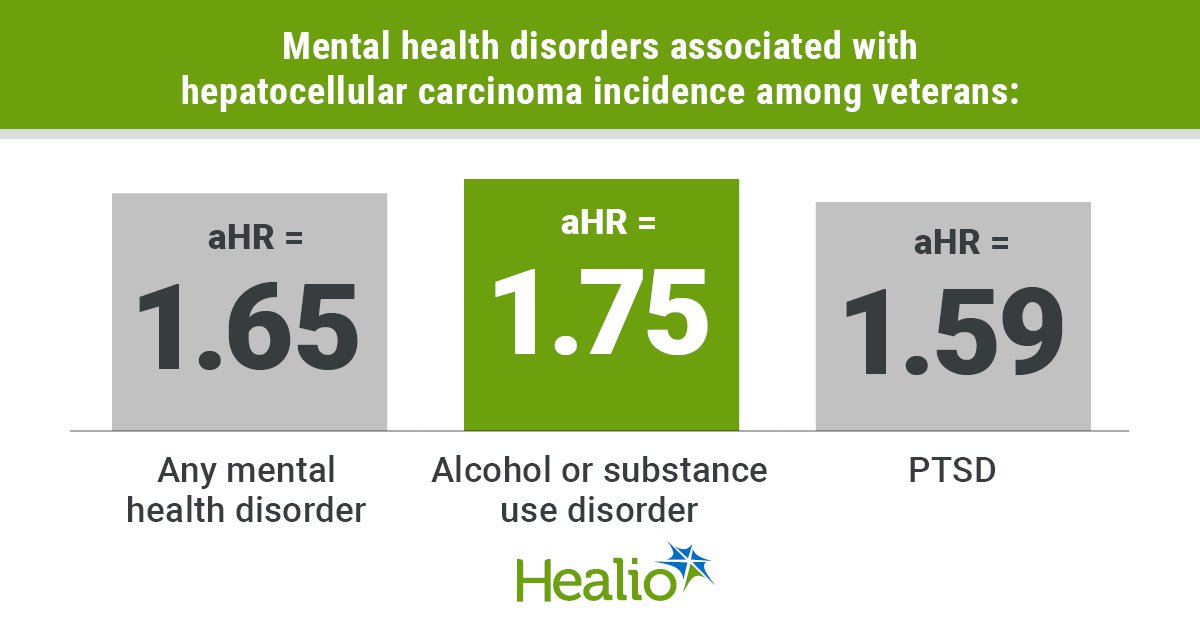
An investigation of more than 220,000 veterans found those with any mental health disorder had a 65% higher risk for developing hepatocellular carcinoma.

Data derived from Pham NV, et al. Clin Gastroenterol Hepatol. 2025;doi:10.1016/j.cgh.2025.11.026.
The approval of direct-acting antivirals for hepatitis C virus substantially reduced the connection between mental health and HCC among veterans, but the association stayed significant as individuals with these disorders may have barriers to care.

Jihane N. Benhammou
“If we have a patient who has developed liver failure from alcohol, if we’re not addressing the alcohol use problem, it’s putting a Band-Aid on the problem,” Jihane N. Benhammou, MD, PhD, assistant professor of medicine at David Geffen School of Medicine at UCLA and staff physician at the Greater Los Angeles VA Healthcare System, told Healio.
“If you’re not addressing the mental health, [the cancer risk is] higher and potentially going to come back.”
HCC rising in veterans
Patients with liver cancer have 5-year survival rates of 22%, among the lowest of all malignancies, according to American Cancer Society’s Cancer Statistics 2026 report.
American Cancer Society estimated 42,340 individuals would be diagnosed with liver and intrahepatic bile duct cancer in 2026 and 30,980 would die of the disease.
HCV is the leading risk factor for HCC, according to study background. Other risk factors include metabolic dysfunction-associated steatotic liver disease (MASLD) and alcohol-associated liver disease.
Healio previously reported at least 500,000 global liver cancer diagnoses could be avoided with interventions targeting modifiable risk factors, including HCV and alcohol consumption.
HCC incidence increased 2.5-fold and mortality tripled among veterans between 2001 and 2013. Mental health disorders also occur more frequently in veterans than the general population.
“Veterans Affairs has done a really great job at treating hepatitis C, probably better than any other health care system in the U.S.,” Benhammou said. “But we also noticed that the patients who were not cured are patients who had a lot of these mental health issues. They were unhoused, which is closely related to PTSD, substance use. There are a lot of data on hepatitis C, but not as much on what happens post-hepatitis C, and one of the most consequential effects of chronic hepatitis C or chronic liver disease is HCC.”
Prior research showed veterans with schizophrenia or bipolar disorder had higher rates of HCV and alcohol-associated liver disease, and those with cirrhosis and a mental health disorder had a 50% higher mortality risk.
These experiences and data led Benhammou and colleagues to conduct a retrospective analysis of mental health disorders and HCC among veterans.
They identified 221,712 veterans diagnosed with cirrhosis (mean age at diagnosis, 65.4 years; standard deviation, 12; 96.4% men) between 2000 and 2021.
HCC incidence served as the primary endpoint.
Significant associations
In all, 79.9% of veterans had HCV and 61.3% had a mental health disorder. Alcohol use disorder/substance use disorder was the most common mental health condition (19.6%). Most veterans had multiple mental health disorders.
Mental health disorders occurred more frequently among Black (69.1%) and Hispanic veterans (68.7%) than white veterans (58.8%).
At median follow-up of 4.9 years, 7% of the cohort developed incident HCC and 39.4% died.
HCC occurred significantly more often among Hispanic (adjusted HR = 1.5; 95% CI, 1.42-1.59) and Black veterans (aHR = 1.21; 95% CI, 1.16-1.26) than white ones, and significantly less often among those who lived in rural communities than urban areas (aHR = 0.93; 95% CI, 0.89-0.96).
HCV had the most significant association with HCC development (aHR = 2.01; 95% CI, 1.89-2.14), followed by MASLD (aHR = 1.99; 95% CI, 1.9-2.08).
Veterans who had any mental health disorder also had a significantly higher risk for HCC (aHR = 1.65; 95% CI, 1.23-2.22), as did those with alcohol or substance use disorder (aHR = 1.75; 95% CI, 1.26-2.41) or PTSD (aHR = 1.59; 95% CI, 1.14-2.14).
“This applies to any patient with a mental health disorder,” Benhammou said.
Benhammou and colleagues also investigated whether the use of direct-acting antivirals for HCV between 2015 and 2021 impacted results.
They found Black veterans had a significantly lower risk for HCC during this time frame (aHR = 0.87; 95% CI, 0.83-0.92) and Hispanic veterans did not have a higher risk.
The approval and use of direct-acting antivirals have coincided with a decrease in risk for HCC among veterans with any mental health disorder, but the association between HCC and mental health disorder remained significant (aHR = 1.14; 95% CI, 1.03-1.27). The same applied for patients with alcohol or substance use disorder (aHR = 1.48; 95% CI, 1.33-1.65).
Reasons for this could include veterans not coming in for treatments due travel difficulties; not having access to cell phones or other digital devices, which would inhibit use of telehealth; and other environmental factors.
“You can have access to medications, and that decreases the risk significantly, but it does not eliminate that risk because, ultimately, you’re not getting at treating the mental health,” Benhammou said.
Researchers acknowledged study limitations, including potential issues around classifications of mental health disorders.
‘Work better as a team’
Future research could evaluate screening rates with mental health disorders.
“I bet you screening for liver cancer is probably much lower in this patient population,” Benhammou said. “Are there better methods of screening? A lot of people are studying blood-based approaches. [Alpha-fetoprotein (AFP)] is one [biomarker], but not everybody produces AFP when it comes to liver cancer, so you might be missing that subgroup of patients.
“A lot of [screening] is still image-based. Imaging requires the patient to come in, get an ultrasound, it gets read, follow-up. That requires a lot of steps. If there is a blood test, you could incorporate that blood test in any clinic, certainly in primary care, but even potentially in mental health clinics.”
Benhammou also highlighted the importance of education, as well as multidisciplinary care for patients with mental health disorders.
“Hepatologists, or any subspecialists, who don’t manage mental health day in and day out, it’s daunting,” Benhammou said. “Where do you go? How do you manage? Patients and hospitals and doctors tend to focus on what’s going to kill the patient immediately, which is a failing liver.”
“In an ideal world, multidisciplinary clinics would exist more,” she added. “I think we all work better as a team, which is exemplified with the VA system.”
For more information:
Jihane N. Benhammou, MD, PhD, can be reached at jbenhammou@mednet.ucla.edu.

Ask a clinical question and tap into Healio AI’s knowledge base.
- PubMed, enrolling/recruiting trials, guidelines
- Clinical Guidance, Healio CME, FDA news
- Healio’s exclusive daily news coverage of clinical data
<









Leave a Reply