
January 17, 2026
1 min read

WAIKOLOA, Hawaii — Patient history, growth rate and bleeding are important factors to consider when evaluating eyelid lesions and deciding whether or not to biopsy, according to a speaker.
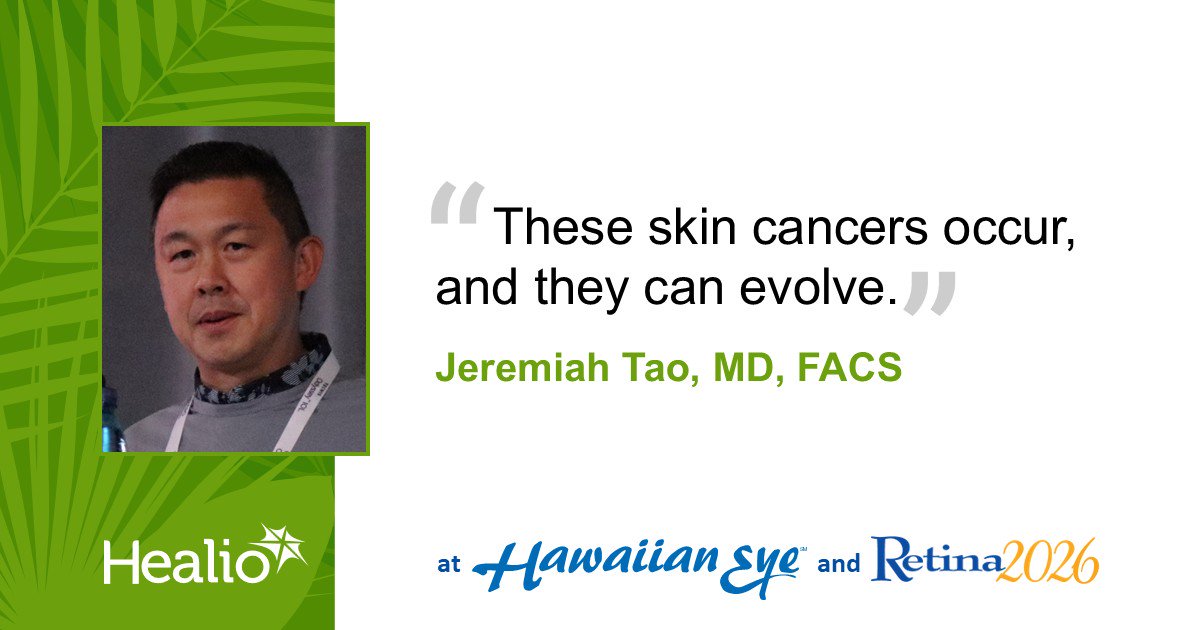
“There are situations where we need to have heightened awareness. These skin cancers occur, and they can evolve,” Jeremiah Tao, MD, FACS, said during a presentation at Hawaiian Eye 2026.

Image: Eamon N. Dreisbach | Healio
“On examination, there are three key findings I think we should all be considering: Ulceration, irregularity and eyelid margin destruction. These are three features that should prompt you to put these patients into the ‘suspicious’ [category].”
When evaluating ulceration, Tao said, it is important to note that malignant cells can rapidly outgrow the patient’s blood supply, while benign lesions usually do not ulcerate. Malignant tumors also have cell populations that expand at different rates, and these uneven growth patterns can cause irregular margins and asymmetrical shapes. Benign lesions, however, usually have smoother borders.
Physicians should also keep a keen eye out for loss of normal eyelid architecture.
“The eyelid margin should be straight or slightly curved. The rim of the eyelid should be straight. The lash line, gray line and mucocutaneous junction should be all in order, and the lashes should be contiguous,” Tao said.
The most common lid malignancy ophthalmologists will encounter is basal cell carcinoma (BCC), which occurs in 90% of eyelid malignancies, he explained. It is important to look for telangiectasias and lesions with a pearly appearance — characteristics typical of BCC.
“You shouldn’t send this patient home. You should tell them, ‘You probably need to set up a biopsy,’” Tao said.
When performing a surgical excision of these lesions, he explained, facial skin tension lines should be followed to avoid scarring.
“The key is not to induce any undue tension on the eyelid, which can cause eyelid malposition,” Tao said. “We also want to be mindful of aesthetics — the eyelids are in the very center of the face, and people care what that looks like.”
Sources/Disclosures
Source:
Tao J. Don’t loathe the eyelid growth. Presented at: Hawaiian Eye 2026; Jan. 17-23, 2026; Waikoloa, Hawaii.
Disclosures:
Tao reports no relevant financial disclosures.

Ask a clinical question and tap into Healio AI’s knowledge base.
- PubMed, enrolling/recruiting trials, guidelines
- Clinical Guidance, Healio CME, FDA news
- Healio’s exclusive daily news coverage of clinical data
<








Leave a Reply