
April 28, 2026
2 min read

Key takeaways:
- Patients who lived in high-deprivation neighborhoods spent less time at home 12 months after a hip fracture.
- Increasing deprivation level was associated with a modest increase in mortality.
Results published in JAMA Network Open showed older adults with a fall-related hip fracture spent fewer days at home 12 months after the fracture if they lived in an economically deprived area.
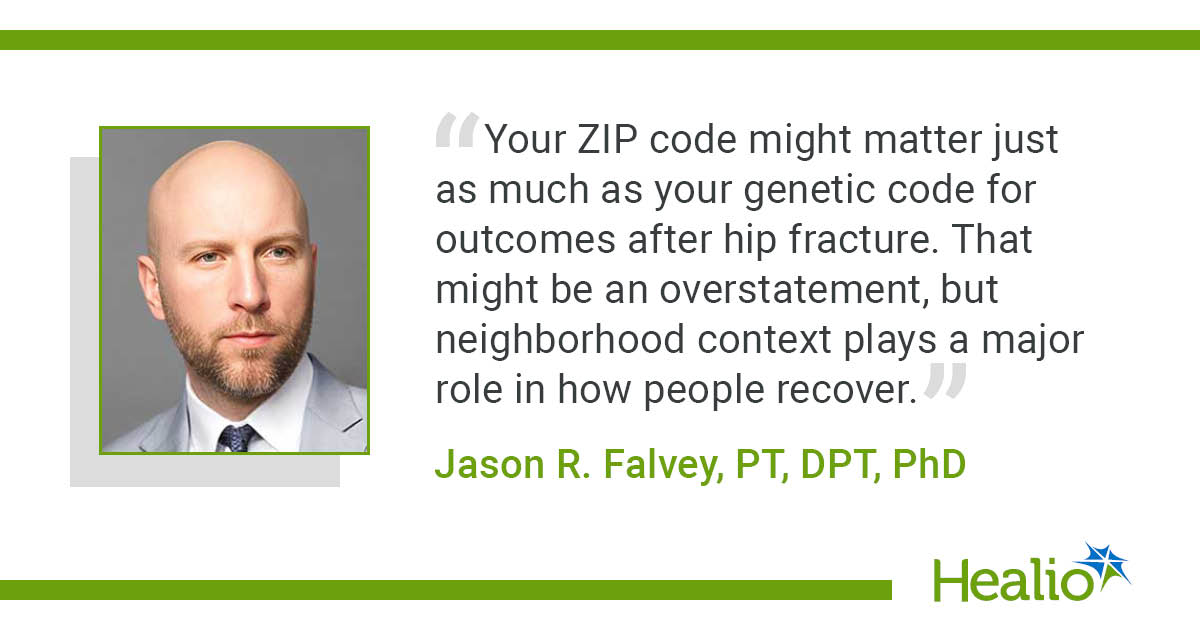
“The overall take home message of the study is that your ZIP code might matter just as much as your genetic code for outcomes after hip fracture,” Jason R. Falvey, PT, DPT, PhD, associate professor in the department of physical therapy and rehabilitation science and the department of epidemiology and public health, as well as director of University of Maryland School of Medicine’s Center for Disability Justice, told Healio. “That might be an overstatement, but I do want to emphasize that neighborhood context plays a major role in how people recover.”

Falvey, along with Alyssa M. Baginski, BS, and colleagues, collected data from a random sample of Medicare patients (n = 52,012) who had a fall-related hip fracture between July 1, 2010, and Dec. 31, 2019; underwent arthroplasty or internal fixation; and were discharged to a nonhospice home or postacute care setting. Researchers used the Area Deprivation Index to assess neighborhood deprivation, where patients in the 10th percentile or lower were considered the least deprived, patients in the 11th to 89th percentile were considered moderately deprived and patients in the 90th to 100th percentile were considered the most deprived. Researchers considered days at home in the 12 months after hip fracture as the main outcome measure.
According to Falvey, patients in 10% of neighborhoods with the highest needs spent 23 fewer days at home compared with “similar patients with similar complexities and similar age. Those patients who lived in the wealthier neighborhoods were able to spend a lot more time at home.”
On average, results showed 54.6% and 3.4% of nonhome days for patients in least deprived neighborhoods were spent in skilled nursing facilities and in long-term care, respectively. For patients in the most deprived neighborhoods, 49.2% of nonhome days were spent in skilled nursing facilities and 6.8% of nonhome days were spent in long-term care, according to results.
Researchers also found a modest increase in mortality with increasing deprivation level, with 13.5%, 15.4% and 16.2% of deaths occurring among the lowest, middle and highest deprivation groups, respectively.
According to Falvey, although the direction of the findings was not surprising, they found the magnitude of the findings was.
“We expect small differences across neighborhoods, knowing that access to medical care, social resources and transportation differs a lot in higher wealth vs. lower wealth areas, but we did not know if that was going to translate into people having to spend more days in hospitals or more days in rehabilitation facilities,” Falvey said.
But he said, “it is not something we are powerless to address.” According to Falvey, there are existing Medicare policies that incentivize home health care agencies to provide care to patients in rural areas.
“There are opportunities to microtarget at the policy level how to incentivize clinicians to take care of or provide extra services to patients in the lowest income areas and allow them to optimally recover,” Falvey said. “It also opens up opportunities to target these areas with other social resources that we know are effective, like community health workers or care coordinators who the hospital could deploy in some of these high risk areas to help connect people with other social resources or help bridge the gaps that are common for somebody with a brand new mobility limitation after hip fracture.”
For more information:
Jason R. Falvey, PT, DPT, PhD, can be contacted at jfalvey@som.umaryland.edu.
Perspective
Back to Top

Socioeconomic status and its impact on access, complexity and outcomes following orthopedic surgery has always been (and remains so) an important and complex topic that directly impacts patients in the United States. Results of the study from Alyssa M. Baginski, BS, and colleagues only further highlights the disparity that exists, especially in the elderly population, where post-fracture/surgical care can be less than ideal depending on the socioeconomic status of the patient. To me, research like this only further emphasizes the need to revise and update Diagnosis Related Groups to accurately reflect modern day comorbidities and medical/surgical complexity, as well as to further revisit the idea that “bundling” care in this patient population is the correct way to undergo “cost savings.”
Back in 2017, we studied and published — and we are not the only ones — the impact of nonmodifiable risk factors in the setting of fracture care, as well as the possibility and impact on hospitals if bundled care was expanded to the fracture setting. Our results overwhelmingly reflected a disproportionate cost when it comes to treating patients in the fracture setting when compared with the elective setting and recommended that it remain out of the bundle. Despite the results of our papers and several others, arthroplasty has been bundled into the total bundle and many hospital systems struggle to see “cost savings” in this patient population.
If you further extrapolate the results of the study from Baginsky and colleagues to these results, it means even more. Some of these elderly patients in underserved or “neighborhood deprived” areas do not have any resources or family to help them, further financially restricting the health care system into “cost savings/containment” mode that does not service our patients well.
The article highlights something we have already known — but what can we do about it? There is no single solution. Rather, attacking it from every angle by offering support from the community as well as expanding services to aid in this patient population is definitely a good start, but we have a long way to go.
References:
Mahure SA, et al. J Orthop Trauma. 2017;doi:10.1097/BOT.0000000000000742.
Yoon RS, et al. J Arthroplasty. 2017;doi:10.1016/j.arth.2017.02.061.
Richard S. Yoon, MD, FAOA, FIOTA
Disclosures: Yoon reports no relevant financial disclosures.

Ask a clinical question and tap into Healio AI’s knowledge base.
- PubMed, enrolling/recruiting trials, guidelines
- Clinical Guidance, Healio CME, FDA news
- Healio’s exclusive daily news coverage of clinical data
<














Leave a Reply