
February 02, 2026
4 min read

Key takeaways:
- The patient-facing MyLungHealth tool significantly improved identification of individuals eligible for lung cancer screening.
- The intervention also helped increase low-dose CT orders.
Combining patient- and clinician-facing support tools could significantly improve identification of individuals eligible for lung cancer screening, as well as increase orders for low-dose CT.
A randomized trial showed adults who had uncertain lung cancer screening eligibility and access to the patient-centered MyLungHealth tool — an electronic health record-integrated educational intervention about lung cancer risk and screening — had a significantly higher likelihood of finding out they could get screened compared with those who did not use the tool.

Data derived from Kukhareva PV, et al. JAMA Oncol. 2025;doi:10.1001/jamaoncol.2025.5672.
Low-dose CT orders also significantly increased in the MyLungHealth arm.
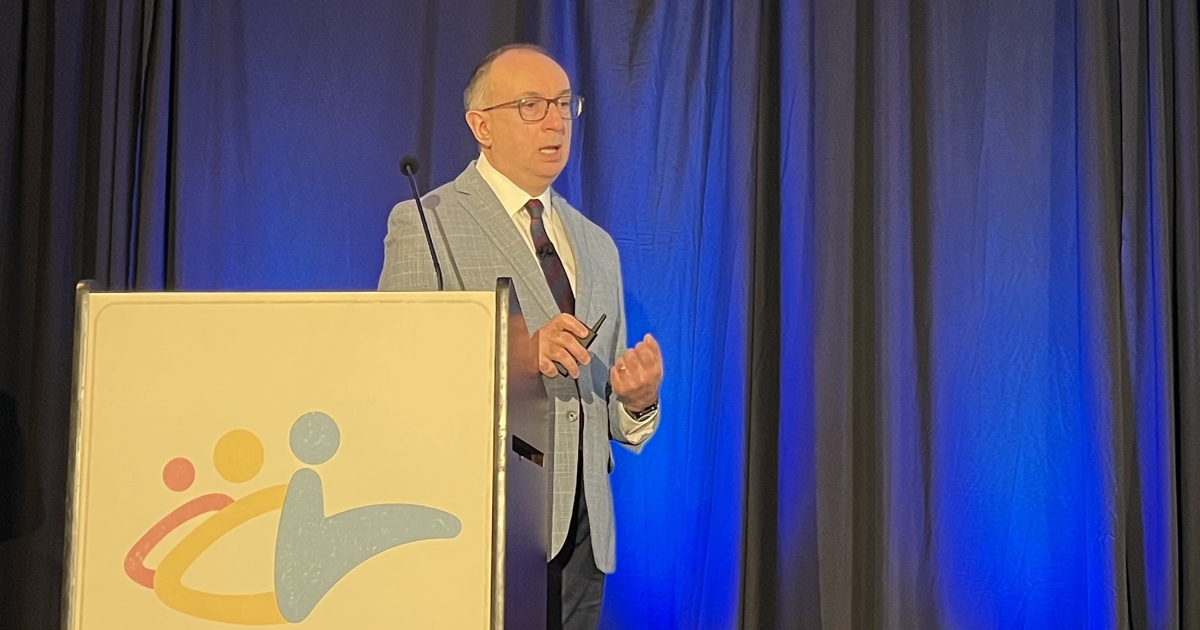
“Lung cancer screening is still very much underutilized, though improving,” Kensaku Kawamoto, MD, PhD, MHS, Dr. Helmuth F. Orthner Endowed Professor and vice chair of clinical AI and informatics at University of Utah, and investigator/researcher at Huntsman Cancer Institute, told Healio.
“Despite lung cancer being the leading cause of cancer deaths among both men and women in the U.S. and worldwide, and despite lung cancer screening being able to reduce deaths from lung cancer by about 20%, less than 1 in 5 eligible patients are screened in the U.S. This is an improvement from before, but much more is needed. Digital tools such as our patient-facing MyLungHealth and provider-facing Decision Precision tools can help push this forward.”
Screening rates low
Lung cancer is projected to cause more deaths (124,990) in the U.S. in 2026 than the next two deadliest malignancies combined (colorectal and pancreatic cancer, 107,970), according to American Cancer Society’s Cancer Statistics 2026 report.
However, lung cancer screening remains low despite the high mortality rate. Only 16% of eligible patients received low-dose CT in 2022, according to study background.
Currently, guidelines recommend screening for adults aged 50 to 80 years who have at least a 20 pack-year smoking history, and who actively smoke or stopped within the previous 15 years, but more than 80% of patients do not have or have incorrect smoking data in their EHR.
Kawamoto and colleagues previously found the EHR-integrated Decision Precision+ clinical decision support tool improved lung cancer screening gap closure from 16% to 47%.
Decision Precision+ consists of clinician-facing care reminders and individualized risk estimates as part of a shared decision-making tool.
Kawamoto described the improvement as a “significant increase” but noted they had “significant room for improvement.”
“Specifically, about half of our patients eligible for lung cancer screening still had not had appropriate screening or documented shared decision-making with their provider about the screening,” he said. “Thus, we were interested in seeing if we could help close this gap by engaging patients directly regarding lung cancer screening through the patient portal.”
Kawamoto and colleagues conducted a randomized trial to see whether combining use of the patient-centered MyLungHealth tool with the Decision Precision+ tool could further improve screening rates.
MyLungHealth provided educational information to patients on lung cancer risk and screening, including videos and text-based learning. Clinicians received notifications when patients engaged with the tool.
The investigation included 31,303 adults aged 50 to 79 years who visited primary care clinics at University of Utah Health and NYU Langone Health within the previous year, had a documented smoking history and an active patient portal account.
Researchers divided the trial into two parts: Study 1 included patients who had uncertain lung cancer screening eligibility (n = 26,729; median age, 62 years; interquartile range, 55-69; 50.8% men; 70.8% white), and study 2 included those with documented eligibility (n = 4,574; median age, 63 years; interquartile range, 56-69; 51.2% men; 78.2% white).
They randomly assigned patients in both studies to receive either the Decision Precision+ tool alone (study 1: n = 13,317; study 2: n = 2,262) or with the MyLungHealth tool (study 1: n = 13,412; study 2: n = 2,312).
New identification of patients eligible for lung cancer screening served as the primary endpoint of study 1. Ordering of low-dose CT for eligible patients served as the primary endpoint of study 2.
‘More to do’
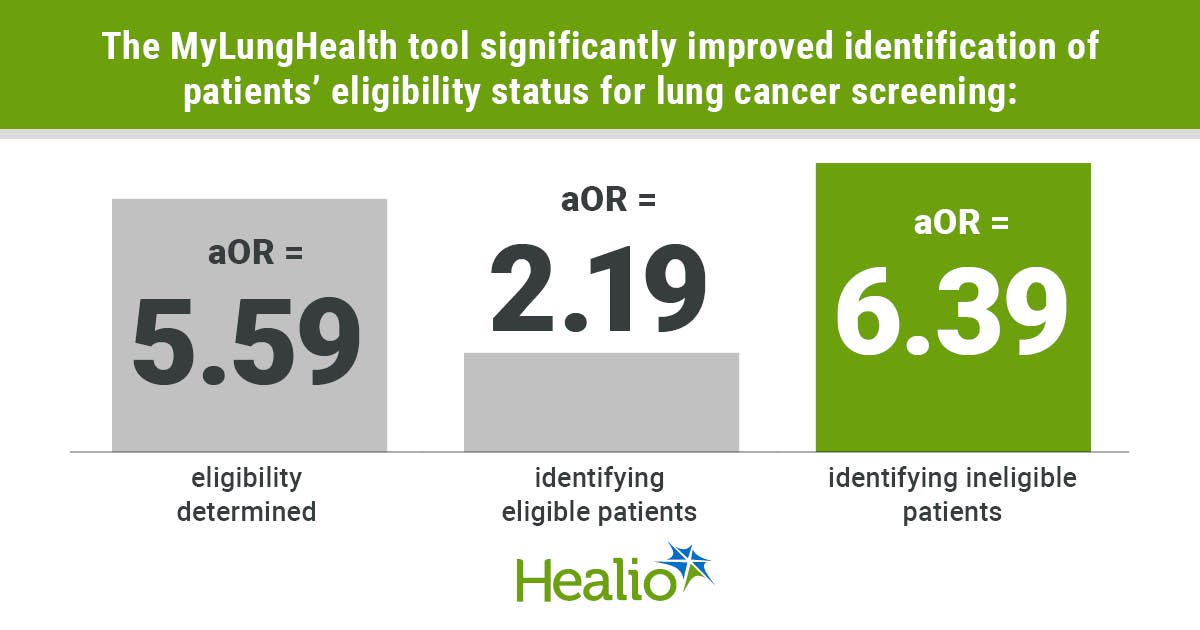
In study 1, patients who received the MyLungHealth intervention had a significantly higher likelihood of having their eligibility status determined (26.6% vs. 6.9%; adjusted OR = 5.59; 95% CI, 5.28-5.92) and of being identified as eligible (4.7% vs. 2.3%; aOR = 2.19; 95% CI, 1.99-2.42) or ineligible (21.9% vs. 4.6%; aOR = 6.39; 95% CI, 5.98-6.83).
Additionally, the intervention arm had significantly higher rates of low-dose CT orders (3.2% vs. 2.6%; aOR = 1.26; 95% CI, 1.14-1.39) and completions (2.1% vs. 1.7%; aOR = 1.25; 95% CI, 1.1-1.41).
In study 2, the MyLungHealth arm had a significantly higher rate of low-dose CT orders (20.5% vs. 19.2%; aOR = 1.16; 95% CI, 1.04-1.3). However, the completion rates did not differ.
“We were glad to see that the patient-facing, EHR-integrated tool augmented the clinician-facing decision support tools we had implemented earlier to improve our primary targeted outcomes,” Kawamoto said.
Researchers acknowledged study limitations, including MyLungHealth focusing on identifying eligibility and ordering low-dose CTs and not completion.
“We still have more to do to make sure patients understand what their options are for lung cancer screening and to get the screening if they so choose,” Kawamoto said. “We believe more research is needed on further closing care gaps in lung cancer screening, making sure that patients who decide to get screening are supported in following up and completing the screening, and identifying approaches to better reach patients with less available resources, such as patients without access to the internet and patient portals.
“There is also a continual need to take approaches that work, such as those we worked on in this project, and broadly scale out the interventions for greater impact.”
For more information:
Kensaku Kawamoto, MD, PhD, MHS, can be reached at kensaku.kawamoto@utah.edu.
Sources/Disclosures
Source:
Kukhareva PV, et al. JAMA Oncol. 2025;doi:10.1001/jamaoncol.2025.5672.
Reference:
Disclosures:
Kawamoto reports grants from Agency for Healthcare Research and Quality, Hitachi and Surescripts; personal fees from Beckman Coulter, Elsevier, NORC at the University of Chicago, Pfizer, Regenstrief Foundation, RTI International, Security Risk Solutions, University of Colorado, University of Michigan, University of Pennsylvania and Yale University; copyright licensing/codevelopment from Custom Clinical Decision Support and MD Aware; and unpaid roles as a board member of Health Level Seven International and a member of the U.S. Health Information Technology Advisory Committee. Please see the study for all other authors’ relevant financial disclosures.

Ask a clinical question and tap into Healio AI’s knowledge base.
- PubMed, enrolling/recruiting trials, guidelines
- Clinical Guidance, Healio CME, FDA news
- Healio’s exclusive daily news coverage of clinical data
<







Leave a Reply