
January 16, 2026
4 min read

An FDA draft guidance nixing the requirement for biosimilar manufacturers to conduct comparative efficacy studies may prove “consequential” in reducing the time and cost of bringing biosimilars to market, according to an expert.
In the last quarter of 2025, the FDA released a draft guidance on biosimilar development stipulating that comparative efficacy studies are no longer required to prove biosimilarity. According to the FDA, this move will improve access to biosimilar medications for patients across the health care landscape, including rheumatology.

“Obviously, this announcement is not specific to one therapeutic area — it will have a meaningful impact on the marketing of biosimilars across the United States in many specialty areas,” Alex Keeton, executive director of the Biosimilars Council and senior vice president of policy at the Association for Accessible Medicines, told Healio. “However, earlier this year we released a report looking at the biosimilar void. Looking into next decade, 118 biologic reference products are going to lose exclusivity. As of now only 10% of those products have biosimilars in the pipeline.”
According to Keeton, among those losing exclusivity in the next 10 years, 22 are in immunology, while only six of those products have biosimilars currently in development.
“That means there are 16 potential targets that do not have biosimilars in the pipeline,” he said. “Of course, while I can’t say for certain that this draft guidance will lead to more development or approvals in a particular therapeutic area, if sponsors are looking where they should develop products, a biosimilar for one of these 16 reference products has become more feasible. If those products are developed, it could provide more options for rheumatologists and their patients.”
Previously, analytic, pharmacokinetic and comparative efficacy studies were required to prove biosimilarity. The new draft guidance stipulates that such studies are no longer necessary for the development process.
“Since the publication of the Scientific Considerations Guidance, the scientific approach to determine the need for [comparative efficacy studies] has evolved, and FDA has gained significant experience in evaluating data from comparative analytical and clinical studies used to support a demonstration of biosimilarity,” read the FDA statement announcing the draft guidance. “Accordingly, FDA is issuing this draft guidance to describe an updated framework for determining when a [comparative efficacy studies] may not be necessary to support a demonstration of biosimilarity.”
Members of the public can submit comments on the draft guidance until Jan. 20.
Healio sat down with Keeton to discuss the particulars of the draft guidance and what it could mean for patients with rheumatic and autoimmune diseases.
[Editor’s note: Healio has created a special report detailing everything the practicing clinician needs to know about biosimilars — what they are, how they are approved, where interchangeable medications fit in, and more. Read more about the special report here.]
Healio: Please discuss the FDA draft guidance on comparative efficacy studies on biosimilars and bio-originators. What are some of the key points of this document?
Keeton: At its core, what I think the draft guidance represents is a much needed and long-awaited update in how the FDA and manufacturers think about what is needed to prove that a biosimilar product is similar to its reference product.
To boil it down, historically, there were three ways manufacturers would be required to prove biosimilarity. The first was an analytic study, the next was a pharmacokinetic study, and the third level was a comparative efficacy study.
However, we have had 10 years of biosimilar approvals in the United States, and a bit longer than that in Europe, and what we have learned in that time is that the comparative efficacy studies are not giving us any more than the analytic or pharmacokinetic studies were giving us. So, the FDA has said that manufacturers are no longer required to conduct these comparative efficacy studies to get approval.
Healio: Will this impact the rigor of the FDA approval process?
Keeton: This is not going to change the rigor of the FDA approval process, no. The FDA can still require a manufacturer to conduct a comparative efficacy study for any given biosimilar if they feel that the other two types of studies did not provide enough evidence.
However, what we have learned is that the analytic and pharmacokinetic studies have really homed in on potential differences between the biosimilar and reference products and should be sufficient to prove or not prove biosimilarity.
Healio: In other outlets, you previously described this as one of the most important changes in the biosimilar landscape in recent years. Why?
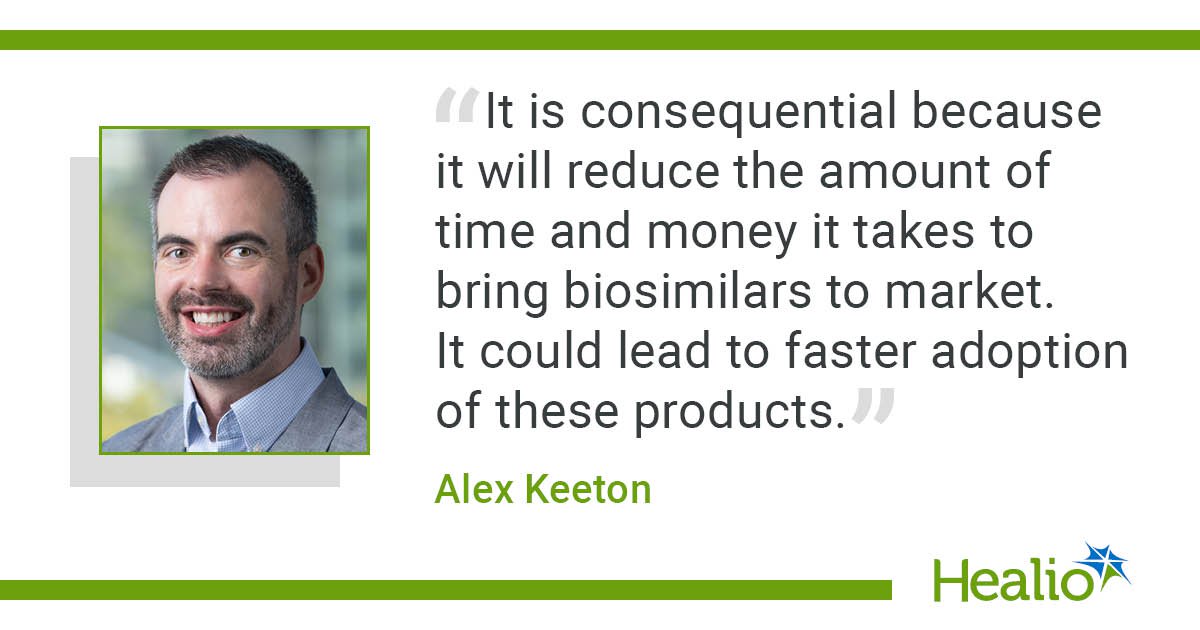
Keeton: It is consequential because it will reduce the amount of time and money it takes to bring biosimilars to market. It could lead to faster adoption of these products.
We know that when biosimilars are available, patient access is improved and medication costs go down. This guidance can help remove barriers associated with cost and access.
Healio: How much could be saved, and what would be the broader impact of these savings?
Keeton: Science being a dynamic thing, it is hard to say specifically for any one product what that means or what the cost savings could be. Comparative efficacy studies can take different forms depending on the medication and the patient population.
However, Boston Consulting Group conducted a study that showed that for the average sponsor, comparative efficacy studies can cost between $25 million and $175 million, and can increase development time by 12 to 18 months. This is quite a savings.
Healio: Why are large, costly, comparative efficacy studies problematic?
Keeton: It’s not that there is anything necessarily wrong with them. It is just that the other two buckets of studies sponsors are conducting tell us everything we need to know.
Healio: What, if anything, could be lost if comparative efficacy trials are no longer conducted?
Keeton: Nothing that we are aware of right now. No biosimilar that failed to make it to market failed because of a comparative efficacy study. They failed in the analytic or pharmacokinetic studies first. As I mentioned, the FDA still maintains the highest level of rigor for demonstrating safety and efficacy.
Healio: Is the door open to go back to requiring comparative efficacy studies?
Keeton: It is hard to say. Because the FDA still has the ability to ask for a comparative efficacy study if they feel the other two types of studies are insufficient for any given biosimilar, they have not been completely eliminated. It is just that it is no longer presumed that they are necessary.
For more information:
Alex Keeton can be reached at Brian.Hart@accessiblemeds.org.

Ask a clinical question and tap into Healio AI’s knowledge base.
- PubMed, enrolling/recruiting trials, guidelines
- Clinical Guidance, Healio CME, FDA news
- Healio’s exclusive daily news coverage of clinical data
<













Leave a Reply