
January 15, 2026
2 min read
Key takeaways:
- Early detection and treatment of sepsis can improve outcomes for children.
- A team of physicians and computer scientists created an AI model that could predict a patient’s odds for sepsis with EHR data.
Researchers developed a machine learning model that could identify children in the ED who were at risk for developing sepsis based on routinely collected electronic health record data.
“Sepsis is very important to detect because we do have evidence-based therapies that we know if we initiate them early can improve the morbidity and mortality associated with sepsis, but we also know that it is very rare,” Elizabeth R. Alpern, MD, MSCE, division head of emergency medicine, vice chair of pediatrics and professor of pediatric emergency medicine at Lurie Children’s Hospital of Chicago and Northwestern Feinberg School of Medicine, told Healio.

“The real goal of everyone who treats children in the ED is to identify that patient, that child … who is going to progress and have sepsis, a life-threatening response to infection, out of all of the children who come with other infectious symptoms,” Alpern said.
Alpern and colleagues collected data from more than 1.6 million ED visits between Jan. 1, 2016, and Feb. 29, 2020, at five health systems to train a machine learning algorithm to predict patients’ odds of sepsis and septic shock within 48 hours of arriving to the ED. Then they tested it with another 719,298 ED visits.
Overall, 48.6% of patients were girls, and the median age was 4.7 years (interquartile range, 1.7-10.1 years). The researchers found 0.35% of patients in the training cohort and 0.37% in the testing cohort had sepsis, and 0.15% had septic shock in both cohorts.
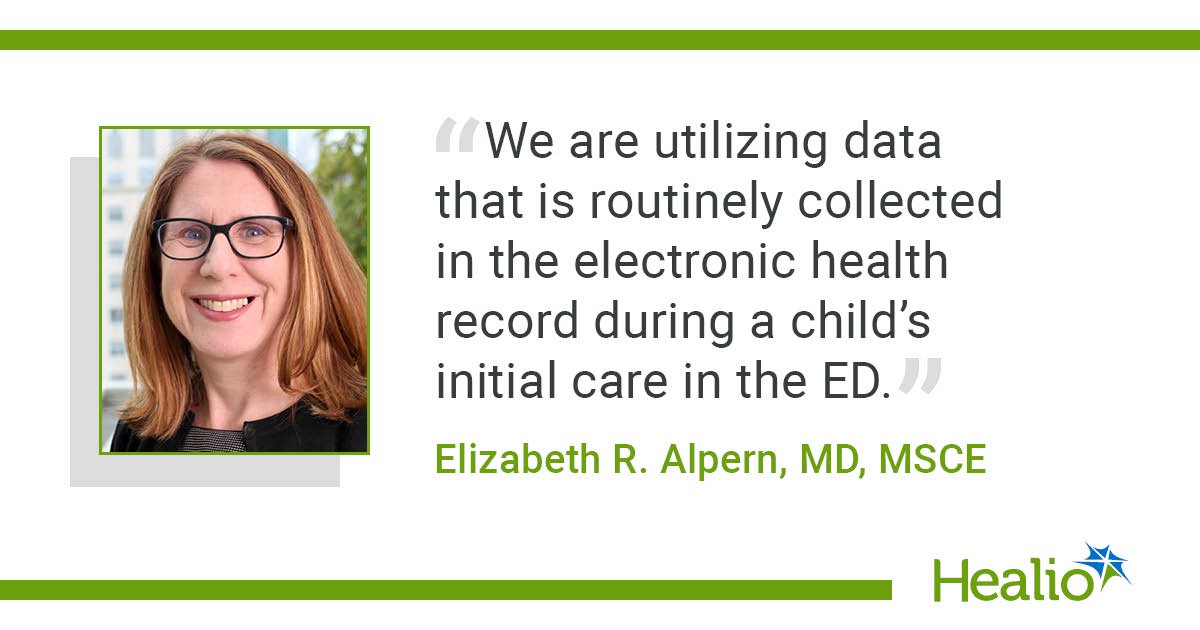
“A big component of the study is that we are utilizing data that is routinely collected in the electronic health record during a child’s initial care in the ED in order to both derive and then validate the study,” Alpern said.
Alpern and colleagues tested a logistic regression model and a gradient tree boosting model, each with a target sensitivity, or ability to detect sepsis, of 90%.
The researchers reported robust area under the receiver operating characteristic curve (AUROC) scores for both models, ranging from 0.923 for predicting sepsis and septic shock with logistic regression to 0.936 for predicting sepsis with gradient tree boosting. The gradient tree boosting model produced a positive likelihood ratio of 4.674 and a positive predictive value of 1.7% for predicting sepsis.
According to Alpern and colleagues, age-adjusted vital signs, emergency severity index and medical complexity were the strongest predictive variables in the analysis.
Future studies will involve implementation science to determine how to integrate the model with EHRs, Alpern said. She added that the code for the model is accessible online with the study.
“Even though we were able to derive and validate predictive models that were very robust, we are still going to need additional work before it can be implemented,” Alpern said.
For more information:
Elizabeth R. Alpern, MD, MSCE, can be reached at pediatrics@healio.com.
Perspective
Back to Top

Hansa Bhargava, MD
Disclosures: Bhargava reports no relevant financial disclosures.

Ask a clinical question and tap into Healio AI’s knowledge base.
- PubMed, enrolling/recruiting trials, guidelines
- Clinical Guidance, Healio CME, FDA news
- Healio’s exclusive daily news coverage of clinical data
<










Leave a Reply