
April 16, 2026
2 min read

Key takeaways:
- An AI model was 78% accurate in identifying high-risk catheters.
- A researcher said she was “surprised” by how well the AI model performed.
Researchers found that an AI infection-detection model was able to identify early warning signs of central line-associated bloodstream infection by studying photos of central venous catheters.
Central line-associated bloodstream infections (CLABSIs) cause thousands of deaths each year in the United States and add billions of dollars in extra costs to the health care system, according to the CDC.

Data derived from Artificial intelligence photo-detection of high-risk lines to prevent central lines associated bloodstream infection (CLABSI). Presented at: SHEA Spring; April 7-10; Chicago.
Identifying the early signs of a CLABSI — which may appear weeks in advance — can help clinicians prevent them, according to Shruti K. Gohil, MD, MPH, assistant professor of infectious diseases and associate medical director of epidemiology and infection prevention at the University of California, Irvine.
Years ago, Gohil and colleagues developed a scoring tool called the Central Line Insertion Site Assessment (CLISA) to help clinicians identify and respond to signs that a central line may be causing inflammation or infection, which can lead to a CLABSI.
For this study, Gohil and colleagues trained an AI model to predict CLISA risk scores for inflammation or infection in thousands of photos of central venous catheters (CVCs) and tested the model against trained clinicians. They presented their findings at SHEA Spring, the Society for Healthcare Epidemiology of America’s annual conference.
The AI model analyzed 5,551 photos of 964 central-line sites taken between January 2014 and June 2017 — 1,191 (21%) photos from hospitalized patients, 2,539 (46%) from outpatient oncology patients, and 1,821 (33%) from nursing home residents.
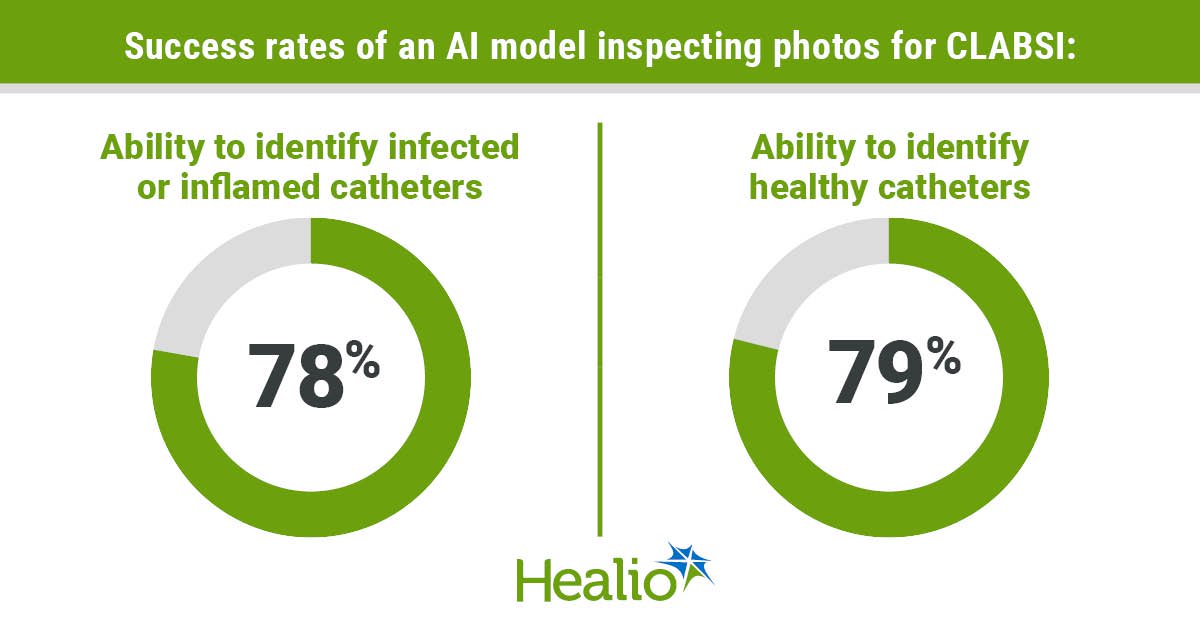
The model demonstrated a sensitivity — the ability to identify infected or inflamed catheters — of 78% and a specificity — the ability to identify healthy catheters — of around 79%, with an area under the curve (AUC) of 0.87, indicating a strong ability to classify the catheter site as either low-risk or high-risk for CLABSIs, according to the researchers. AUC is the “gold standard” for evaluating AI models, Gohil said.
The model’s performance was “unexpectedly strong,” she told Healio, adding that it “is anticipated to improve with further training.”
“We were surprised by how well AI could perform with minimal training,” Gohil said. “At times it seemed AI was able to identify areas of concern that even a clinician may not immediately notice from a photograph alone.”
One issue that will require further study is how the model performs on darker skin tones, which makes it harder to detect redness, Gohil said.
Meanwhile, Gohil said the study shows that AI programs could monitor a catheter site from a non-medical location.
“The algorithms developed in this study could be integrated into remote mobile apps for use by patients and health care workers in all care settings, allowing a pragmatic way to bring infection-prevention practices into the home,” she said. “With more care shifting to outpatient and home settings, scalable tools to monitor central lines are increasingly important for preventing avoidable infections.”
For more information:
Shruti K. Gohil, MD, MPH, can be reached at skgohil@hs.uci.edu.
Perspective
Back to Top

Gonzalo Bearman, MD, MPH, FACP, FSHEA, FIDSA
Professor of MedicineVirginia Commonwealth University
Disclosures: Bearman reports no relevant financial disclosure.
Sources/Disclosures
Source:
Artificial intelligence photo-detection of high-risk lines to prevent central lines associated bloodstream infection (CLABSI). Presented at: SHEA Spring; April 7-10; Chicago.
References:
Disclosures:
Gohil reports no relevant financial disclosure.

Ask a clinical question and tap into Healio AI’s knowledge base.
- PubMed, enrolling/recruiting trials, guidelines
- Clinical Guidance, Healio CME, FDA news
- Healio’s exclusive daily news coverage of clinical data
<










Leave a Reply