
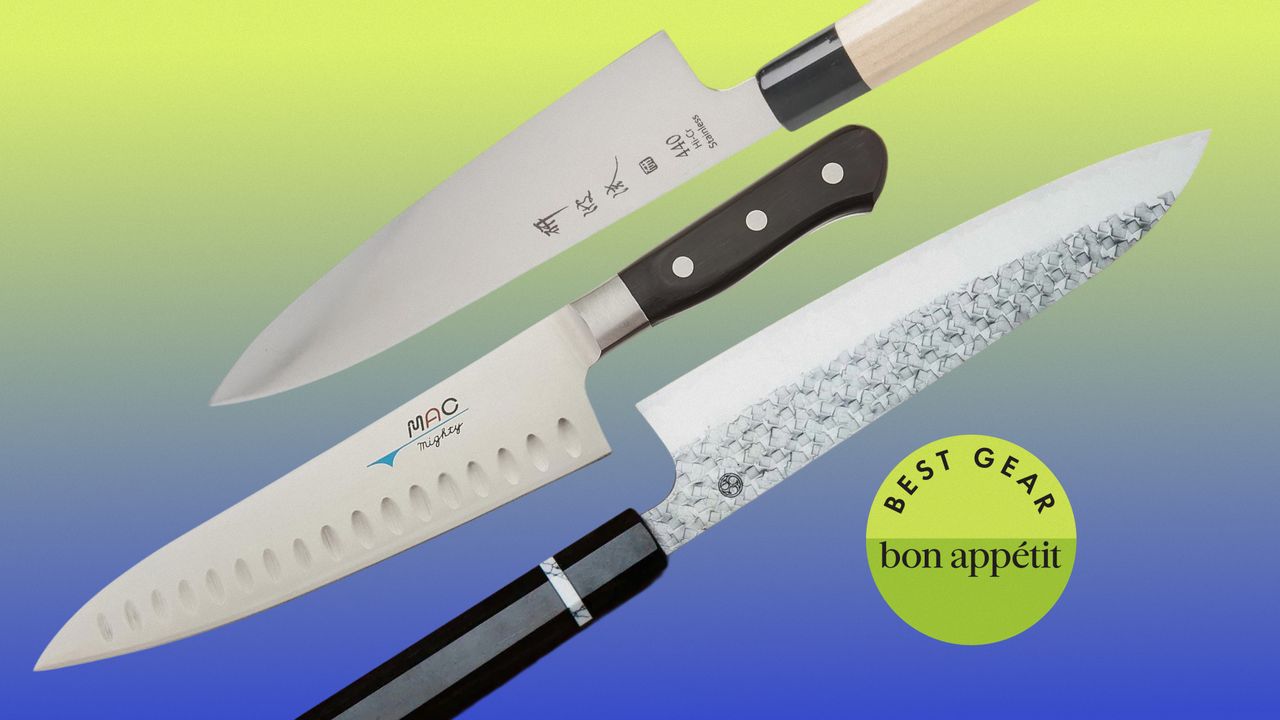
A longtime favorite, this budget-friendly gyuto slices, chops, and cuts with the best of them.
What we love: Tojiro’s knives have been longtime favorites, and their Classic-line gyuto has been thoroughly tested over the last few years as a personal knife for multiple people. Its VG10 core is clad in stainless steel to protect it well during everyday use, and its full-tang handle design is sturdy and comfortable to hold. Compared to other hybrid-style knives, the Tojiro has a longer handle and a bit more heft, making it more comfortable to hold and more versatile. If you’re used to Western-style knives, the Tojiro chops, slices, and cuts with the same level of durability. Somehow, it also has a razor-fine edge right from the factory, easily slicing through paper, flank steak, and onions with little to no effort. In the world of Japanese knives that can easily run into the hundreds of dollars, it’s a budget knife that overperforms its price.
What we’d leave: The biggest downside to the Tojiro gyuto is the lack of proper finishing—these knives can have sharp burrs and rough corners along the spine or where the blade meets the bolster. You can buff them out with a little sandpaper, but it’s definitely a trade-off compared to more expensive knives.
What is a Japanese Knife?
A Japanese knife, to put it plainly, is a knife made in Japan. That answer’s not as glib as it might seem—we wanted to separate the knives considered here from the broader category of “Japanese-inspired” knives sold by direct-to-consumer kitchen brands.
The most prominent style of Japanese kitchen knife (and the one this review is focused on) is the gyuto, a Japanese chef’s knife that translates to “cow sword.” This knife, however, is already a Japanese interpretation of a Western-style knife. Before the gyuto was introduced in the late 1800s, most Japanese knives were designed for very specific tasks. The gyuto was born when Western culinary influences became de rigeur, and chefs needed a more versatile blade shape, adept at push cuts and pull-through slicing, with a slight curve that allowed some light chopping.
As the gyuto has grown in popularity in recent years, many new knife designs from American companies have taken inspiration from the gyuto shape. That’s right: We’re talking about Western knives, inspired by Japanese knives that were themselves inspired by Western knives. It’s a bit of an ouroboros situation. By focusing on knives exclusively made in Japan—and featuring traditional gyuto elements—we hope to put a spotlight on unique pieces that can upgrade a home knife rack.
But before getting into which gyuto is best, you need to decide if its style will work for your cooking. So let’s go deep on what makes a gyuto a gyuto.
How Japanese gyuto knife blade shape vs. Western-style chef’s knife
Most Western-style blades curve upward toward the point. This makes them easy to rock up and down on the cutting board for fast chopping. These knives also feature a sturdy spine for extra heft and durability. A gyuto, on the other hand, has a much gentler curve with a drop point (sometimes called a sheep’s foot).










Leave a Reply