
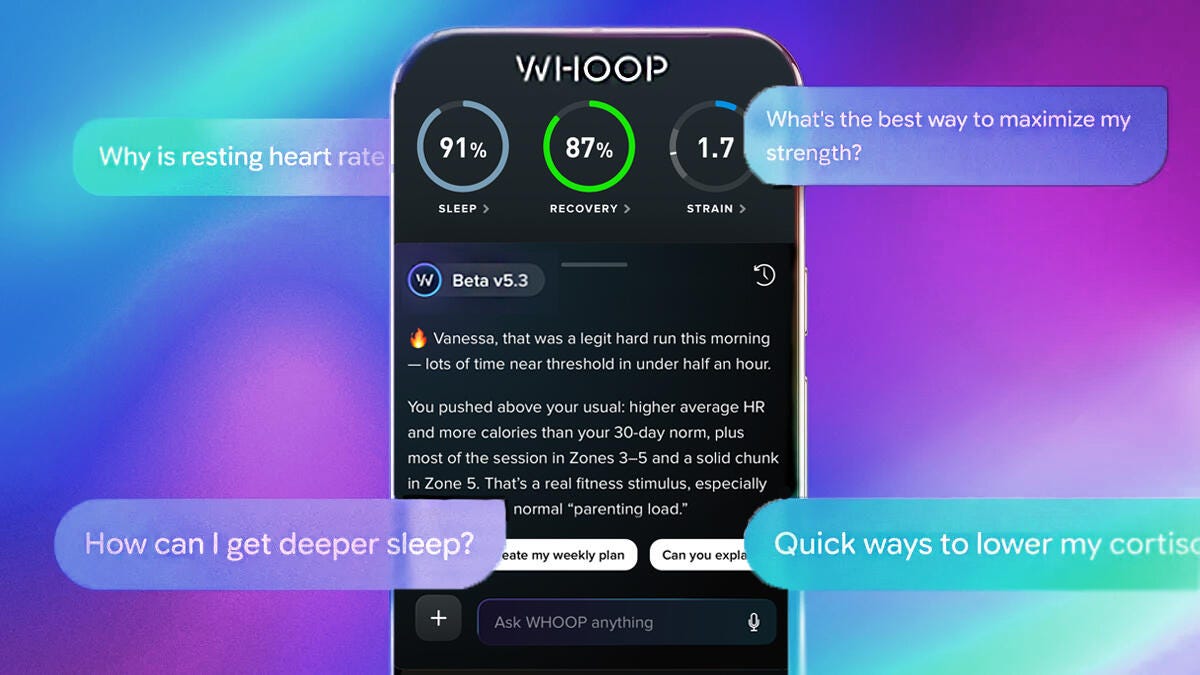
Just hearing the phrase “AI health coach” listed among the Whoop band’s features was enough to make me tune out. After testing many of these supposed coaches, taking their advice became somewhat meaningless. But Whoop’s take on this tired perk may have turned the tide for me.
I’ve spent two months testing the latest Whoop MG band, a screenless fitness tracker built for athletes and long-term performance, and I’m shocked at how much I’ve learned.
The chatbot doesn’t regurgitate generic wellness tips or wait for you to come to it with questions. Think of it as that little cartoon angel that pops up on your shoulder at exactly the right moment, except instead of moral guidance, it’s flagging that your heart rate data suggests you should probably skip the HIIT class tomorrow.
It wasn’t just surfacing metrics. It was helping me understand what to do with them.
AI health coaches are the hot buzzword of the season among wellness enthusiasts. Over the last year, I’ve tested different versions from Google, Apple, Oura, Garmin, and Meta. On paper, most AI health coaches promise to contextualize the years’ worth of biometric data from your wearable device and turn it into personalized guidance.
In reality, most require you to go looking for it: Open the right tab and ask the right questions about your data, if you remember the feature exists in the first place.
Even when you do use AI health coaches as intended, they still offer mostly generic wellness advice (with the added worry about potentially handing off your data to train future models). At that point, it doesn’t feel much different from going straight to ChatGPT or Claude, just with your biometrics layered on top.
The Whoop MG with the proprietary band (left) and the third party alternative (right).
If you’re already using a Whoop band, you’ve likely made that call about the risk to your information. The company says it uses anonymized, aggregated data to improve its platform and doesn’t sell your data to advertisers. The subscription, which ranges from $199 to $359 per year, is what you’re really paying for, and the AI coach is included. Though handing over your health data isn’t a small decision.
As I explored in my piece on AI health coaches, my biggest concern going in was data privacy. We’ve become so desensitized to clicking “agree” on data disclosures that most of us aren’t even sure what we’re signing away anymore. The language is often intentionally vague, and much of this data falls outside HIPAA protections, meaning it can legally be repurposed in ways you never intended. If you’re concerned about privacy, read the fine print before you commit. From there, opt out of having your data used to train future models when possible, or skip the AI features entirely. In my case, the benefit still outweighs the risk (and testing them is part of my job), but I approach with a healthy dose of skepticism.
Like most apps, it has a dedicated coach button at the bottom of the nav bar that you can summon on demand. But this one finds me.
Two days before my period (which I’d genuinely forgotten was coming), the Whoop coach flagged that workouts might feel harder due to hormonal changes and suggested scaling back. Call it suggestive reasoning or newfound body awareness, but workouts truly did feel harder that week.
During my regular 3-mile loop, my metrics showed signs of strain. My heart rate was higher than usual, my recovery was lower, and my running index came back “very good” instead of the “elite” level I’d hit on previous days. The next day, it didn’t just suggest a generic “rest day.” Instead, the coach pulled workouts already in my rotation and tailored them to my recovery, down to the number of minutes and heart rate zone targets.
Example of personalized workout recommendations from Whoop’s AI coach based on my strain score.
The Whoop band flagged that my all-out efforts hit differently, too. After crushing a PR (personal record), the AI coach surfaced a warning not to push into the peak heart rate zone more than once a week.
As a casual athlete with chronic imposter syndrome, I’m usually beating myself up for not pushing myself to work out hard five days a week. Instead of praising me for being a martyr, it was saying the opposite. I was skeptical enough to verify it outside the app, and sure enough, sustained effort at peak heart rate can increase injury risk if you’re not baking in recovery time.
This insight has forced me to rethink my all-or-nothing approach to training, where every workout had to be max effort to count. It also led me to put more trust in the AI coach.
That trust got tested when I logged a hike carrying my 40-pound toddler, and my strain score didn’t reflect the effort. The band has no altimeter and no way to account for extra weight. When I flagged it, the coach couldn’t retroactively fix the score, but it explained that my elevated heart rate had already partially signaled the added effort. Not a perfect answer, but more than I’d have gotten staring at a number with no context.
The same logic applies to sleep. The Whoop coach adjusts your recommended bedtime dynamically based on strain, sleep debt and recent patterns. As bedtime approaches, the coach surfaces a reminder on my lock screen about my optimal bedtime window: “If you want to stay in the green recovery zone tomorrow, aim for 11:40 p.m.”
And while it might not be enough to will me off the couch and into bed, the AI coach has stopped me from blowing too far past midnight. It feels less like a nagging parent and more like, “I’m trusting you to make the right choices for your body.”
The Whoop band and its built-in AI coach labled as a “W” icon in the app.
That’s ultimately what sets the Whoop band’s AI coach apart. It’s the closest thing to an actual coach I’ve tested because it meets you where you are. It shows up at the right moment, connects the dots and gives you something actionable without asking anything extra from you.
While most AI health tools still feel like dashboards with a slapped-on chatbot, this one is the first to feels like it’s truly coaching. Now it just needs to give me the same type of coaching at the gym or at the track while I’m doing the actual workout. Then I’d be all in.









Leave a Reply