
January 26, 2026
6 min read

Key takeaways:
- Researchers performed the first-in-human minimally invasive coronary artery bypass procedure.
- A University of Michigan interventionalist provided perspective on the significance of this achievement.
Researchers at the NIH and Emory School of Medicine have completed the first minimally invasive coronary artery bypass of the left main stem before transcatheter aortic valve replacement.
Ventriculo-coronary transcatheter outward navigation and reentry (VECTOR), a closed-chest, transcatheter, coronary ostial bypass procedure, was performed for the first time in a human, a 67-year-old man with aortic and mitral valve replacements and decompensated heart failure from severe stenotic degeneration of a previous aortic bioprosthesis.

Redo TAVR was not feasible due to the replacement’s proximity to the coronary ostium, and other minimally invasive procedures such as BASILICA, UNICORN or CATHEDRAL were not feasible due to heavy calcification and lack of a calcium-free traversal window.
A multidisciplinary care team consulted the patient on the novel VECTOR procedure, designed to move the patient’s coronary ostium away from the calcified aortic valve.
Full details of the VECTOR procedure and this case were published in Circulation: Cardiovascular Interventions.
Via femoral access, the operators passed a wire through the aorta into the coronary artery, where the wire is steered into one of the artery’s branches, breaching the vessel into the right ventricle, according to the publication.
A separate catheter was used to ensnare the first wire to then pull the wire’s end out through the femoral vein.
Next, the operator created a hole in the aorta away from the calcified aortic valve, as well as a second opening through the coronary artery wall, braced by a stent.
Using the second wire, the operator fed a coronary bypass graft of two overlapping covered stents (PK Papyrus, Teleflex), providing a new route for blood flow away from the calcified aortic valve, allowing for subsequent redo TAVR (Sapien 3 Ultra Resilia, Edwards Lifesciences).
Healio spoke with Brett L. Wanamaker, MD, FACC, FSCAI, clinical associate professor and interventional cardiologist at University of Michigan Health, for perspective on this novel procedure and how the use of existing tools to create novel solutions can help to propel innovation in complex procedural situations.
Healio: Can you tell us about your own background and interest in the VECTOR procedure and similar invasive solutions to complex cases?
Wanamaker: I’m an interventional cardiologist and my interest is in chronic total occlusion procedures, where the coronary is blocked for oftentimes a long segment, and most patients have had bypass surgery before, and the bypasses have become blocked. Maybe they’ve had prior stents and those are blocked. We’re seeing patients on their second, third or fourth option. As part of that, there are some different tools that we use to try to reopen blood vessels and establish either previously existing or new pathways in the coronary arteries. VECTOR is a little bit different than that but uses some of the same techniques.
Healio: Can you tell us about your interest in the VECTOR procedure and its development?
Wanamaker: It’s a technically amazing procedure, with what they were able to do using existing technology. It’s not like they developed any new devices to do this procedure. The imagination and ingenuity from this group is impressive, but especially impressive here because they’re melding structural heart techniques as well as some complex percutaneous coronary intervention and chronic total occlusion PCI techniques to establish a new path to perfuse the coronaries.
The situation they used it in — and had to use it in, otherwise the patient would have had no treatment options — is where the entrance to the coronary artery was no longer viable. When they were going to put the valve in, it was going to completely block that blood vessel and be catastrophic for the patient. They needed to establish a new starting point, or ostium, of the blood vessel.
Thank goodness it’s rare, but this is an obstacle that a lot of structural cardiologists face multiple times per year.
We also encounter patients who have had either surgery done to or near the ostium in their blood vessel, and we’re trying to get that blood vessel open. There are some techniques that involve using the blood vessel wall or going subintimal, but this takes it to the next level, and says, what if we could just create an entirely new pathway toward that blood vessel, from the aorta to the target area, just inside the pericardial space?
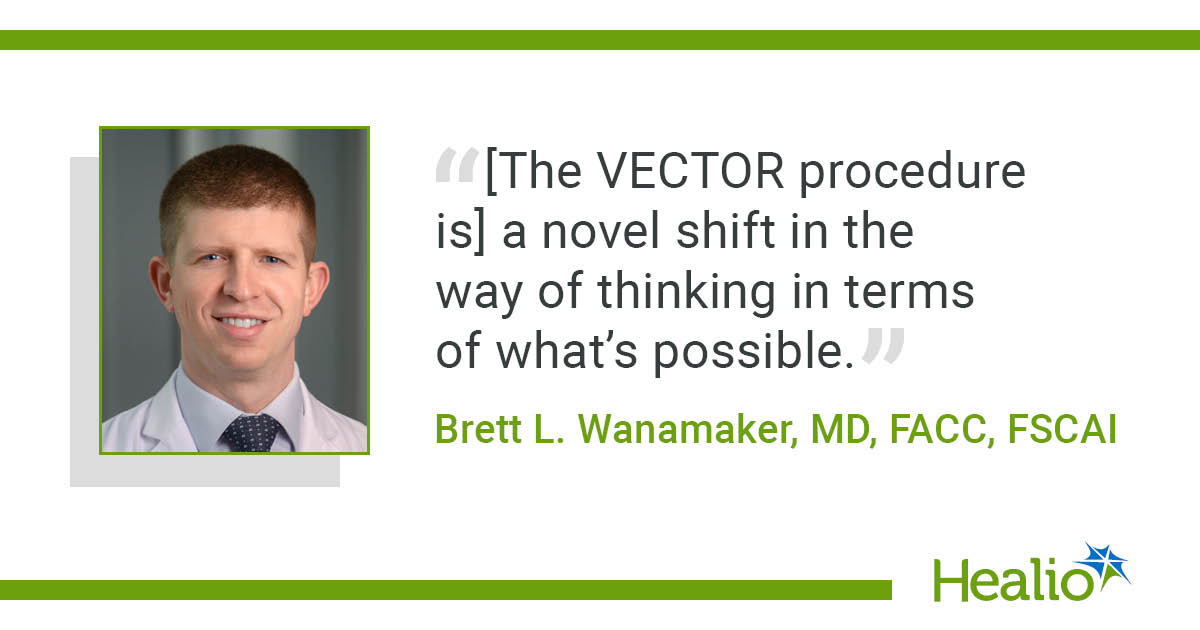
It’s a novel shift in the way of thinking in terms of what’s possible.
Healio: In the case of the patient from the case report in Circulation: Cardiovascular Interventions, what made him the optimal test subject for this procedure?
Wanamaker: The patient absolutely had no other options and needed treatment of his valve. That valve treatment was always going to involve catastrophic obstruction of his coronary artery. Because the patient wasn’t a bypass candidate, they needed to completely move the opening of that blood vessel, and they reconstructed the osteoproximal vessel using covered stent grafts.
Healio: Can you comment on the safety of the VECTOR procedure compared with other minimally invasive procedures?
Wanamaker: It’s too early to know because this is a first-in-human procedure that is in very highly specialized and innovative hands. To assess intraprocedural safety issues, we would need a larger case series to understand the pitfalls and troubleshooting that an operator would encounter. This is not something that’s going to be done by your typical interventional cardiologist. This is going to be something that, maybe one day, is offered at large referral centers with a high degree of expertise in structural cardiology as well as complex PCI.
Healio: Are there any other clinical scenarios where something like the VECTOR procedure might be preferred, and could this expand minimally invasive bypass to a wider patient population?
Wanamaker: For right now, the big thing we need to understand is the longevity of
the percutaneous bypass graft that they created. It’s unknown what the long-term patency of that would be.
For a typical patient, the question is, what is the propensity of those covered stents to experience restenosis and downstream issues. We don’t know that.
For a long time, we’ve been using the patient’s own conduits, be it their own arteries, the left internal mammary artery, or saphenous vein grafts, which don’t perform quite as well as the arteries.
Attempts at synthetic grafts have not panned out because of durability issues. What they’ve done here is a little bit different. They’re using covered stents, so it’s not quite the same thing, but the real question will be how durable can this be?
The other scenarios I alluded to would be patients that have had their artery oversewn or obstructed, and they have a failing bypass graft going to that particular vessel. Recanalizing the native artery isn’t really an option, and so this provides a way to create a new conduit, if you will.
There are some patients where the osteoproximal vessel is so entirely hostile because of calcium. We meet some patients with multiple layers of prior stents that have gone bad, or perhaps they’re mangled, and the ostium of the vessel isn’t a viable option anymore. This is an interesting workaround to that.
Healio: Can you comment on the potential learning curve for operators if use expands?
Wanamaker: No. There would have to be a case series in expert hands first before it could be expanded to other operators. This would be a highly specialized procedure that would be done by people trained by those who developed it.
Healio: One of the co–authors on the case report, Christopher G. Bruce, MBChB, said the clinical translation of this procedure came together rather quickly. How does this statement reflect progress in the landscape of interventional cardiology, and are new procedures developing at an ever-faster pace?
Wanamaker: That’s absolutely true. Because of the therapies that we’re able to offer, patients are living longer and they’re presenting with ever more complex issues.
The typical patient that we see has had multiple procedures or surgeries that helped them to survive, and so when they do present with an additional problem, it’s often more complex. They’ve been operated on multiple times, so it requires these innovative, out-of-the-box solutions.
One thing that’s interesting is that the operators were able to conceive of this using just existing coronary technology, not any new sort of devices specifically designed for this purpose, which is impressive.
Healio: Is there anything else that you would like to say about VECTOR or the state of interventional cardiology today?
Wanamaker: I’m always impressed and inspired by people that are able to innovate and push the field forward like this.
There will be iterative developments to ideas like this that will make them safer and more practical and maybe even translatable to a broader patient population, so we’ll hopefully be learning about that in the coming years.
It’s important that all cardiologists understand that there are potentially innovative solutions to patients that are thought to be inoperable, and it’s just a matter of knowing that such things exist and referring the patient to the right person that could potentially offer at least a discussion of what’s out there.
For more information:
Brett L. Wanamaker, MD, FACC, FSCAI, can be reached at cardiology@healio.com.
Sources/Disclosures
Source:
Healio Interviews
References:
Disclosures:
Wanamaker reports consulting and speaking for Boston Scientific.

Ask a clinical question and tap into Healio AI’s knowledge base.
- PubMed, enrolling/recruiting trials, guidelines
- Clinical Guidance, Healio CME, FDA news
- Healio’s exclusive daily news coverage of clinical data
<






Leave a Reply