
January 28, 2026
2 min read
Key takeaways:
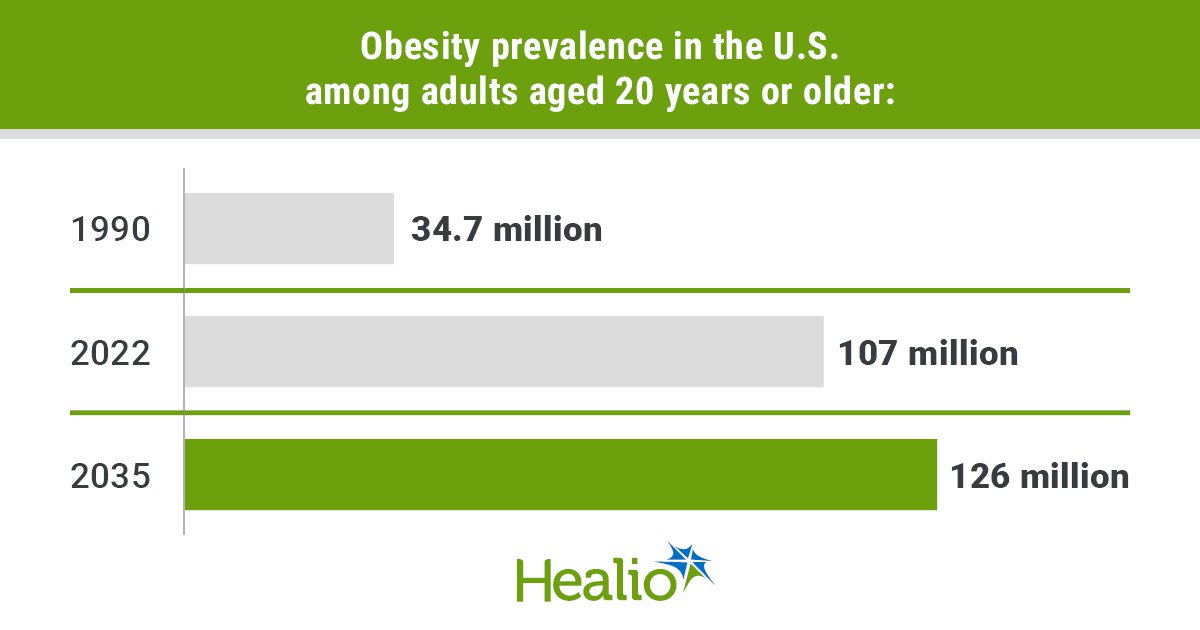
- An estimated 107 million American adults were living with obesity in 2022, up from 34.7 million in 1990.
- The prevalence of the chronic disease is estimated to rise from 42.5% in 2022 to 46.9% by 2035.
The prevalence of obesity in the United States is projected to increase to 126 million by 2035, according to a new study published in JAMA.
“Obesity continues to increase, especially in young people, and remains a major public health threat,” Catherine O. Johnson, PhD, MPH, a scientist at the Institute for Health Metrics and Evaluation, University of Washington, Seattle, told Healio. “One of our major findings was the large increases in the prevalence of obesity in younger age groups for all race and ethnicity groups, highlighting the need for effective strategies to prevent weight gain and the development of obesity.”

Data derived from: DeCleene NK, et al. JAMA. 2026;doi:10.1001/jama.2025.26817.
Healio recently reported that obesity prevalence in the U.S. is 75.2% under new criteria proposed by The Lancet Diabetes & Endocrinology Commission.
But recently updated estimates of obesity prevalence and its forecasted future trends “are not available by race and ethnicity subgroups within U.S. states,” Johnson and colleagues pointed out.
The researchers estimated the prevalence of obesity — defined as a BMI of 30 kg/m2 or above — among American adults aged 20 years or older from 1990 to 2022 while forecasting this prevalence by 2035 using data from the National Health and Nutrition Examination Survey, as well as the Behavioral Risk Factor Surveillance System and Gallup Daily Survey.
Johnson and colleagues reported that an estimated 107 million American adults [95% uncertainty interval (UI), 101-113 million] were living with obesity in 2022.
This amount represented 42.5% (95% UI, 40.2%-45%) of the adult population and was an increase from 34.7 (95% UI, 31.1-38.3) million adults in 1990.
The prevalence of obesity in the U.S. in 2022 ranged from 40.1% (95% UI, 37.8%-42.5%) for non-Hispanic white men to 56.9% (95% UI, 54.1%-59.9%) for non-Hispanic Black women.
The researchers noted obesity prevalence by states differed substantially, with it being highest in Midwestern and Southern states.
“States with consistently high prevalence of obesity, such as Oklahoma, had among the lowest percentage of people meeting dietary intake recommendations,” they wrote.
Johnson and colleagues additionally estimated that 46.9% (95% UI, 43.9%-49.9%) of the American adult population will live with obesity in 2035, “with prevalence by demographic group ranging from 43.1% (95% UI, 39.8%-46.6%) to 59.5% (95% UI, 56%-62.9%).”
They acknowledged that BMI “may incorrectly estimate the amount and location of adipose tissue vs. lean muscle mass” but wrote that BMI-based measures “are an important proxy that can be used to assess population-level risk.”
They also urged to interpret forecasted data with caution “because the past may not predict the future.”
“Increasingly, clinicians will need to be prepared to care for patients with very high BMI,” Johnson told Healio. “Our health systems and payors will need to provide access to the therapies these patients will need.”
She added clinicians play a critical role “in helping patients maintain a healthy weight early in life, starting in childhood. But the messages and strategies needed to do this have to start very early in life — so supporting early childhood education around maintaining a healthy weight is key.”
Regarding future research directions, Johnson acknowledged the possible impact of newer weight loss drugs “remains to be seen.”
“Access to these medications, currently limited by cost and payor policies, is a necessary step if they are going to influence population health,” she said. “In addition, public health research should focus on implementation research for strategies to prevent initial weight gain, including interventions focused on diet and physical activity, especially for children and young adults.”

Ask a clinical question and tap into Healio AI’s knowledge base.
- PubMed, enrolling/recruiting trials, guidelines
- Clinical Guidance, Healio CME, FDA news
- Healio’s exclusive daily news coverage of clinical data
<










Leave a Reply