
January 29, 2026
1 min watch

Key takeaways:
- U.S. adults overall express high trust in scientists for cancer information.
- Those with conservative-leaning views appeared less likely than those with liberal-leaning views to express high levels of trust.
Political ideology is linked to Americans’ trust in scientists as sources of cancer information, study results suggest.
A survey of several thousand U.S. adults revealed a high level of trust overall; however, those with more conservative views appeared less likely than those with more liberal views to express high levels of trust.

Data derived from Wheldon CW, et al. JAMA Netw Open. 2025;doi:10.1001/jamanetworkopen.2025.46818.

Christopher W. Wheldon
The “clear ideological gradient” researchers observed underscores the need for tailored messaging to ensure evidence-based cancer information reaches diverse audiences, Christopher W. Wheldon, PhD, assistant professor of social and behavioral sciences at Temple University’s Barnett College of Public Health, and colleagues concluded.
“The patterns we observed likely reflect how people feel about institutions, not whether they care about their own health or whether they trust the scientific process,” Wheldon told Healio. “Those institutions have a responsibility to deliver scientifically and medically accurate information about cancer prevention, screening and care. They may need to frame that information so it resonates with different communities, which may require different communication strategies.”
Broad potential impacts
A growing volume of evidence suggests political ideology may be an important determinant of health behaviors.
COVID-19 pandemic-era debates about public health mandates — including mask and vaccine requirements — represent one example.
A study by Chido-Amajuoyi and colleagues, published in 2023, examined whether political ideology affected trust in public health agencies for cancer information. As Healio previously reported, individuals with more conservative political views had lower levels of trust in cancer information disseminated by these entities than people with more liberal views.
Whether political polarization in the United States affects public trust in scientific authorities had not been established.
Wheldon and colleagues conducted a cross-sectional secondary analysis of the 2024 Health Information National Trends Survey, a nationally representative survey conducted by NCI that assesses the American public’s knowledge of, attitudes toward and use of information related to cancer and other health topics.
The survey asked respondents: “In general, how much would you trust information about cancer from scientists?”
Researchers classified respondents who selected “some” or “a lot” as having high trust. They classified respondents who selected “a little” or “not at all” as having low trust.
Survey respondents also described their current political viewpoint. A 7-point bipolar scale offered a range of “very liberal” to “very conservative,” with “moderate” as a midpoint.
Researchers used survey-weighted logistic regression models to estimate associations between trust and political ideology.
More than 7,200 people responded to the survey.
Investigators included 6,260 (52.1% men) with complete data in their analysis. They controlled for several variables, including age, education and family cancer history.
A majority of respondents (86%) reported high trust in scientists as sources of cancer information.
“The high level of trust overall surprised me,” Wheldon said. “Despite increasing political polarization, most people across the ideological spectrum still reported high trust in scientists for cancer information.”
Adjusted logistic regression models showed trust varied by political ideology.
Each 1-point increase on the 7-point scale toward greater conservatism appeared associated with a 25% reduction in odds of reporting high trust (adjusted OR = 0.75; 95% CI, 0.68-0.83).
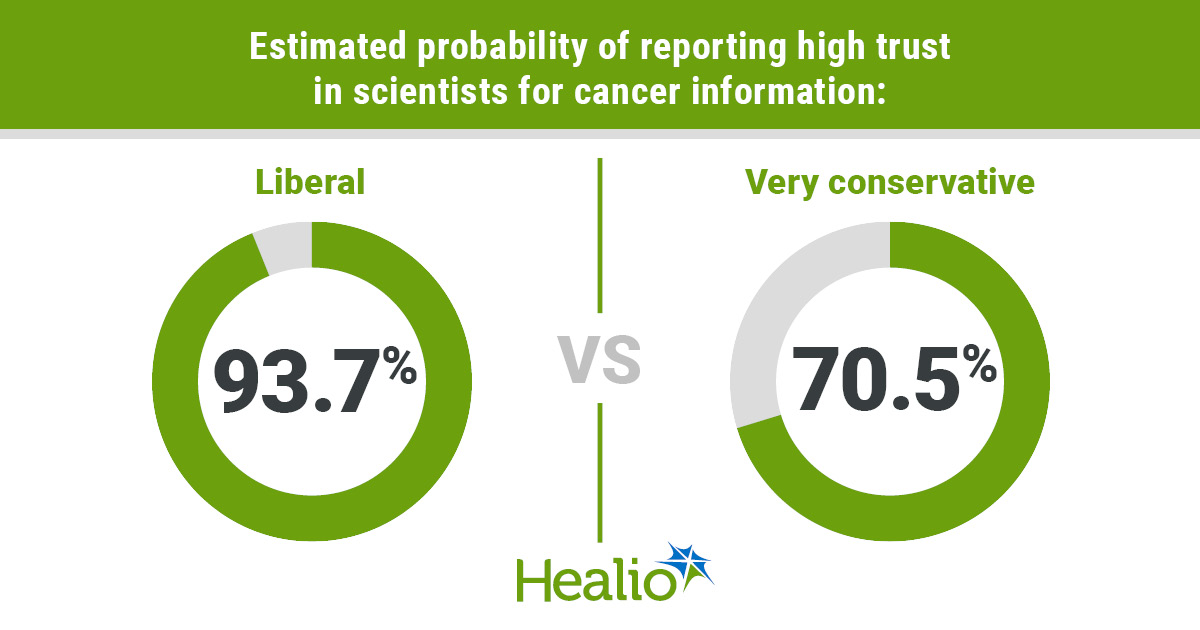
Survey respondents who identified as liberal had a greater estimated probability of reporting high trust than those who identified as very conservative (93.7% vs. 70.5%).
This finding could have implications that range from adherence to cancer screening guidance to how someone diagnosed with cancer feels about treatment recommendations, Wheldon said.
“If someone doesn’t trust the messenger — especially when the information is highly technical — that can affect decisions at every stage of cancer care, from prevention to treatment,” Wheldon said. “Trust is something we need to take seriously as a factor in cancer outcomes.”
‘Speak to people’s values’
Researchers acknowledged study limitations, including its cross-sectional design and the fact that single-item measures used to assess trust and political ideology may not capture “the full complexity or multidimensionality” of these variables. The low survey response rate (27.3%) also could increase potential for nonresponse bias, they wrote.
The wording of the survey question may have impacted the results, Wheldon said, noting an overwhelming majority of survey respondents (94.2%) reported having high trust in their physicians for cancer information.
“That is terrific news, and it makes sense on an interpersonal level because people are likely responding based on their relationship with a specific clinician they know,” Wheldon said. “Trust in scientists is different because not everyone knows a scientist, and people may have different interpretations of what that means.”
Academic medical institutions and cancer centers could consider promoting the fact that oncologists and other physicians conduct cutting-edge cancer research, helping to “put a face” on the scientific field, Wheldon said.
Meanwhile, effective and respectful communication that emphasizes cooperation, promotes supportive dialogue and avoids “hierarchical dynamics” could help build trust that crosses ideological lines, study authors wrote.
Involving “trusted messengers” can support that effort, as can recognition that people respond differently to how messaging is framed, Wheldon said.
He used HPV vaccination recommendations as an example.
“Some messaging may rely on statistics. They may say the vaccine can prevent ‘X’ percentage of cervical cancer cases, but not everybody responds to statistics like that,” he said. “Some people may respond more to messages about protecting their family from the real human costs of cancer. The key is framing information in ways that speak to people’s values while remaining scientifically accurate.”
For more information:
Christopher W. Wheldon, PhD, can be reached at chris.wheldon@temple.edu.

Ask a clinical question and tap into Healio AI’s knowledge base.
- PubMed, enrolling/recruiting trials, guidelines
- Clinical Guidance, Healio CME, FDA news
- Healio’s exclusive daily news coverage of clinical data
<






Leave a Reply