
April 13, 2026
3 min read
Key takeaways:
- Incidence rate ratios for alopecia areata were greater among those receiving dupilumab vs. topical corticosteroids or prednisone at 0 to 4 months of treatment.
- At 20 to 24 months, these ratios decreased.
After receiving dupilumab vs. topical corticosteroid or prednisone for up to 24 months, the risk for alopecia areata development among patients with atopic dermatitis fell, according to study results.
These data were published in The Journal of Allergy and Clinical Immunology: In Practice.

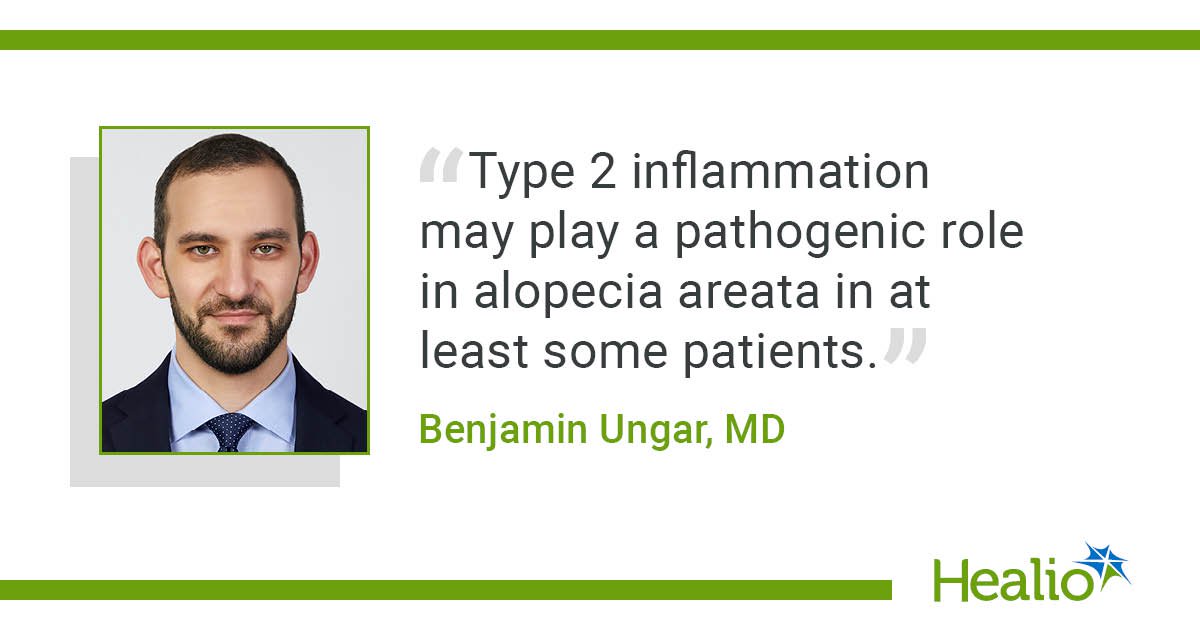
“The results of this study further support that type 2 inflammation may play a pathogenic role in alopecia areata in at least some patients,” Benjamin Ungar, MD, assistant professor of dermatology and director of the Alopecia Center of Excellence and the Rosacea & Seborrheic Dermatitis Clinic at the Icahn School of Medicine at Mount Sinai, told Healio.
“In atopic dermatitis patients with high risk for alopecia areata, treating with dupilumab seems to reduce that risk, which can be very meaningful for patients who might otherwise develop a disease associated with an enormous psychosocial burden,” Ungar, who is also a member of Healio’s Allergy/Asthma Peer Perspective Board, said.
In a multicenter, retrospective cohort study, Ungar and colleagues assessed 3,282,639 patients with AD from the Epic Cosmos electronic health record database to determine if having a dupilumab vs. topical corticosteroid or prednisone prescription impacts the risk for alopecia areata development.
“Over the last several years, alopecia areata has been increasingly recognized as having a strong link with atopic disease,” Ungar said. “By far the most common comorbidities of alopecia areata are atopic diseases, with AD being the common among those. Moreover, having AD is a risk factor for developing alopecia areata.
“Recent studies have shown that targeting type 2 inflammation can be a successful therapeutic approach in alopecia areata patients with atopy, which we are evaluating further in ongoing clinical trials for adults and children,” he continued. “However, studies have not yet evaluated if targeting type 2 inflammation can reduce the risk of alopecia areata in AD who have not yet developed it, so we set out to evaluate that question.”
This study population included 154,967 patients treated with dupilumab, 2,137,234 patients treated with topical corticosteroids and 970,438 patients treated with prednisone.
“Medication exposure served to differentiate cohorts by severity, with topical corticosteroids representing milder, systemic-untreated AD and prednisone representing more severe disease requiring short-term or intermittent systemic therapy but not chronic immunomodulatory treatment,” Ungar and colleagues wrote.
In the 24 to 20 months prior to receiving treatment, researchers found an increased risk for alopecia areata in the group that was going to be treated with dupilumab when compared with those to be treated with topical corticosteroids (incidence rate ratio [IRR] = 2.11) or prednisone (IRR = 1.76).
This pattern held true in the 0 to 4 months of treatment, as the risk for alopecia areata was greater among those receiving dupilumab vs. topical corticosteroids (IRR = 2.12) or prednisone (IRR = 1.97).
At 20 to 24 months of treatment, researchers observed decreases in these rates. The IRR among patients receiving dupilumab dropped to 1.73 vs. topical corticosteroids and 1.38 vs. prednisone.
Compared with the topical corticosteroid group, the prednisone group had an elevated risk for alopecia areata that stayed the same at both 0 to 4 months of treatment (IRR = 1.25) and 20 to 24 months of treatment (IRR = 1.25).
Researchers noted “consistent patterns” in relation to those outlined above within subgroups based on sex, race, age, IgE levels and atopic comorbidities including asthma, allergic rhinitis and food allergy.
This outcome continued to be found after the study excluded patients with asthma, prurigo nodularis, eosinophilic esophagitis, nasal polyps, COPD, chronic spontaneous urticaria, rheumatoid arthritis and psoriasis in a sensitivity analysis.
“Overall, the results of the study were in line with our hypothesis that since type 2 inflammation contributes to alopecia areata pathogenesis, at least in the patient subset with an atopic background, reducing that type of inflammation may decrease how often alopecia areata develops,” Ungar told Healio.
“Future studies will need to explore this link in more detail,” Ungar added. “Ideally, prospective studies with different systemic treatments for AD will be conducted to evaluate the effects of successful AD-directed therapies on the risk of alopecia areata.”
For more information:
Benjamin Ungar, MD, can be reached at benjamin.ungar@mountsinai.org.
Sources/Disclosures
Source:
Levine J, et al. J Allergy Clin Immunol Pract. 2026;doi:10.1016/j.jaip.2026.03.015.
Disclosures:
Ungar reports receiving research funds (grants paid to the institution) from Bristol Myers Squibb, Incyte, Rapt Therapeutics, Pfizer and Sanofi; being a consultant for AbbVie, Arcutis Biotherapeutics, Bristol Myers Squibb, Botanix Pharmaceuticals, Castle Biosciences, Ebla Holdco, Fresenius Kabi, Galderma, J&J, LEO Pharma, Lilly, Pfizer, Primus Pharmaceuticals, Sanofi, Sun Pharma, UCB, Veradermics and VRG Therapeutics. Please see the study for all other authors’ relevant financial disclosures.

Ask a clinical question and tap into Healio AI’s knowledge base.
- PubMed, enrolling/recruiting trials, guidelines
- Clinical Guidance, Healio CME, FDA news
- Healio’s exclusive daily news coverage of clinical data
<












Leave a Reply