
April 17, 2026
2 min read

Key takeaways:
- Sean Ianchulev, MD, MPH, introduced micro-interventional dynamic outflow curve during the Kelman Lecture.
- miDOC provides real-time, instantaneous, high-precision outflow monitoring.
WASHINGTON — A technology introduced at the American Society of Cataract and Refractive Surgery meeting has shown promise in addressing an unmet need in glaucoma surgery, according to a presenter.
During the Charles D. Kelman, MD, Innovator’s Lecture, Sean Ianchulev, MD, MPH, said that while cataract surgery has had a success rate of about 95% for the past 50 years, the success rate of medication-free outcomes for glaucoma surgery is far less.

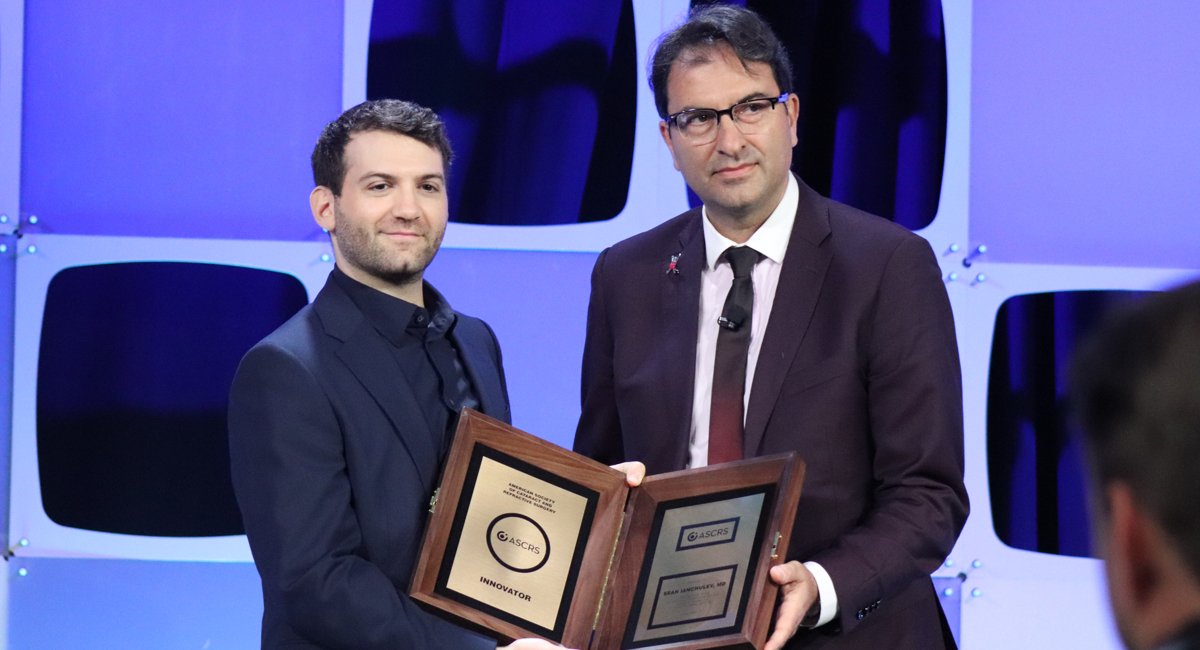
At the ASCRS meeting, Sean Ianchulev, MD, MPH, (right) received the Charles D. Kelman, MD, medal from Evan Kelman. Image: Eamon N. Dreisbach | Healio
“You’re lucky if you get to 40% or 50%,” he said. “Half of the time, you don’t have complete success.”
The cataract surgery success rate is due to the surgeon’s ability to measure a patient’s biometry, which helps tailor the IOL choice. In glaucoma surgery, however, measuring patient outflow remains a knowledge gap.
“We don’t measure it, and we don’t qualify it yet,” Ianchulev said. “We’re operating in the dark.”
To address this issue, Ianchulev introduced miDOC (micro-interventional dynamic outflow curve), a technology designed to provide glaucoma surgeons with instantaneous, high-precision outflow biometry and ocular rigidity measurement.

“And we can show what happens over time after the intervention,” he said.
According to a press release from Mount Sinai, miDOC allows surgeons to measure outflow facility, IOP, flow and ocular rigidity in real time, allowing for procedures to be adjusted for individual patients. In addition, this tool may have benefits for refractive outcomes after cataract surgery because IOP spikes in the postoperative recovery period can affect vision.
Researchers at New York Eye and Ear Infirmary of Mount Sinai found that miDOC may also be able to detect choroidal blood flow, the release said.
During the presentation, Ianchulev demonstrated how miDOC can be used to measure outflow in a patient at baseline, a patient who received one iStent (Glaukos) and a patient who received two iStents. The technology measured outflow facilities of 0.09 µL/min/mm Hg at baseline, 0.19 µL/min/mm Hg with one iStent and 0.458 µL/min/mm Hg with two iStents.
“We’ve had cases where you do an intervention and nothing happens. You do fenestrations and nothing happens because they didn’t work or you do too much,” Ianchulev said. “Wouldn’t it be nice to know that you’re overtreating the outflow?”
Sources/Disclosures
Source:
Ianchulev S. From eyedeation to eyenovation … It takes a tribe. Presented at: American Society of Cataract and Refractive Surgery meeting; April 10-13, 2026; Washington.
Reference:
Disclosures:
Ianchulev reports having financial disclosures for AEYE Health, Dropmate, Eyenovia, Iantech, Iantrek, KYS Vision, PME Ventures, Preceyes, RemoniHealth, Sofia Biologics, Transcend Medical, Wavetec and Z-Optic.

Ask a clinical question and tap into Healio AI’s knowledge base.
- PubMed, enrolling/recruiting trials, guidelines
- Clinical Guidance, Healio CME, FDA news
- Healio’s exclusive daily news coverage of clinical data
<











Leave a Reply