
April 20, 2026
6 min read
Key takeaways:
- The Lancet will convene its first commission dedicated solely to global skin health.
- A diverse group of experts will establish goals for reducing the burden of skin disease and training a global workforce.
The Lancet announced a new international commission to address the burden of skin disease, with the goal of creating measurable targets and delivery models that will improve skin health and build a workforce that can meet patient demand.
The initiative is the first time the publication will focus a commission entirely on skin health, according to the International League of Dermatological Societies (ILDS). In a press release, the ILDS, which represents more than 175,000 dermatologists worldwide, called the decision a “major step forward in achieving global recognition that skin diseases are serious public health conditions, which affect billions of people.”

“The ILDS and its members have long championed skin health as a cornerstone of overall wellbeing,” Henry W. Lim, MD, FAAD, president of ILDS, senior vice president of academic programs at Henry Ford Health and past president of the American Academy of Dermatology, said in the release. “With the establishment of The Lancet Commission on Skin Health, dermatology takes its rightful place on the global health stage, supported by one of the world’s most influential scientific voices.”

Henry W. Lim
The Commission will be co-chaired by Xiang Chen, MD, PhD, professor of dermatology at Xiangya Hospital in China, Esther E. Freeman, MD, PhD, FAAD, director of global health dermatology at Massachusetts General Hospital and associate professor of dermatology at Harvard Medical School, and Sinéad Langan, professor of clinical epidemiology at the London School of Hygiene & Tropical Medicine and honorary consultant dermatologist at St John’s Institute of Dermatology.
Healio spoke with Freeman, also vice chair of the ILDS’ International Foundation for Dermatology, about the importance of elevating skin diseases as a public health issue, as well as efforts to build the global dermatology workforce and train front-line health care workers to treat the most common dermatologic diseases.
Healio: What is a Lancet Commission and what is its significance?
Freeman: A Lancet Commission is organized by The Lancet, one of the most renowned publications in the medical field. The Lancet has a history of creating commissions focused on specific areas within medicine. Two recent examples are The Lancet Commission on Obesity and The Lancet Commission on Global Surgery. These reports take anywhere from 2 to 5 years to build. They focus on the state of the science in that particular focus area, new and emerging data and then larger goals similar to United Nations development goals. It is essentially a group of experts drawing a line in the sand and saying, “This is where we should be in 10 years, 20 years down the line.”
It is very exciting because, in its 200-year history, The Lancet has never had a commission focused on skin disease. This is a way to explain to the international medical community and to international policymakers that this is an important issue.
Healio: Why do you think The Lancet chose to elevate and prioritize skin health now?
Freeman: Dermatology has been a bit sidelined for some time. Historically, people have thought of skin as something that is more cosmetic and not a serious medical condition. Now, with a lot of political advocacy and effort, that thinking is finally starting to shift. People see the major public health effects of skin disease.
Beyond skin cancer, we have significant inflammatory conditions that are hugely impactful on stigma and a person’s quality of life. In May 2025, the World Health Assembly, the governing body of WHO, passed for the first time a resolution on skin disease overall, called “Skin Disease as a Global Public Health Priority.” That did not happen on its own. That followed 20 years’ worth of international advocacy and coalition building.
Healio: What are the goals of this commission? What can we expect now that there is this heightened focus?
Freeman: We are marking the kickoff of the Commission. The language that The Lancet uses — what you and I might think of as the Commission finishing or publishing — they call that the launch. The reason they use that language is they consider the launch the beginning. They are setting the targets for where we should be.
The biggest goal is raising the profile of skin disease as not a cosmetic issue, but a public health issue that affects people’s quality of life. Skin disease often affects length of life. It affects a person’s job. It has substantial impact on stigma, social isolation and things like itch and pain. The impact includes people’s families.
Another key message is that skin disease cannot be thought of just by itself. If we try to build something separate or outside the system, it will never work. We talk a lot about integration and universal health coverage. How do you integrate skin health into primary care and front-line health care? As an example, one of the countries where I work is Rwanda. Imagine you are a patient in Rwanda with a skin disease. There are about 14 dermatologists in the whole country of Rwanda; all but one are in the capital city, Kigali. Now, imagine you are in a remote area of Rwanda, you have a skin disease and you try to find a health care professional who can diagnose you and know how to treat you.
We must think about how we integrate training in skin disease with front-line health care workers, primary care doctors and pediatricians. Unfortunately, I would love to say we are going to have enough dermatologists everywhere, but that will probably never be the case. It is not the reality on the ground.
Healio: There are four specific case studies that the Commission plans to focus on. Can you explain what those are?
Freeman: It would be difficult to cover everything in dermatology all in one report, and The Lancet recognizes that. The Commission uses case studies, essentially specific examples, which go into more depth in certain areas. There are four main case studies, and it is certainly possible that more will be added over time.
The first case study is focusing on countries in an industrialization transition. China is one key example country, where historically there has been a higher burden of infectious skin conditions.
As industrialization occurs and lifestyles across a country begin to change … we are seeing a transition into more non-communicable diseases and inflammatory skin conditions.
That is not true everywhere in the world. There are still large parts of the world where infectious diseases and infectious skin conditions are still the major issue.
The second case study, which I will be directing, focuses on our global dermatology workforce. I mentioned before that there are only 14 dermatologists in Rwanda. There are six dermatologists in Burundi for a population of 14 million people. There are four dermatologists in the country of Malawi. You do not forget numbers like that.
We know dermatologists provide the gold standard of care for skin diseases. We also know that if there is no dermatologist, skin diseases do not go away. People turn to their primary care doctor. Sometimes they see pharmacists. They are seeing traditional healers.
There are all these other layers of health care workers. Our job is to understand who sees these patients across these countries. How do we train and upskill them?
We have between 2,000 and 3,000 skin diseases. We are not proposing that we need to train someone in all of them. What we can do is train people in the top 10 most common skin diseases.
The third case study looks at neglected tropical diseases. Most neglected tropical diseases involve the skin and around 80% of them involve a major skin manifestation. The Commission will be looking at that, particularly through the lens of Nepal.
The fourth case study is going to look at melanoma and other skin cancer diagnoses. We will study how AI is starting to be used for skin cancer diagnostics. That case will be focused on Australia.
Healio: How will the findings be disseminated?
Freeman: The big report will be published as The Lancet Commission is launched. That will take 2 to 3 years, as the different work groups summarize and collect the evidence and new studies, and then set these larger goals. There may be additional smaller pieces released along the way.
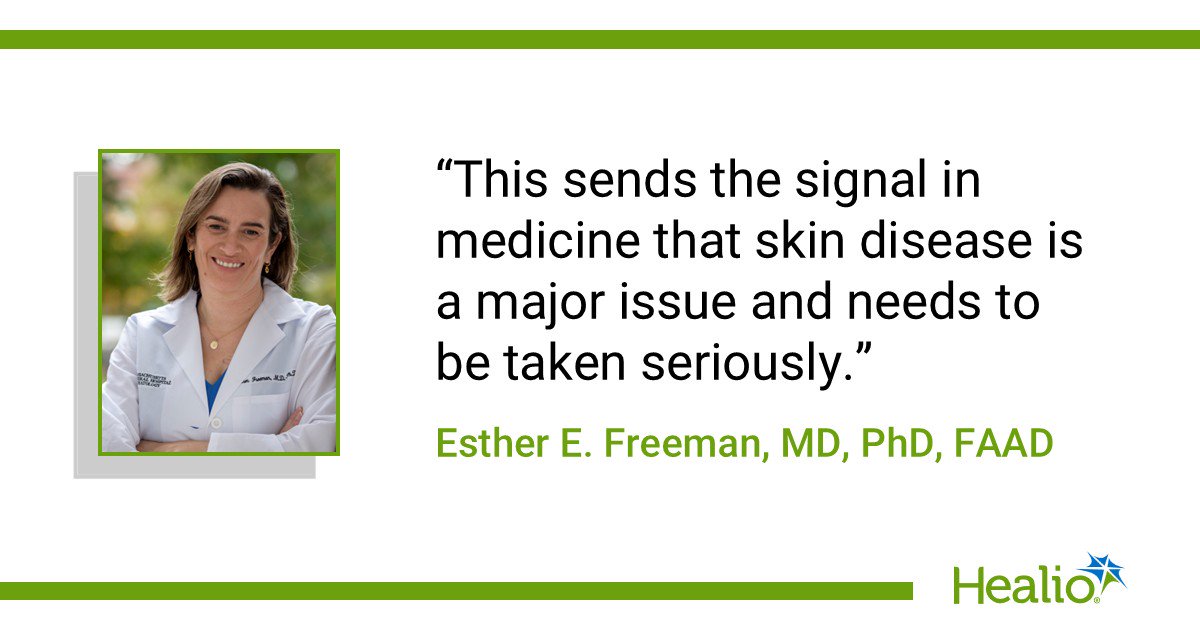
As we work toward creating these goals, we wanted the world to know that this is happening and that The Lancet is prioritizing skin health. This sends the signal in medicine that skin disease is a major issue and needs to be taken seriously.
For more information:
Esther Freeman, MD, PhD, FAAD, can be reached on LinkedIn and on Instagram: @drestherfreeman.
Sources/Disclosures
Source:
Healio Interviews
References:
Disclosures:
Freeman reports no relevant financial disclosures.

Ask a clinical question and tap into Healio AI’s knowledge base.
- PubMed, enrolling/recruiting trials, guidelines
- Clinical Guidance, Healio CME, FDA news
- Healio’s exclusive daily news coverage of clinical data
<






Leave a Reply