

Key takeaways:
- Combination therapy at the outset of lupus nephritis diagnosis can be effective in preventing downstream complications.
- Proteinuria is an imperfect biomarker in lupus nephritis.
DESTIN, Fla. — Until biomarkers that can predict treatment response emerge, early and aggressive treatment is recommended in lupus nephritis, according to a presenter at Congress of Clinical Rheumatology East.
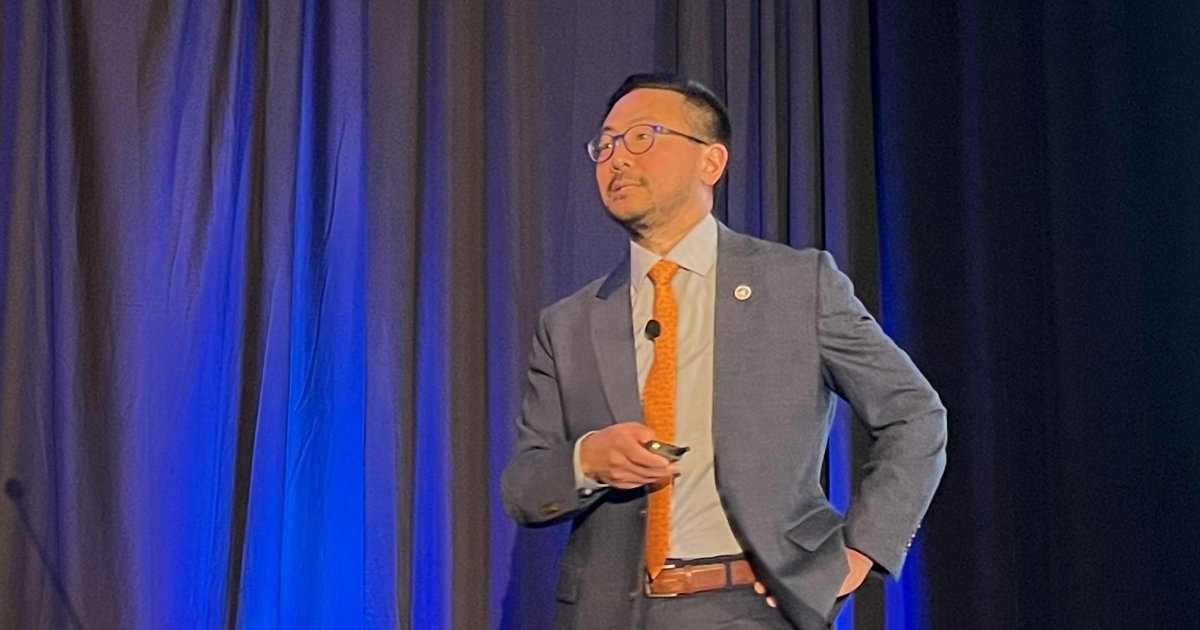
“We have to be aggressive in lupus nephritis right off the bat because most patients have had untreated disease,” Alfred H.J. Kim, MD, PhD, director of the Washington University Lupus Center, told attendees, here.

“We have to be aggressive in lupus nephritis right off the bat because most patients have had untreated disease,” Alfred H.J. Kim, MD, PhD, told attendees. Image: Rob Volansky | Healio
Patients may have waited as long as 5 years between initial presentation and an actual diagnosis of lupus nephritis, according to Kim. It is critical to gain disease control as soon as possible.
Standard of care for newly diagnosed lupus nephritis generally involves glucocorticoids and mycophenolate mofetil (MMF) or some combination of cyclophosphamide and/or azathioprine, Kim said.
“Using traditional standard of care therapies and then adding belimumab on top is going to improve things, at least in the short term,” Kim said. “Triple therapy does have benefits.”
The key benefit of belimumab is B-cell depletion. While the data for the B-cell depleter rituximab (Rituxan, Genentech) in lupus nephritis have been suboptimal, the recent FDA approval of the humanized type II anti-CD20 monoclonal antibody obinutuzumab (Gazyva, Genentech) has provided a lift to this approach. “Obinutuzumab eliminates nearly all B cells in the kidney,” Kim said. “It works like a natural killer cell engager.”
But the jury is still out on the effectiveness of B-cell depletion in lupus nephritis. “You will hear this argument in the next talk, and then the next, talking about the depth of B-cell depletion, and whether it is clinically important,” Kim said.
A companion argument pertains to infection risk in patients who have undergone B-cell depletion, according to Kim. He added that vaccine schedules could be problematic in patients who undergo the FDA-approved dosing schedule of obinutuzumab.
As those parameters are worked out in clinical trials and post-marketing studies, Kim highlighted another critical concern for rheumatologists managing lupus nephritis. “We have really run into some problems with proteinuria,” he said.
While proteinuria often defines treatment response in many lupus nephritis trials, Kim suggested the outcome does not often align with biopsy data. Moreover, many patients have low proteinuria but still show signs of proliferative lupus nephritis.
“Proteinuria is problematic for lupus nephritis detection,” Kim said. “It does not correlate with intrarenal activity.”
The search for other biomarkers has yielded similarly conflicting results. Kim discussed uIL-16, uCD163 and tenascin C, among others.
While uIL-16 and uCD163 have shown some potential in defining certain lupus nephritis parameters, Kim said more information is needed.
“They have no relationship to chronicity,” he said. “I am not saying that these biomarkers don’t have potential. I am saying we have to be careful not to oversimplify what these biomarkers will mean in the future.”
Regarding tenascin C, Kim noted that the exact function of the protein is unknown. “But we know that it correlates with fibrosis,” he said. “It could be a useful predictor of kidney function loss when measured in urine.”
As more data emerge on those biomarkers, Kim said the call to be aggressive in treatment. “Be as aggressive as you and the patient are comfortable being,” he said.
Sources/Disclosures
Source:
Kim AHJ. The changing landscape of SLE nephritis treatment. Presented at: Congress of Clinical Rheumatology East; April 30-May 3, 2026; Destin, Florida (hybrid meeting).
Disclosures:
Kim reports having sponsored research agreements with AstraZeneca, Bristol Myers Squibb, CRISPR Therapeutics and Novartis; consulting for Abbvie, AstraZeneca, Aurinia Pharmaceuticals, Biogen, Exagen Diagnostics, Genentech/Roche, GlaxoSmithKline, Hinge Bio, Invivyd, Johnson & Johnson, Kymera Therapeutics, Kypha Inc., Miltenyi Biomedicine, Novartis/Alexion, RheumNow, TREG, UpToDate and Zenas BioPharma; and receiving royalties/patent beneficiary from Kypha Inc.

Ask a clinical question and tap into Healio AI’s knowledge base.
- PubMed, enrolling/recruiting trials, guidelines
- Clinical Guidance, Healio CME, FDA news
- Healio’s exclusive daily news coverage of clinical data
<












Leave a Reply