

Key takeaways:
- A novel pulsed field ablation technology successfully treated most patients with paroxysmal AF.
- The rate of serious adverse events was low and the 1-year rate of freedom from atrial arrhythmia was high.
A novel pulsed field ablation technology was safe and prevented atrial arrhythmia recurrence in most patients with paroxysmal atrial fibrillation at 1 year, according to a first-in-human study presented at Heart Rhythm 2026.
The circular nanosecond pulsed field ablation catheter (CellFX nsPFA 360, Pulse Biosciences) delivers nanosecond pulses as opposed to the microsecond pulses delivered by existing pulsed field ablation technologies, Vivek Y. Reddy, MD, director of cardiac arrhythmia services for the Mount Sinai Health System and the Leona M. and Harry B. Helmsley Charitable Trust Professor of Medicine in Cardiac Electrophysiology, who presented the findings, told Healio.

Data derived from Reddy VY, et al. Late-breaking clinical trials: Pulsed field ablation. Presented at: Heart Rhythm 2026; April 23-26, 2026; Chicago.
“The issue with microsecond [pulsed field ablation] is that it certainly works, but our durability is not as high as we’d like it to be. So we want to have more intense ablation of lesions to improve our outcomes,” he told Healio. “The problem with that is that already it’s becoming clear that there are some near-field effects that can happen. And those near-field thermal effects can have an important impact in terms of potential clot and stroke. What nanosecond does is by shortening the duration of each of these impulses, you can basically push the output so you can increase the voltage. With microsecond, you could increase the voltage, but you’d just get too much heating because you’re dumping a lot of energy into the tissue. With nanosecond, you can get up over 10,000 volts compared to microsecond, which is around 2,000, and still not get any appreciable heating.”
Nanosecond pulsed field ablation
For the first-in-human study, simultaneously published in JACC: Clinical Electrophysiology, Reddy and colleagues performed nanosecond pulsed field ablation on 177 patients with paroxysmal AF (mean age, 61 years; 36% women). All patients had pulmonary vein isolation using 2.5-second or 5-second applications, and some also had ablation at the posterior wall, cavotricuspid isthmus or mitral isthmus. Lesion durability was assessed via invasive remapping at 2 to 3 months. Patients received transtelephonic and Holter monitoring at 6 months and 1 year.
Acute success occurred in 100% of lesions, the mean pulmonary vein isolation time was 12 minutes, the mean total left atrial dwell time was 19 minutes, the mean procedure time was 65 minutes, and the mean fluoroscopy time was 9 minutes, according to the researchers.
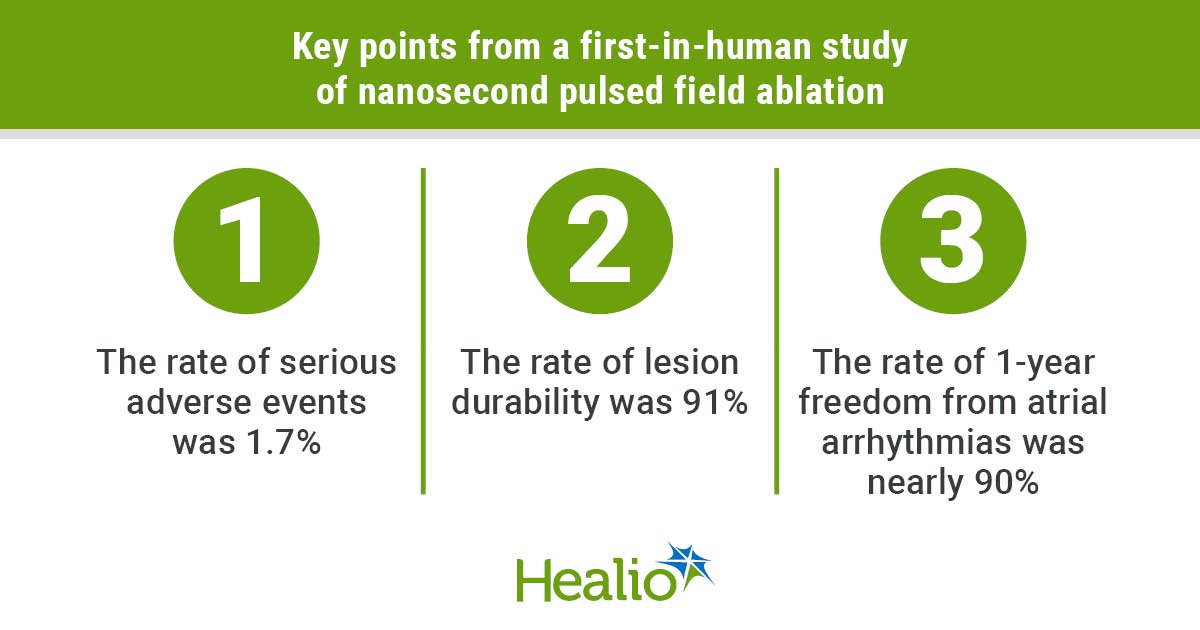
There were three serious adverse events, for a rate of 1.7%: one patient had inflammatory pericardial effusion, one had hemolysis with acute kidney injury, and one had a stroke, the researchers reported.
The patient with hemolysis “happened relatively early in our experience,” Reddy told Healio. “Since then, we’ve not had any other such dialysis incidents because we now know to hydrate the patients, but that’s still an important complication.”
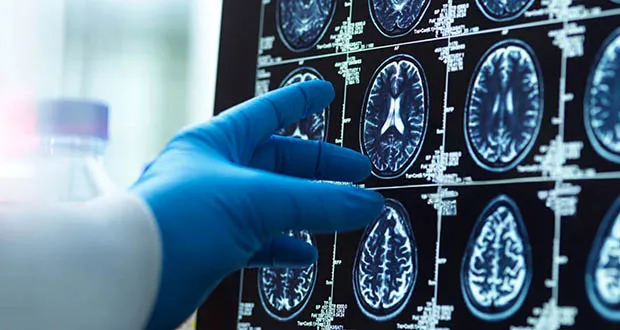
Among the 35 patients who had a brain MRI, 11.4% had silent cerebral events and 11.4% had silent cerebral lesions, according to the researchers.
“That’s on the low end of what we see with most of these technologies,” Reddy told Healio.
At 2 to 3 months, the durability of the procedure with 5-second applications was 91%, and at 1 year, the estimated rate of freedom from atrial arrhythmias was 89.7% (95% CI, 80.5%-94.6%), Reddy and colleagues found.
‘The patients did … quite well’
The durable isolation rate of 91% “is actually quite good,” Reddy said. “Obviously, I’d like it to be even higher, but given that we had seven different operators at three different centers, I feel pretty good about that.”
A limitation of the study is that the patients did not have implantable loop recorders, so asymptomatic arrhythmias could have gone undetected, Reddy said.
“The rate of 1-year freedom from arrhythmias was pretty impressive,” he told Healio. “These patients did not have implantable loop recorders, so you can’t take this too far, but the fact is that the patients did seem to do quite well. The idea of nanosecond [pulsed field ablation] works.”
A pivotal trial of the technology just started enrolling, he said. The system is not yet approved for commercial use in the United States.
For more information:
Vivek Y. Reddy, MD, can be reached at vivek.reddy@mountsinai.org.
Perspective
Back to Top

Roderick H. Tung, MD
Director, Cardiovascular Center
Banner – University Medical Center Phoenix
Professor and division chief of cardiology
University of Arizona College of Medicine – Phoenix
Disclosures: Tung reports no relevant financial disclosures.
Sources/Disclosures
Source:
Reddy VY, et al. Late-breaking clinical trials: Pulsed field ablation. Presented at: Heart Rhythm 2026; April 23-26, 2026; Chicago.
Reference:
Disclosures:
Reddy reports financial ties with numerous drug and device companies, including consulting for and holding equity in Pulse Biosciences. Please see the study for all other authors’ relevant financial disclosures. The study was funded by Pulse Biosciences.

Ask a clinical question and tap into Healio AI’s knowledge base.
- PubMed, enrolling/recruiting trials, guidelines
- Clinical Guidance, Healio CME, FDA news
- Healio’s exclusive daily news coverage of clinical data
<










Leave a Reply