
Key takeaways:
- The most common predictors of a patient skipping an appointment were young age, race and ethnicity, no insurance or limited English proficiency.
- Solutions must target the root causes of access to care.
Certain demographic and socioeconomic factors were associated with no-show rates for dermatology appointments, according to a study published in JAAD Reviews.
Missed appointments without patient notice can add to the already strained scheduling system, contributing to the health care barriers of others and lengthening appointment wait times, according to Allen F. Shih, MD, MBA, department medical director and quality director of dermatology at Beth Israel Deaconess Medical Center and Harvard Medical School.

“Like many academic dermatology centers, we have experienced significant challenges increasing access to care — especially for general dermatology visits,” Shih told Healio. “At the same time, even with long waitlists, some clinic days still have a substantial number of no-shows, leaving appointment slots unused. We wanted to better understand why this happens and identify ways to improve appointment utilization and access to dermatology services.”
For the scoping review, Shih and colleagues evaluated 22 articles for factors associated with no-shows in U.S. adult dermatology clinics and found that younger age, racial or ethnic minority status, lack of insurance or limited English proficiency were all associated with higher rates of missed appointments.
Adults aged 19 to 25 years were 2.3 times more likely to miss an appointment compared with older patients, according to one study referenced by the authors. Black and Hispanic patients were 1.9 and 1.2 times more likely to no-show as well.
According to another study, 20.6% of patients with Medicaid missed an appointment without notice vs. 9.8% of those with private insurance (P < .0001). The highest risk for no-show was seen among the self-insured, who were 7.03 times more likely to miss an appointment compared with commercial payers, another study reported.
Non-English speakers were 1.4 times more likely than English speakers to miss an appointment. Overall, patients in the “high social vulnerability” category were 3.39 times more likely to no-show, according to another study.
Although these statistics provide helpful insight for no-show predictors, Shih notes that it is important to consider an individual’s personal reasons.
“What stood out was that we can often identify who is at higher risk for no-shows, but we know much less about why patients actually miss visits,” Shih said. “Very few studies asked patients directly about the barriers they face.”
Only four of the 22 studies evaluated strategies to reduce no-show rates, with two finding that video-based teledermatology was associated with significantly lower no-show rates. However, solutions for addressing demographic and socioeconomic concerns need to be layered, Shih said.
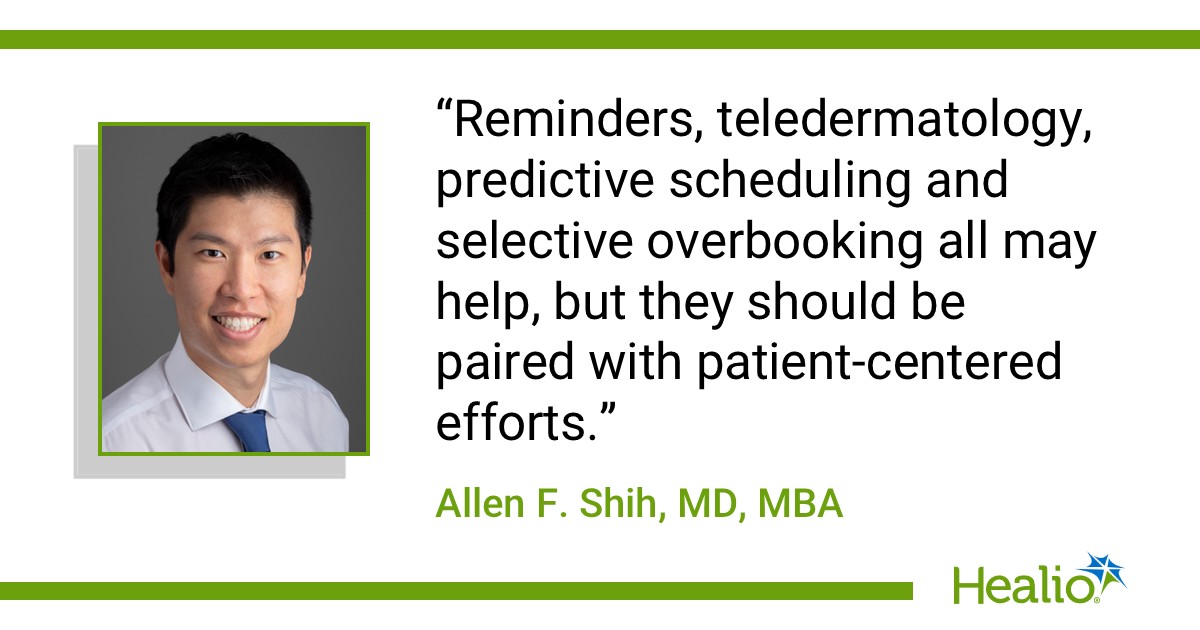
“Reminders, teledermatology, predictive scheduling and selective overbooking all may help, but they should be paired with patient-centered efforts to understand and address real-world barriers to attendance,” Shih told Healio. “This is ultimately about both access and equity. The patients at highest risk for missed appointments are often the same patients who face the greatest barriers to care. Reducing no-shows is not just about filling schedules or improving clinic efficiency. It is about making dermatology care easier to access for the patients who may need that access the most.”
For more information:
Allen F. Shih, MD, MBA, can be reached at ashih@bidmc.harvard.edu.

Ask a clinical question and tap into Healio AI’s knowledge base.
- PubMed, enrolling/recruiting trials, guidelines
- Clinical Guidance, Healio CME, FDA news
- Healio’s exclusive daily news coverage of clinical data
<








Leave a Reply