

Key takeaways:
- Combination therapy is necessary for most patients with systemic sclerosis.
- Early treatment and management of individual systems with off-label therapies is critical in SSc.
DESTIN, Fla. — Most patients with systemic sclerosis require treatment with multiple modes of action, according to a presenter at Congress of Clinical Rheumatology East.
“We need to think of all the organs when we are treating systemic sclerosis,” Janet E. Pope, MD, MPH, FRCPC, professor of medicine at the University of Western Ontario, in London, Canada, said in her presentation. “Treat what is treatable.”

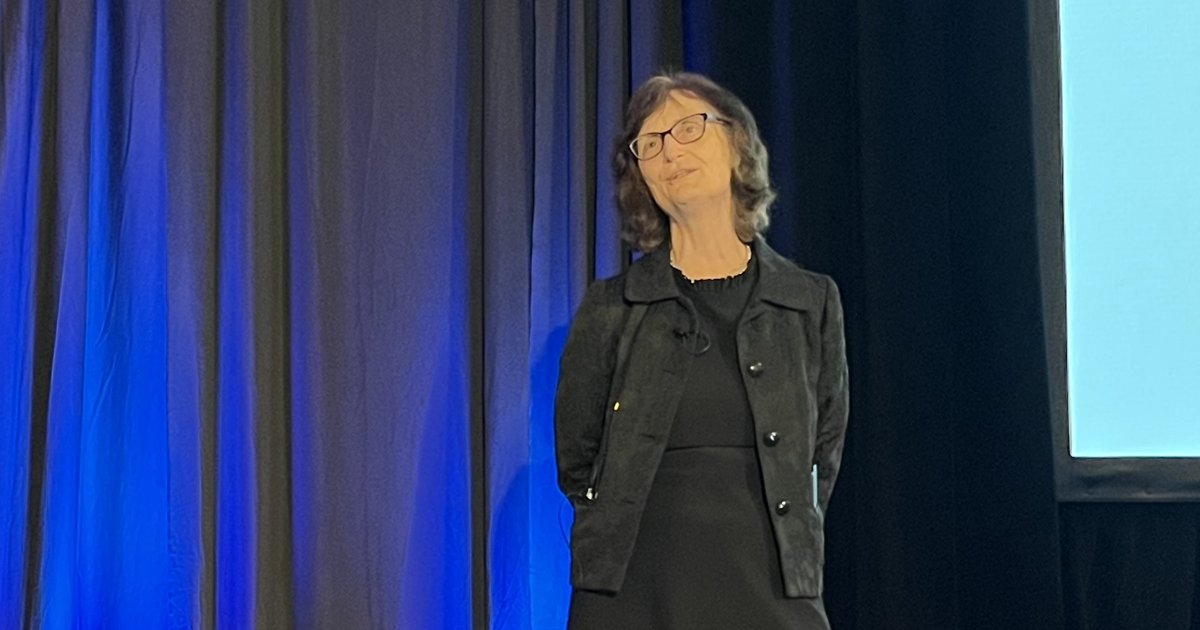
“Monotherapy is not going to be the home run in systemic sclerosis,” Janet Pope, MD, told attendees. Image: Rob Volansky | Healio
Systemic sclerosis (SSc) can impact multiple organ systems, most commonly the lungs and skin, according to Pope.
“The damage is not reversible, but damage increases the risk of further damage,” she said, noting that rheumatologists treating SSc can take their cues from other autoimmune diseases. “We are kind of working with a lupus paradigm.”
Because patients with SSc are most likely to die from lung complications, understanding the treatment landscape for pulmonary arterial hypertension (PAH) and interstitial lung disease (ILD) is critical to preventing fatalities.
While FDA approvals are few and far between in SSc, sotatercept-csrk (Winrevair, Merck) has been approved for patients with PAH. “This can improve survival,” Pope said.
But one drug is unlikely to minimize damage or prevent mortality. Combination therapy with a phosphodiesterase type 5 (PDE5) inhibitor plus an endothelial receptor medication can be effective for PAH in SSc. “Then add a third therapy such as a [prostaglandin] receptor agonist,” Pope said.
A few options are available for patients with ILD in SSc, according to Pope. “The PDE4 selective inhibitor nerandomilast added to nintedanib or on its own can prolong survival in progressive pulmonary fibrosis, including the subset with SSc-ILD,” she told Healio. “I might also add it to nintedanib.”
Rituximab (Rituxan, Genentech) or tocilizumab (Actemra, Genetech) can be added to mycophenolate mofetil (MMF) for ILD in SSc, as well, according to Pope.
For skin fibrosis, methotrexate and rituximab may be used in the first line. “We want to treat early diffuse disease,” Pope said.
Hematopoietic stem cell transplantation (HSCT) has gained attention as a treatment of SSc, particularly in patients with skin fibrosis. “Is it a cure?” Pope said. “No. There is a chance of failure. But if I have patients with aggressive onset and early diffuse disease, with a high lung score, a high skin score, why not just give them everything?”
Pope told attendees that HSCT is not likely to fix all of the manifestations of SSc.
“I don’t think a single therapy will be a home run for my patients,” Pope said. “We need an orchestra of therapies working together.”
The success of chimeric antigen receptor T-cell replacement in lupus has spawned significant interest in cellular therapies to treat other autoimmune and rheumatic diseases.
Pope noted that bispecific T-cell engager (BiTE) therapy may have utility in SSc.
“I think of it as a deeper B-cell depletion than rituximab,” she said. “It is probably not as deep as CAR-T cell replacement, but it is easier to administer at less cost.”
Regarding CAR T cells, Pope noted a recent search of ClinicalTrials.gov showing close to 30 trials involving more than 300 patients currently under way. However, there does not appear to be a clear pathway to approval in a specific indication or for a specific patient population.
“We need people to give us guidance on what should happen,” she said. “If there is no pathway to approval, you have to wonder why this is being done. I wonder if we are putting the CAR T before the horse in scleroderma.”
The other issue pertains to cure. “Are these people looking like they are cured at the end of these trials?” Pope said. “No. we need more data. Monotherapy is not going to be the home run in systemic sclerosis.”
For more information:
Janet E. Pope, MD, MPH, FRCPC, can be reached at Janet.Pope@sjhc.london.on.ca.
Sources/Disclosures
Source:
Pope J. Novel therapies in systemic sclerosis. Presented at: Congress of Clinical Rheumatology East; April 30-May 3, 2026; Destin, Florida (hybrid meeting).
Disclosures:
Pope reports receiving grants or research funding from BMS, Mallinckrodt/Therakos, Pfizer (Seattle Genetics) and Primus; consulting for Abbvie, Amgen, AstraZeneca, Boehringer Ingelheim, Boxer Capital, Bristol Myers Squibb, Celltrion Healthcare, Eli Lilly, Fresenius Kabi, Genzyme, GSK, Janssen, Merck, Novartis, Pfizer, Sandoz and Sanofi; being a speaker or on the advisory board of Abbive, Amgen, Boehringer Ingelheim, Bristol Myers Squibb, Certa, Eli Lilly, Fresenius Kabi, Janssen, Mallinckrodt/Therakos, Nordic Pharma, Merck, Novartis, Organon, Otsuka, Palleon, Pfizer, Roche, Sandoz, Sanofi, UCB and Zura; being on the data safety and monitoring board of AstraZeneca, Horizon and Novartis.

Ask a clinical question and tap into Healio AI’s knowledge base.
- PubMed, enrolling/recruiting trials, guidelines
- Clinical Guidance, Healio CME, FDA news
- Healio’s exclusive daily news coverage of clinical data
<










Leave a Reply