
April 24, 2026
1 min watch

Key takeaways:
- A single infusion of cilta-cel induced minimal residual disease negativity in all 20 treated patients.
- MRD negativity persisted and no patients had progressed to active multiple myeloma by data cutoff.
Chimeric antigen receptor T-cell therapy conferred sustained benefit to individuals with high-risk smoldering multiple myeloma, according to phase 2 trial results.
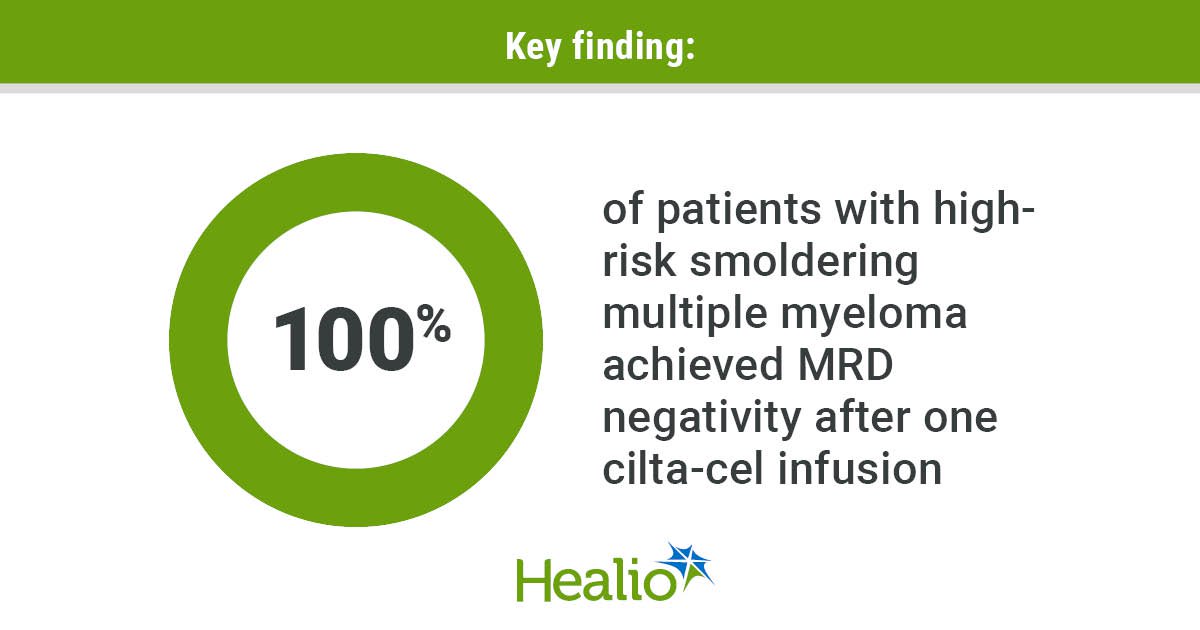
All patients who received a single infusion of ciltacabtagene autoleucel (Carvykti; Johnson & Johnson, Legend Biotech) — administered with no induction or bridging therapy — achieved minimal residual disease (MRD) negativity within 2 months.

Data derived from Nadeem O, et al. Abstract CT103. Presented at: American Association for Cancer Research Annual Meeting; April 17-22, 2026; San Diego.
All patients remained MRD negative and none had progressed to active multiple myeloma by data cutoff, findings presented at American Association for Cancer Research Annual Meeting showed.

Omar Nadeem
“We expected to see better results than had been observed with previous therapies in this space, but the results far exceed our expectations,” first author Omar Nadeem, MD, medical oncologist at Dana-Farber Cancer Institute and assistant professor of medicine at Harvard Medical School, told Healio. “We are very pleasantly surprised that a one-and-done therapy can lead to that depth of response so quickly for all patients.”
‘What are you waiting for?’
Smoldering multiple myeloma (SMM) is an asymptomatic plasma cell disorder.
An estimated 0.5% of adults older than 40 years have SMM. Incidence is higher among men and non-Hispanic Black individuals.
People with high-risk SMM — commonly defined by the proportion of plasma cell levels in the bone marrow and volume of plasma-cell protein products in the blood — have an approximately 50% chance to progress to active multiple myeloma within 2 years.
Until recently, patients with SMM underwent active surveillance, during which they underwent regular imaging, lab tests and bone marrow biopsies. Upon signs of progression to active myeloma — which causes debilitating symptoms — they received standard first-line therapy.

Name
“The biggest question our patients ask is: What are you waiting for?” senior author Irene Ghobrial, MD, professor of medicine at Dana-Farber Cancer Institute, said in an interview. “For any other cancer, we would never tell a patient to wait until they have end-organ damage or metastases to get treatment. Yet, for a long time, we waited for symptomatic disease because we had no good therapy.”
In the past decade, the FDA has approved more than a dozen new agents and nearly 30 unique regimens for multiple myeloma.
“Many of these drugs lead to impressive responses — and potentially cure — yet we still have been telling our patients, ‘Wait until you have higher tumor burden, end-organ damage or fractures in your bones and then I will treat you,’” Ghobrial said. “Our patients have told us, ‘Treat me now with the best therapy you have.’ This call from our patients really drove us to do something different.”
‘Something more’
That patient-centered mission marked its first milestone in November when the FDA approved daratumumab and hyaluronidase-fihj (Darzalex Faspro, Janssen), a subcutaneous CD38-targeted therapy, for individuals with high-risk SMM.
The agency based the indication on results of the randomized phase 3 AQUILA trial, which showed the therapy delayed progression to multiple myeloma by 51% at 5 years compared with active monitoring.
However, the therapy is administered regularly for 3 years. Also, fewer than 10% of patients assigned the therapy in AQUILA achieved complete response and 40% developed disease progression at 5 years, suggesting limited curative potential in this setting, Nadeem said.
“The question has become: Is this enough for people who are truly at high risk, or can we give them something more?” Nadeem said.
Nadeem, Ghobrial and colleagues conducted the CAR-PRISM trial to evaluate the efficacy and safety of ciltacabtagene autoleucel, often called cilta-cel.
The CAR T-cell therapy targets the B-cell maturation antigen (BCMA), found on the surface of abnormal plasma cells.
Cilta-cel already is approved for relapsed or refractory multiple myeloma. Researchers hypothesized the therapy could be even more effective in SMM given patients’ immune systems would be more robust and plasma cells would be less genomically complex, potentially leading to enhanced efficacy with reduced toxicity.
Investigators enrolled 20 patients (median age, 58 years; range, 37-78; 70% men) with high-risk SMM. Because participants did not receive induction or bridging therapy, trial protocol excluded patients whose plasma cells comprised more than 40% of bone marrow due to elevated potential for toxicities.
Trial participants received standard lymphodepletion chemotherapy, followed by a single cilta-cel infusion at doses ranging from 0.3×10⁶ cells/kg to 1×10⁶ cells/kg.
Safety, assessed by incidence of dose-limiting toxicities, served as the primary endpoint. Objective response rate, complete response rate, MRD negativity, PFS, and incidence and severity of adverse events served as secondary endpoints.
Safety and efficacy
No dose-limiting toxicities occurred.
All patients experienced grade 1 (85%) or grade 2 (15%) cytokine release syndrome. No grade 3 or higher CRS or infectious adverse events occurred.
All patients experienced neutropenia (grade 3/grade 4, 90%) and leukopenia (grade 3/grade 4, 90%). Researchers reported four cases (20%) of grade 3/grade 4 lymphopenia, two cases (10%) of grade 3/grade 4 anemia, three (15%) grade 3/grade 4 thrombocytopenias, and three (15%) cases of increased lymphocyte count.
No delayed hematologic toxicity occurred, and no patients developed immune-effector cell-associated neurotoxicity syndrome (ICANS).
Seven patients developed non-ICANS neurotoxicity (NINTS), with median time to onset of 21 days. Four of those patients had facial nerve palsies that resolved. Three had ongoing NINTS at data cutoff — two had grade 1 movement/neurocognitive symptoms and one had grade 1 intention tremor during fine motor tasks.
“Thankfully, the ongoing neurological toxicities remain low grade, and they have improved without impacting patients’ activities of daily living,” Nadeem said. “This is one of the complications that can occur from CAR T-cell therapy. We’re still learning how to use dose modification or other strategies to mitigate it and hopefully prevent it.”
All 20 patients achieved MRD negativity at a threshold of 10-6 by next-generation sequencing. MRD negativity for all patients persisted through data cutoff after median follow-up of 15.3 months. Twelve patients remained MRD negative after 1 year of follow-up and six remained MRD negative after more than 18 months.
All patients achieved objective response per International Myeloma Working Group criteria. Eighteen patients (90%) — including all 16 who had at least 6 months of follow-up — achieved complete or stringent complete response.
No patients experienced disease progression. Median PFS and OS had not been reached.
‘The way to cure’
Researchers acknowledged study limitations, including the small cohort, short follow-up, single-arm/single-institution design and exclusion of patients with plasma cell infiltration greater than 40%.
Still, the findings support the hypothesis that administration of CAR T-cell therapy prior to symptom development and onset of active multiple myeloma can induce deep responses, researchers concluded. The approach also allows standard induction regimens to be reserved if patients do progress.
CAR-PRISM represents a proof-of-concept clinical trial. Longer follow-up will be necessary to assess response durability and cilta-cel’s risk-benefit ratio in this setting, according to researchers.
“Dr. Ghobrial has made it her mission for over a decade, if not longer, to try to shift the paradigm to early therapy,” Nadeem said. “The approval of daratumumab last year signaled that the tide is shifting in this area. Now, the data we’re seeing with cilta-cel adds to the momentum.”
Researchers in Spain are evaluating cilta-cel for patients with high-risk SMM who received induction with daratumumab (Darzalex, Janssen), lenalidomide, bortezomib and dexamethasone.
Results of that investigation — coupled with the CAR-PRISM data presented at AACR — could lead to even more enthusiasm about the potential value of CAR-T and other immunotherapy approaches for high-risk smoldering myeloma, Ghobrial said.
“That is when a person’s T cells are at their best fitness, tumor burden is low and there is less clonal evolution, so it is probably the perfect time to use this type of therapy,” she said.
“This has been an amazing journey,” Ghobrial added. “We owe so much to the 20 patients in our trial who took the risk to try something completely new, and it is so gratifying to see the amazing responses they have had. Hopefully in our lifetime we will see myeloma as a preventable disease. We want to be able to screen early, identify it early and treat it early so a person never develops active disease, never develops bone fractures and never has renal failure. Early interception is potentially the way to cure.”
For more information:
Irene Ghobrial, MD, can be reached at irene_ghobrial@dfci.harvard.edu.
Omar Nadeem, MD, can be reached at omar_nadeem@dfci.harvard.edu.
Perspective
Back to Top

Disclosures: Htut reports no relevant financial disclosures.
Sources/Disclosures
Source:
Nadeem O, et al. Abstract CT103. Presented at: American Association for Cancer Research Annual Meeting; April 17-22, 2026; San Diego.
References:
Disclosures:
Johnson & Johnson supported this study. Ghobrial is a founder of and holds private equity in Predicta Biosciences. She also reports consulting roles with or honoraria from AbbVie, Amgen, AstraZeneca, Bristol Myers Squibb, Genentech, GSK, Janssen, Kite Pharma, Pfizer, Takeda and other companies. Nadeem reports research funding from or advisory board roles with AstraZeneca, Bristol Myers Squibb, GPCR Therapeutics, Johnson & Johnson, Kite Pharma and Sanofi. He also reports his spouse has stock ownership in Sanofi. Please see the study for all other authors’ relevant financial disclosures.

Ask a clinical question and tap into Healio AI’s knowledge base.
- PubMed, enrolling/recruiting trials, guidelines
- Clinical Guidance, Healio CME, FDA news
- Healio’s exclusive daily news coverage of clinical data
<









Leave a Reply