
April 13, 2026
2 min read

Key takeaways:
- A custom osseointegrated implant had a lower rate of distal chip fracture vs. an off-the-shelf osseointegrated implant.
- No implant failures or deep infections were found with the custom osseointegrated implant.
NEW ORLEANS — Results showed custom electron beam melting 3D-printed implants may reliably osseointegrate without loosening and have similar short-term functional outcomes vs. other press-fit osseointegration options.
“Within the last 5 to 10 years there has been a lot more industry that has been capable of quickly turning around custom titanium implants with a textured surface that can achieve osseointegration and be made whatever shape we need it to be made,” Taylor J. Reif, MD, an orthopedic surgeon at the Osseointegration Limb Replacement Center at Hospital for Special Surgery, told Healio about results presented at the American Academy of Orthopaedic Surgeons Annual Meeting. “Seeing this trend happening within orthopedics, we applied it to osseointegration. In our case, we thought this is an odd shape to this bone, maybe we should try something custom to get a better fit and then assessing the custom group vs. our prior group.”

Data were derived from Rozbruch S, et al. ePoster 468. Presented at: American Academy of Orthopaedic Surgeons Annual Meeting; March 2-6, 2026; New Orleans.
Reif and colleagues retrospectively reviewed all patients who underwent transfemoral, transtibial or transhumeral osseointegration with a custom electron beam melting 3D-printed implant between May 2024 and March 2025. They collected intraoperative distal chip fracture and postoperative adverse events as the primary outcomes, as well as limb deformity-Scoliosis Research Society and Patient-Reported Outcome Measurement Information System outcome scores. These outcomes were compared with a historical control group of patients who received an off-the-shelf osseointegrated implant.

Taylor J. Reif
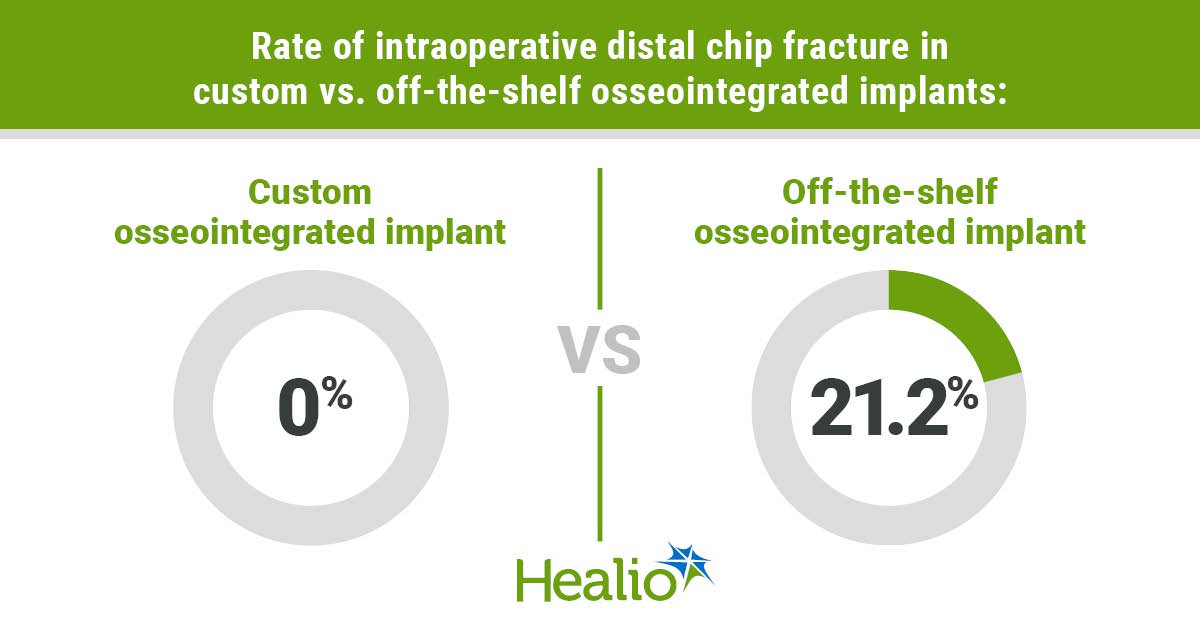
“The biggest difference we saw was, intraoperatively, the custom implants had a much lower rate — 0% — when we looked at our initial cohort of fracturing the bone while putting in the implant,” Reif said. “That makes sense because the implants have been custom fit to that bone, so it tends to go in nicely and fit perfectly.”
In comparison, results showed the historical control group had a 21.2% rate of intraoperative distal chip fracture. Researchers found all patients progressed to full weight-bearing without loosening, and there were no implant failures, deep infections or unplanned surgeries at an average follow-up of 6 months. Patients with a custom osseointegrated implant had statistically significant improvements in patient-reported outcome measures, according to the abstract.
“This is something that we want to continue to evaluate because we know we are going to continue to be in these circumstances where we have oddly shaped bones that we would like to do osseointegration on, and having that option to have a custom fit implant is going to be nice, especially if they function ultimately in the same way as the other implants,” Reif said.
For more information:
Taylor J. Reif, MD, wishes to be contacted through mediarelations@hss.edu.
Sources/Disclosures
Source:
Rozbruch S, et al. ePoster 468. Presented at: American Academy of Orthopaedic Surgeons Annual Meeting; March 2-6, 2026; New Orleans.
Disclosures:
Reif reports no relevant financial disclosures.

Ask a clinical question and tap into Healio AI’s knowledge base.
- PubMed, enrolling/recruiting trials, guidelines
- Clinical Guidance, Healio CME, FDA news
- Healio’s exclusive daily news coverage of clinical data
<










Leave a Reply