
April 23, 2026
3 min read

Key takeaways:
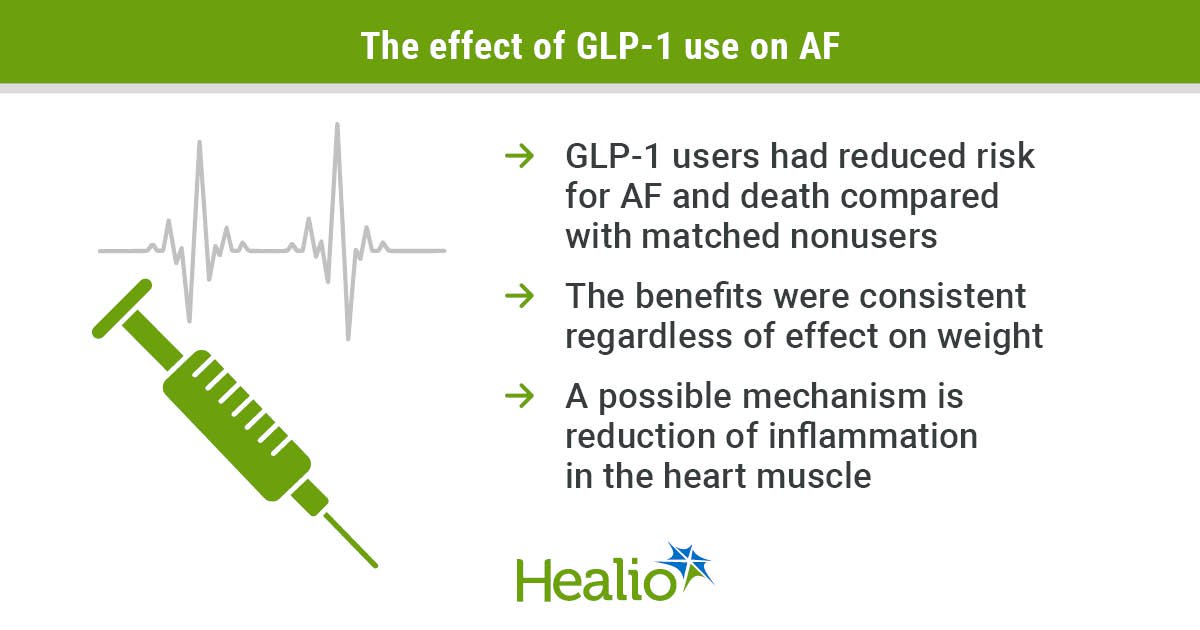
- Compared with nonusers, people taking a GLP-1 had reduced risk for atrial fibrillation and death.
- The relationship persisted regardless of the effect on weight.
People taking GLP-1s had reduced risk for atrial fibrillation, regardless of whether they lost weight or how much they lost, according to findings presented at Heart Rhythm 2026.
“We were prompted to undertake this study by some encouraging data that … GLP-1 receptor agonists seem to have a favorable effect on reducing the incidence of atrial fibrillation, particularly in patients with metabolic risk factors,” Kenneth C. Bilchick, MD, MS, professor of cardiovascular medicine at the University of Virginia School of Medicine, who presented the findings, told Healio. “I think the results were expected, but they were even better than we thought they would be.”

Data derived from Bilchick KC, et al. Do GLP1 agonists have a role in the treatment of atrial fibrillation? Presented at: Heart Rhythm 2026; April 23-26, 2026; Chicago.
Bilchick and colleagues conducted a retrospective, single-center study of 13,034 patients without AF at baseline who initiated GLP-1 use between January 2020 and May 2024 (mean age, 55 years; 67% women; mean baseline BMI, 35.7 kg/m2). Those patients were matched via propensity scoring to the same number of controls who did not initiate a GLP-1 and did not have AF at baseline. Participants in the GLP-1 group were stratified by change in weight (weight loss of 10% or more, weight loss of less than 10% or weight gain).
Survival was higher among GLP-1 users compared with nonusers (HR = 0.35; 95% CI, 0.3-0.4; P < .001), and the benefit in the GLP-1 group was consistent across weight group and individual GLP-1 medications (P < .001 for all), according to the researchers.
After accounting for the competing risk for death, Bilchick and colleagues determined that GLP-1 use was linked to reduced risk for incident AF (HR = 0.75; 95% CI, 0.64-0.88; P < .001), and that the relationship was true regardless of weight-change category (weight loss of 10% or more, HR = 0.42; 95% CI, 0.25-0.69; P < .001; weight loss of less than 10%, HR = 0.78; 95% CI, 0.63-0.97; P = .028; weight gain, HR = 0.71; 95% CI, 0.54-0.93; P = .014).
“The effect of these medications on reducing atrial fibrillation did not seem to be dependent on weight loss,” Bilchick told Healio. “Even if you gained weight, you still had a reduction in the risk of atrial fibrillation. This is really one of the remarkable findings.”
Among specific GLP-1s, the strongest reduction in risk for AF occurred with semaglutide (Ozempic/Wegovy, Novo Nordisk; HR = 0.67; 95% CI, 0.53-0.84, P < .001), but reduced risk for AF also occurred in patients taking liraglutide (Victoza/Saxenda, Novo Nordisk), dulaglutide (Trulicity, Eli Lilly) and tirzepatide (Mounjaro/Zepbound, Eli Lilly), the researchers found.
“I think [the effect of GLP-1s on AF] is related to inflammation and reduction in inflammation and improvement in metabolic factors like glucose metabolism,” Bilchick told Healio. “With respect to the inflammation, there’s been a really interesting observation that there is fat around the heart that causes inflammation in the heart muscle and causes arrhythmias like atrial fibrillation. There are also data that support that these medications actually reduce inflammation systemically and also in this fat that is around the heart, changing the fatty acid composition, changing the way immune cells such as T cells and B cells work.”
The results could have implications for the prevention and treatment of AF, he said.
“What catheter ablation does not do is it doesn’t modify someone’s risk for atrial fibrillation in terms of inflammation and metabolism,” Bilchick told Healio. “And so there is a potential to change practice by having more patients, particularly with risk factors, be on these medications to treat … the systemic inflammation and metabolic abnormalities. And then in that way, the effects of these medications can be synergistic with the procedural interventions we have to treat atrial fibrillation, and that could lead to even more successful results and greater freedom from atrial fibrillation.”
For more information:
Kenneth C. Bilchick, MD, MS, can be reached at cardiology@healio.com.
Sources/Disclosures
Source:
Bilchick KC, et al. Do GLP1 agonists have a role in the treatment of atrial fibrillation? Presented at: Heart Rhythm 2026; April 23-26, 2026; Chicago.
Disclosures:
Bilchick reports no relevant financial disclosures.

Ask a clinical question and tap into Healio AI’s knowledge base.
- PubMed, enrolling/recruiting trials, guidelines
- Clinical Guidance, Healio CME, FDA news
- Healio’s exclusive daily news coverage of clinical data
<














Leave a Reply