
February 04, 2026
2 min read
Key takeaways:
- Cutaneous adverse events with GLP-1 receptor agonists are rare but can include rash and pruritus.
- Clinicians could consider weekly vs. daily GLP-1 formulations for sensitive patients.
An FDA database analysis shows that reported adverse skin events after GLP-1 receptor agonist use are rare but can include rash and pruritus, highlighting a need for further research, according to a study.
“GLP-1 receptor agonists are being prescribed more than ever, both for diabetes and weight management, and dermatologists are increasingly seeing patients who are taking these medications and in some cases prescribing them themselves,” Marisa Fat, BS, a medical student at the Anne Burnett Marion School of Medicine at Texas Christian University, told Healio. “Despite how common GLP-1 use has become, there has been relatively little dermatology-focused research on their cutaneous side effects, with most of the existing literature limited to individual case reports.”

Data derived from Fat MN, et al. J Drugs in Dermatology. 2026;doi:10.36849/JDD.9448.
For the cross-sectional analysis, Fat and colleagues compared cutaneous adverse events reported in the FDA Adverse Event Reporting System (FAERS) for the GLP-1 receptor agonists semaglutide (Ozempic/ Wegovy, Novo Nordisk), liraglutide, exenatide and dulaglutide (Trulicity, Eli Lilly) with cutaneous adverse event reports for the dipeptidyl peptidase-4 (DPP-IV) inhibitors sitagliptin, saxagliptin, linagliptin and alogliptin. The mean age for cutaneous cases was 60 years, according to the database, a greater proportion of which were women.
A total of 129,330 adverse events were reported for GLP-1 receptor agonists, and of these, 5.75% were cutaneous. Once weekly dulaglutide had the most total adverse events, but the lowest percentage of cutaneous adverse events at 3.75%, which researchers noted could be due to greater prescription rates rather than increased dermatologic risk. Semaglutide had the highest rate of cutaneous cases at 8.16%, followed by liraglutide at 7.66% and exenatide at 5.74%.
“Dulaglutide is commonly prescribed due to its once-weekly injection compared to its more frequent counterparts, such as liraglutide and exenatide, possibly reducing localized or injection-related reactions,” the researchers wrote. “This highlights the need to evaluate not only the quality of adverse events reported, but also the proportion of cutaneous adverse events compared to all adverse events.”
Most commonly reported were cases of rash and pruritus, followed by alopecia and hyperhidrosis. Some cases particularly stood out to the researchers, according to Fat.
“Hair loss isn’t commonly discussed as a potential side effect of GLP-1 therapy, yet it came up repeatedly in the database,” Fat told Healio. “We also saw more reports of hypersensitivity-type reactions, such as urticaria, than we anticipated, which raises interesting questions about possible immune-related mechanisms.”
The researchers also calculated the proportional reporting ratio (PRR) of adverse event rates between GLP-1 receptor agonist and DPP-IV users. Results showed those receiving GLP-1 receptor agonists reported fewer skin-related adverse events compared with those receiving DPP-IVs (PRR = 0.27; 95% CI, 0.257-0.284).
Because FAERS is a passive reporting database, Fat emphasized that these findings should be used to signal awareness and not establish causation.
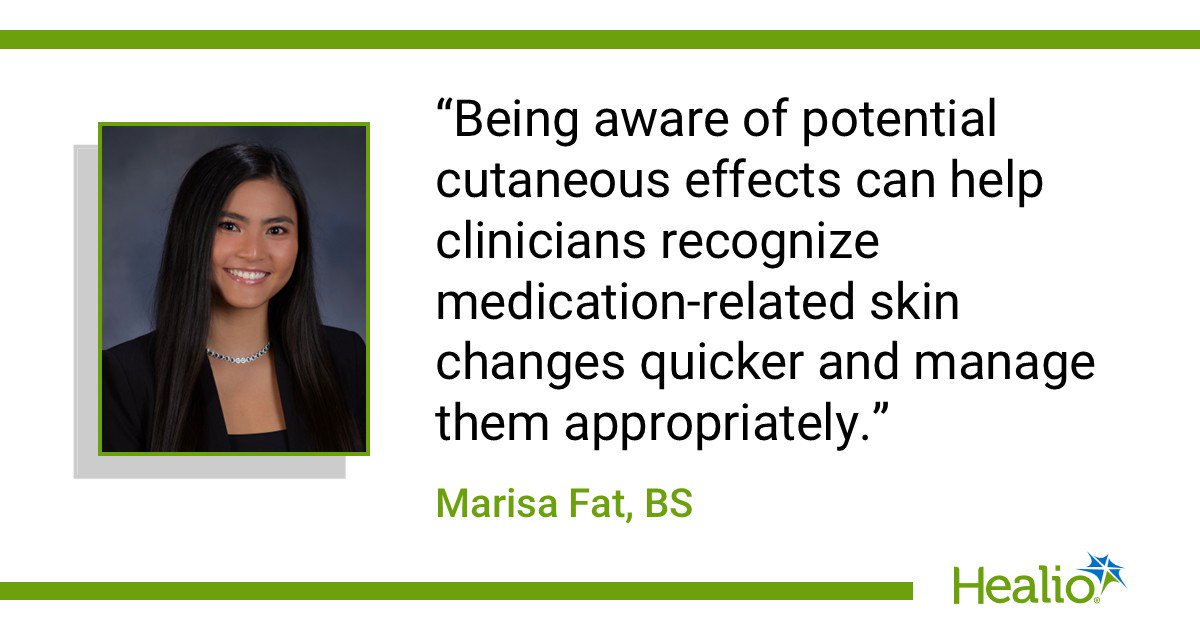
“Overall, our findings support that GLP-1 receptor agonists remain safe and effective medications; however, they also show that skin-related adverse events do occur and may be underrecognized in clinical practice,” Fat told Healio. “The reactions reported ranged from relatively mild findings to less common but more significant skin reactions. The takeaway isn’t that these medications should be avoided, but rather that being aware of potential cutaneous effects can help clinicians recognize medication-related skin changes quicker and manage them appropriately.”
For more information:
Marisa Fat, BS, can be reached at marisa.fat@tcu.edu.

Ask a clinical question and tap into Healio AI’s knowledge base.
- PubMed, enrolling/recruiting trials, guidelines
- Clinical Guidance, Healio CME, FDA news
- Healio’s exclusive daily news coverage of clinical data
<















Leave a Reply