
April 28, 2026
3 min read

When it comes to myopia, most parents are aware that it is not just about getting a new pair of glasses every year. There are things we can do to help with myopia progression.
When I have a conversation with these parents, I usually start with what is globally beneficial for the child. We know that outdoor time is protective against the prescription increasing year after year at a faster rate than is considered normal. I talk about trying to hit 90 minutes of outdoor time per day. It helps that I am a mom in the community, and we can talk about how much time children are getting with recess and how to target this strategy. This is something that you want to do even in the wintertime when the weather is cold.

When it is not possible to get outside, it is still nice to think about distance-focused activities. Are the children indoor soccer players? Can they go to an indoor gymnastics place or maybe a trampoline park?
We are trying to avoid endless amounts of near work, which in general is the problem. However, many children are avid readers. I was an avid reader. I am also a myope. However, reading, doing homework or performing other fine motor tasks has a tangible benefit. A child who is reading or building Legos or is an artist is expanding their mind, so I don’t instantly say those are of no value. However, they should take breaks with things like reading every 20 to 30 minutes. I want someone to interrupt and have that child break that near focus and concentration. Ask them what they are reading or what they are doing. They should also be reading in a well-lit environment.
When it comes to screens, I don’t think we can necessarily know if a near-held tablet or phone is inherently worse than a book. However, I think we can all agree that a digital device is able to endlessly provide video content that is far more addictive than a book. That makes it harder to put down, which is what worries me. While you cannot exactly project a book onto a TV, content on a phone could go on a tablet and be held farther away; even better, it could go on a TV, and the child could sit 20 feet away.
If lifestyle modifications fail, my go-to is to use low-dose atropine. I prescribe 0.05% with the caveat that some children experience near vision blurring and dilation. There are some case reports of it inducing eye misalignment, but the vast majority of patients tolerate it well. However, it does require diligent compliance, and that can be challenging for some families.
There is also a little bit of unknown when it comes to stopping low-dose atropine, with the possibility of a rebound effect. That means for many families, when we start atropine, we are going to be continuing it. So, I talk in terms of years. This is something that will follow children into high school, and even at that point, there may be rebounds.
The recent FDA authorization of the Stellest (Essilor) lens has given me a great option for people who may not be the best candidates for a nightly eye drop, who may be progressing on that dilating drop, or who wear glasses and want to do something proactive. I let families know that these lenses are more expensive than regular glasses, so they are not necessarily accessible to everyone. The lens was authorized by the FDA in September 2025, so we are starting to get our first rounds of 6-month follow-ups.
Finally, there is the MiSight (CooperVision) contact lens. This is good for children who are ready to make the transition to contact lenses, but I don’t push anyone into a MiSight lens before I would naturally introduce the idea of a contact lens.
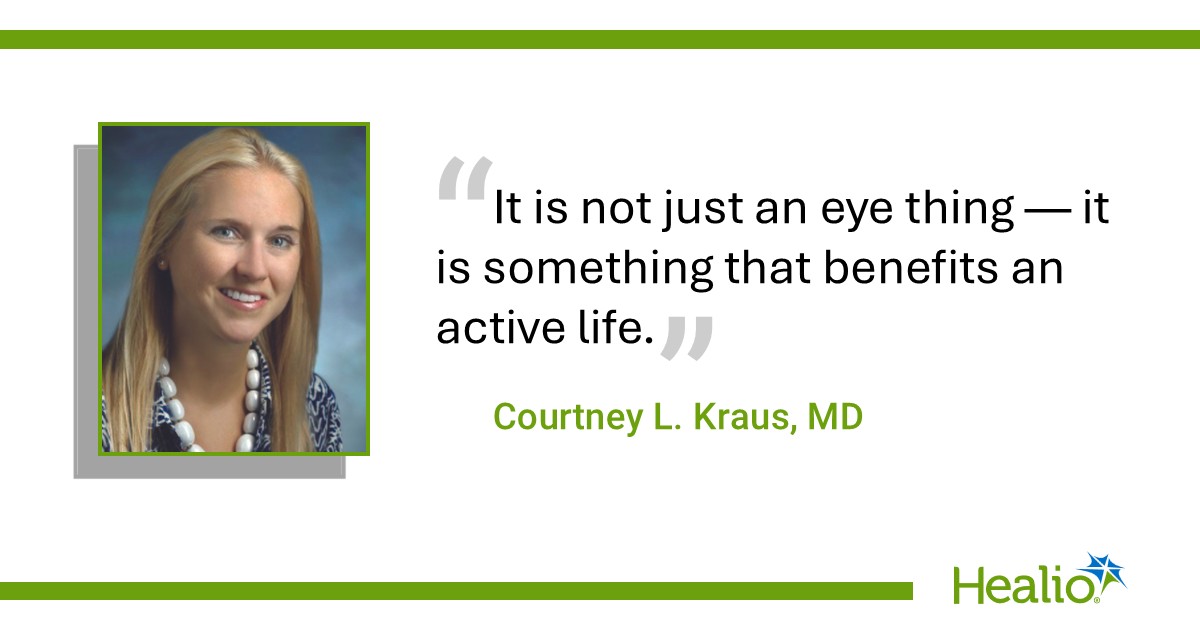
It does not make me the most popular person in the room, but I think screen time does deserve limits. This is something that benefits the whole child. It is not just an eye thing — it is something that benefits an active life.
For more information:
Courtney L. Kraus, MD, a Healio | OSN Pediatrics/Strabismus Board Member, can be reached at ckraus6@jhmi.edu.
Sources/Disclosures
Source:
Expert Submission
Disclosures:
Kraus reports receiving support from the Knights Templar Eye Foundation.

Ask a clinical question and tap into Healio AI’s knowledge base.
- PubMed, enrolling/recruiting trials, guidelines
- Clinical Guidance, Healio CME, FDA news
- Healio’s exclusive daily news coverage of clinical data
<









Leave a Reply