
April 19, 2026
3 min read
Key takeaways:
- Patients lived within 3 miles of groundwater sample sites.
- Water in carbonate aquifers is most vulnerable to contamination.
- Glacial aquifers provide natural filtration for surface contaminants.
CHICAGO — Odds for developing Parkinson’s disease increased with newer groundwater and with carbonate aquifers, according to a poster presented at the American Academy of Neurology Annual Meeting.
“Our previous studies have focused a lot on air pollution, but we know from prior research that contaminated drinking water can also impact health,” Brittany Krzyzanowski, PhD, who conducted the study at Barrow Neurological Institute, told Healio.

Data derived from Krzyzanowski B, et al. Younger groundwater associated with greater risk of Parkinson’s disease in nationwide Medicare study: Implications of aquifer type. Presented at: American Academy of Neurology Annual Meeting; April 18-22, 2026; Chicago.
“There’s a wealth of underused data on drinking water sources, like aquifer type and groundwater characteristics, so we took the opportunity to explore how these factors might be linked to Parkinson’s disease,” said Kryzyzanowski, who is now with the Atria Research Institute.

Brittany Krzyzanowski
Krzyzanowski and colleagues conducted a population-based, case-control study comprised of 12,370 patients with PD and 1,224,174 matched controls, all aged 65 years and older. All patients had Medicare and lived within 3 miles of 1,279 sample sites for 21 principal aquifers.
The researchers noted that most aquifers in the United States are carbonate aquifers, with water stored in the fractures and channels of their mostly limestone composition. Rapid flow through these fractures often leads to greater vulnerability to contamination.
Glacial aquifers formed more than 12,000 years ago with glacial movement, andaccording to the study, previous research has shown that water is stored in the gaps in their sand and gravel composition, which promotes more diffuse flow and natural filtration.
Consisting of rain that has fallen over the past 70 to 75 years, newer groundwater has more pollutant exposure, the researchers said. Since older groundwater usually is deeper and better protected, it generally is less contaminated.
The Midwest, South and Florida primarily get their water from carbonate aquifers, while the Upper Midwest and Northeast mostly get their water from glacial aquifers, according to the poster.
“Groundwater can contain a range of contaminants, including pesticides, heavy metals, and industrial solvents,” Krzyzanowski said. “Many of these exposures have already been linked to Parkinson’s disease in human studies and are known to affect neurological health.”
Carbonate aquifers included 3,463 patients with PD and 300,264 controls. Glacial aquifers included 515 patients with PD and 62,917 controls. Other types of aquifers included 8,392 patients with PD and 860,993 controls.
“We found that characteristics of groundwater in your town or city, such as the type of aquifer it comes from and the age of the water, are associated with differences in Parkinson’s disease risk,” Krzyzanowski said.
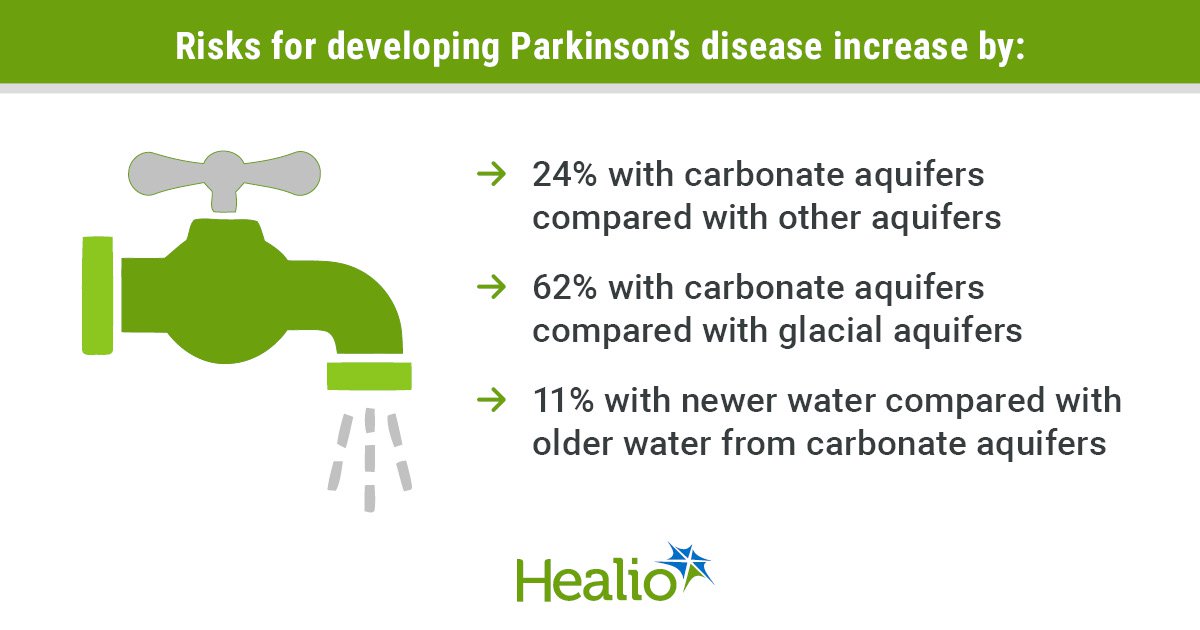
Patients with drinking water drawn from carbonate aquifers were 24% more likely to develop PD than patients whose water came from other aquifers (95% CI, 1.18-1.3). Specifically, carbonate aquifers were associated with a 62% greater risk for PD than glacial aquifers (95% CI, 1.45-1.81).
However, the researchers said, older groundwater from carbonate aquifers appeared to have a protective effect with a decrease of approximately 6.5% in odds for PD with each one-standard-deviation increase in the age of the groundwater.
When groundwater in carbonate aquifers was from the past 75 years, risks for PD increased by 11% compared with groundwater from more than 12,000 years ago (95% CI, 1.02-1.2), according to a press release related to the study.
“Overall, these findings help clarify how environmental exposures in drinking water could play a role in the development of Parkinson’s disease,” Krzyzanowski said.
Krzyzanowski and colleagues attributed these differences to clear contrasts between older and newer water in carbonate aquifers, with confining layers protecting older groundwater from surface contamination, compared with newly recharged groundwater.
Older and newer groundwater may be more difficult to distinguish in glacial aquifers, the researchers said, which slow groundwater movement and filter contaminants naturally, leading to smaller differences in contamination.
“This matters because it suggests that the groundwater conditions in your area may influence risk, potentially depending on how well the underlying geology protects against surface contaminants,” Krzyzanowski said.
Although further studies are necessary, the researchers said, these findings indicate that groundwater age and sources could impact neurological health, informing potential community assessment to reduce these risks.
“Clinicians and patients can use this information to better understand where their drinking water comes from and how local groundwater conditions might influence exposure to contaminants,” Krzyzanowski said. “This awareness can help guide conversations about environmental risk and potential prevention strategies.”
The researchers already have gathered data on specific contaminants in the groundwater they tested.
“Our next step is to identify which of these contaminants may be driving the associations we observed,” Krzyzanowski told Healio.
For more information:
Brittany Krzyzanowski, PhD, can be reached at neurology@healio.com.
Sources/Disclosures
Source:
Krzyzanowski B, et al. Younger groundwater associated with greater risk of Parkinson’s disease in nationwide Medicare study: Implications of aquifer type. Presented at: American Academy of Neurology Annual Meeting; April 18-22, 2026; Chicago.
Reference:
Disclosures:
Krzyzanowski reports no relevant financial disclosures. Please see the study for the other authors’ relevant financial disclosures. The study was supported by the AAN Clinical Research Training Scholarship, American Brain Foundation and the Parkinson’s Foundation.

Ask a clinical question and tap into Healio AI’s knowledge base.
- PubMed, enrolling/recruiting trials, guidelines
- Clinical Guidance, Healio CME, FDA news
- Healio’s exclusive daily news coverage of clinical data
<








Leave a Reply