

Key takeaways:
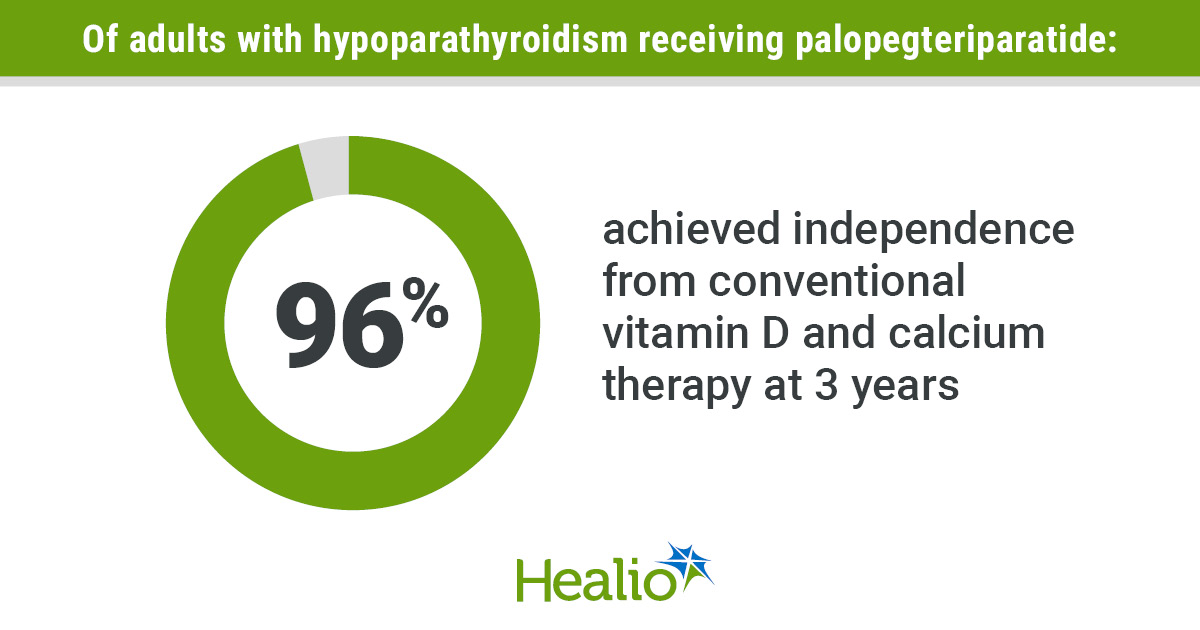
- At 3 years, 96% of adults receiving palopegteriparatide were able to stop receiving conventional therapy.
- Mean 24-hour urine calcium excretion declined to 162 mg per day at 3 years.
LAS VEGAS — Most adults with hypoparathyroidism who received long-term therapy with a daily parathyroid hormone prodrug achieved normal serum calcium levels independent of conventional therapy at 3 years, according to a speaker.
As Healio previously reported from the phase 3 PaTHway open-label extension, 81% of adults receiving palopegteriparatide (Yorvipath, Ascendis Pharma) had normal serum calcium levels at 1 year without conventional therapy. The therapy was approved by the FDA in August 2024 for the treatment of hypoparathyroidism.

Data were derived from Kohlmeier L, et al. Palopegteriparatide treatment in adults with hypoparathyroidism: Efficacy and safety results through year 3 of the phase 3 PaTHway trial. Presented at: American Association of Clinical Endocrinology Annual Scientific and Clinical Conference; April 22-24, 2026; Las Vegas.
In new data from PaTHway presented at the American Association of Clinical Endocrinology Annual Scientific and Clinical Conference, researchers found the proportion of participants who reached normal serum calcium levels independent of conventional therapy increased further to 84% at 3 years.

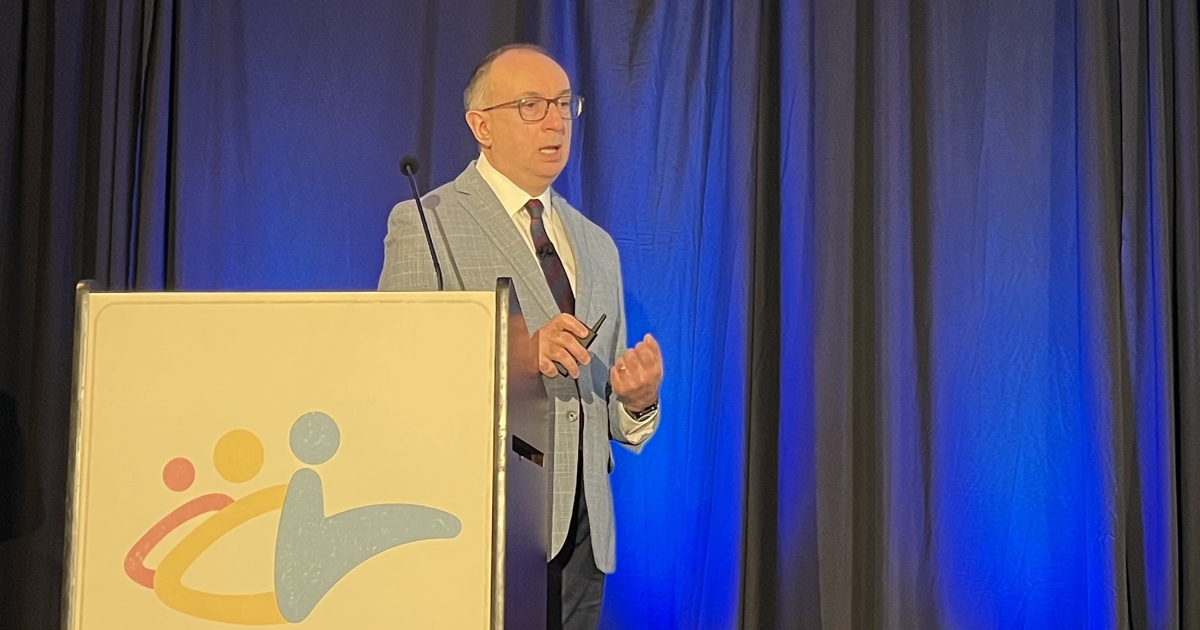
Lynn Kohlmeier
“Treatment with palopegteriparatide [parathyroid hormone] replacement in adults with hyperparathyroidism showed sustained efficacy and safety through 3 years, week 156 in the PaTHway trial,” Lynn Kohlmeier, MD, director of endocrinology at Spokane Osteoporosis and Endocrinology – Arthritis Northwest Research, said during a presentation. “There was a high rate of achievement, 96% independent from conventional therapy at year 3, 100% off active [vitamin] D.”
In the PaTHway trial, 82 adults with hypoparathyroidism receiving conventional therapy of active vitamin D and calcium were randomly assigned 3:1 to once-daily palopegteriparatide 18 µg or placebo for 26 weeks. At 26 weeks, all participants began receiving palopegteriparatide as part of the open-label extension. Efficacy endpoints included independence from active vitamin D and calcium therapy, and proportion of adults with normal serum calcium levels.
Conventional therapy independence
Of 73 adults still enrolled in the extension trial at 3 years, 84% had normal albumin-adjusted serum calcium independent of conventional therapy. Normal albumin-adjusted serum calcium levels were achieved by 88% of the study group, and 96% were able to stop all conventional therapy. All 73 adults stopped receiving active vitamin D at 3 years, and 96% were no longer receiving calcium therapy.
Extension trial participants maintained serum calcium and serum phosphate levels in the normal range throughout the extension trial.
Kidney benefits
From baseline to 3 years, estimated glomerular filtration rate improved by 8.76 mL/min/1.73 m2 at 3 years for the entire study group and by 13.98 mL/min/1.73 m2 for adults with a baseline eGFR of less than 60 mL/min/1.73 m2. Of the extension trial participants, 59% had an improvement in eGFR of at least 5 mL/min/1.73 m2, and 61% of those with a baseline eGFR of less than 60 mL/min/1.73 m2 had an increase in eGFR of 10 mL/min/1.73 m2 or more.
Kohlmeier said there are several possible reasons why there was such an improvement in eGFR.
“Was it [parathyroid hormone’s] ability to hold onto calcium in the kidney, its vasodilatory effect in the kidney, [or] the combination of its benefits at the glomerulus,” Kohlmeier said. “These are all important theories as to why [parathyroid hormone] replacement has such a good effect on the kidney.”
Mean 24-hour urine calcium excretion normalized to 195 mg per day at 1 year and continued to drop to 167 mg per day at 2 years and 162 mg per day at 3 years. Kohlmeier said the urine calcium excretion decline continued after participants stopped conventional therapy, and the mean amount seen at 3 years in the trial is “almost unseen” in people with hyperparathyroidism.
“They can come off their thiazide,” Kohlmeier said. “Thay can increase their salt intake if they’ve been afraid of a kidney stone.”
Improvements in self-reported hypoparathyroidism-related symptoms and health-related quality of life were observed with palopegteriparatide and maintained at 3 years.
Safety data
Among all PaTHway participants, 56.3% experienced an adverse event related to palopegteriparatide. Serious adverse events related to the therapy occurred in 2.5% of adults. The most common treatment-emergent adverse events were injection site reaction, hypercalcemia, nausea, headache, hypocalcemia and postural orthostatic tachycardia syndrome. There was one death due to fatal cardiac arrest during the trial, deemed unrelated to palopegteriparatide.
“We can confidently say that palopegteriparatide in adults with chronic hyperparathyroidism was well tolerated, and there were no new safety signals identified,” Kohlmeier said.
Sources/Disclosures
Source:
Kohlmeier L, et al. Palopegteriparatide treatment in adults with hypoparathyroidism: Efficacy and safety results through year 3 of the phase 3 PaTHway trial. Presented at: American Association of Clinical Endocrinology Annual Scientific and Clinical Conference; April 22-24, 2026; Las Vegas.
Disclosures:
Kohlmeier reports receiving research funding from Alexion/Amolyt and Ascendis Pharma, speaking for Amgen and Ascendis Pharma and advising or consulting for Alexion and Ascendis Pharma. The trial was funded by Ascendis Pharma.

Ask a clinical question and tap into Healio AI’s knowledge base.
- PubMed, enrolling/recruiting trials, guidelines
- Clinical Guidance, Healio CME, FDA news
- Healio’s exclusive daily news coverage of clinical data
<











Leave a Reply