
January 17, 2026
2 min read

Key takeaways:
- In patients with ptosis, a large pupil may be indicative of third nerve palsy.
- Levator function measurement can help determine the best treatment approach.
WAIKOLOA, Hawaii — Examining the pupil and performing motility checks are key for effectively managing patients with ptosis and catching underlying conditions, according to a speaker at Hawaiian Eye 2026.
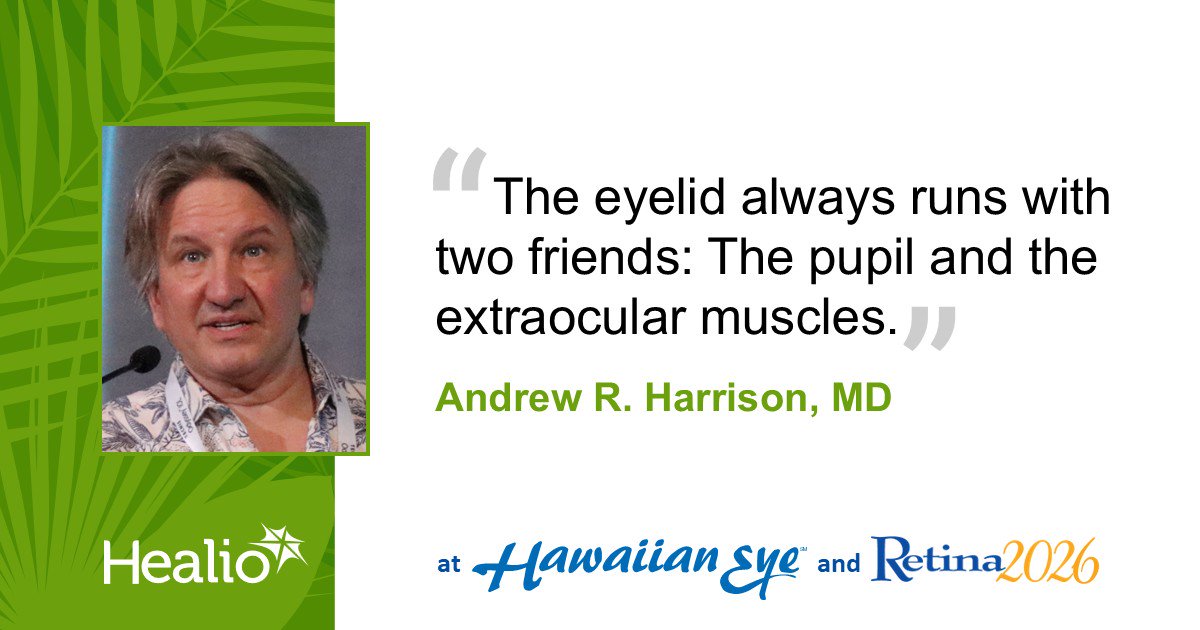
“When you think about the eyelid, and ptosis in general, the eyelid always runs with two friends: The pupil and the extraocular muscles,” Andrew R. Harrison, MD, said. “When you see a patient with an eyelid problem, a ptosis, you need to think about these two as well.”

Image: Eamon N. Dreisbach | Healio
In patients with ptosis, a large pupil may be a sign of third nerve palsy, Harrison said. These patients should immediately be given an MRI and an MRA to prevent an enlarging aneurysm. Additionally, a small pupil may be a sign of Horner’s syndrome, according to Harrison.
Another indicator of third nerve palsy among patients with ptosis is abnormal motility in patients with both asymmetric and symmetric pupils.
“They could have myasthenia,” Harrison said. “Do the test where you have them hold their eyelid up and see if it comes down over time or do the ice pack test. They could have some other neuromuscular disorder like chronic progressive external ophthalmoplegia or muscular dystrophy. They could have thyroid eye disease. If they have asymmetric pupils and abnormal motility … you need to think about a third nerve palsy, because those patients are at risk.”
According to Harrison, levator function is the most important measurement to take for a patient with ptosis.
“Brace the brow, have the patient look up and down and measure that excursion,” he said. “It’s really the excursion of the eyelid that you’re measuring — you’re not really measuring function, per se, but that’s what we call it — because that’s what we are going to use to determine which kind of surgery to do.”
If the patient has good levator function, which Harrison defined as excursion of 10 mm or greater, he recommends performing Müller’s muscle-conjunctival resection (MMCR) or another form of levator surgery, along with tarsectomy for those with fair (5 mm to 10 mm of excursion) levator function. For patients with poor (< 4 mm of excursion) levator function, he recommended a frontalis sling.
“Either use an autogenous material like silicone or use their frontalis muscle to sling that eyelid up,” he said.
In patients with good levator function, the next step is to perform a phenylephrine test, according to Harrison.
“I think it works fine with 2.5%, and there is less risk of having a heart issue,” he said. “If they have a good response, meaning the eyelid comes up to a normal height, you can do an MMCR procedure. If they don’t, you probably should do a levator resection.”
Sources/Disclosures
Source:
Harrison A. Let’s lift those lids. Presented at: Hawaiian Eye 2026; Jan. 17-23, 2026; Waikoloa, Hawaii.
Disclosures:
Harrison reports no relevant financial disclosures.

Ask a clinical question and tap into Healio AI’s knowledge base.
- PubMed, enrolling/recruiting trials, guidelines
- Clinical Guidance, Healio CME, FDA news
- Healio’s exclusive daily news coverage of clinical data
<













Leave a Reply