
April 21, 2026
4 min read

Key takeaways:
- Some physicians consider laser refractive surgery as dangerous in eyes with keratoconus.
- But an expert said refractive surgery improves vision and contributes to biomechanical reorganization of the cornea.
In this exclusive interview with Healio, Cosimo Mazzotta, MD, PhD, one of the pioneers of corneal cross-linking, reverses the conventional view of laser refractive surgery as a potentially harmful procedure in eyes with keratoconus.
This topic has divided the field between physicians who view the procedure as dangerous and those who consider it a viable option in select patients. According to Mazzotta, advanced CXL protocols combined with new ray tracing methods of ocular system analysis have made laser refractive surgery a safer, data-driven approach to corneal remodeling. In certain patients with keratoconus, refractive surgery not only improves vision but actively contributes to the biomechanical reorganization of the cornea.

Healio: With the advent of CXL, is keratoconus still considered a contraindication to laser refractive procedures?
Mazzotta: For a long time, laser refractive surgery in individuals with keratoconus was taboo. This view was based on limited knowledge that raised fears, diagnostic tools that offered partial data, and because we did not have the possibility of stabilizing corneal biomechanics to accurately calculate aberrations and generate predictable outcomes. In this context, the advent of CXL, which I personally introduced in Italy in 2004, was a milestone that led to a profound paradigm shift. It made refractive therapeutic surgery for keratoconus clinically feasible because it directly addressed the biomechanical instability of corneas with keratoconus, which was the main barrier to laser interventions. This is why I like to call it “biomechanical surgery.”
The concept of “cross-linking plus” comes from the possibility we were offered to combine biomechanical stabilization and optic regularization or remodeling in the same therapeutic intervention. The development of pachymetry-guided accelerated CXL protocols, including my own “M nomogram,” has radically transformed the way we perform and guide the combined treatment.
Healio: What is available in the current armamentarium to optimize outcomes of refractive surgery?
Mazzotta: We are now aware that a laser procedure guided exclusively by anterior topography can lead to calculation errors and excessive tissue ablation with consequent overcorrection and unpredictable refractive outcomes. Modern ray tracing technology allows for a more complete and accurate reading of the optical system. We don’t rely on the refraction of a single surface but on the overall refractive contribution of all the structures through which the light travels. I showed this in a large cohort of patients with a long follow-up in a study published in Cornea. This approach allows for a truly personalized surgery, minimizing the amount of tissue ablation and the risk for overcorrection and preserving the biomechanical integrity of the cornea. In this evolution, the new nomograms of modulated CXL, such as the M nomogram, played a crucial role, allowing us to tailor the amount and distribution of ultraviolet-A energy based on pachymetry. The accelerated CXL treatment is done in a pulsed light mode, using high-concentration dextran-free riboflavin, enabling us to extend the indication to thinner corneas.
In light of these advances, we can be confident that refractive surgery for keratoconus is now a well-defined, safe, comprehensive and data-driven approach to biomechanical stabilization and advanced optical remodeling of the cornea that is based on precise mathematical formulas and algorithms as well as analysis of the whole visual system.
Healio: What are the specific goals and mechanisms of action for refractive surgery in patients with keratoconus?
Mazzotta: In traditional refractive surgery, we aim to achieve emmetropia in an eye that is affected by lower-order aberrations such as common myopia, regular astigmatism and hyperopia. In keratoconus, the target is different because our aim is optical remodeling of an eye that is affected by higher-order aberrations, which profoundly degrade the quality of vision, transforming them into lower-order aberrations that can be corrected with spectacles or soft contact lenses. Maybe we could name it “eumetropia.”
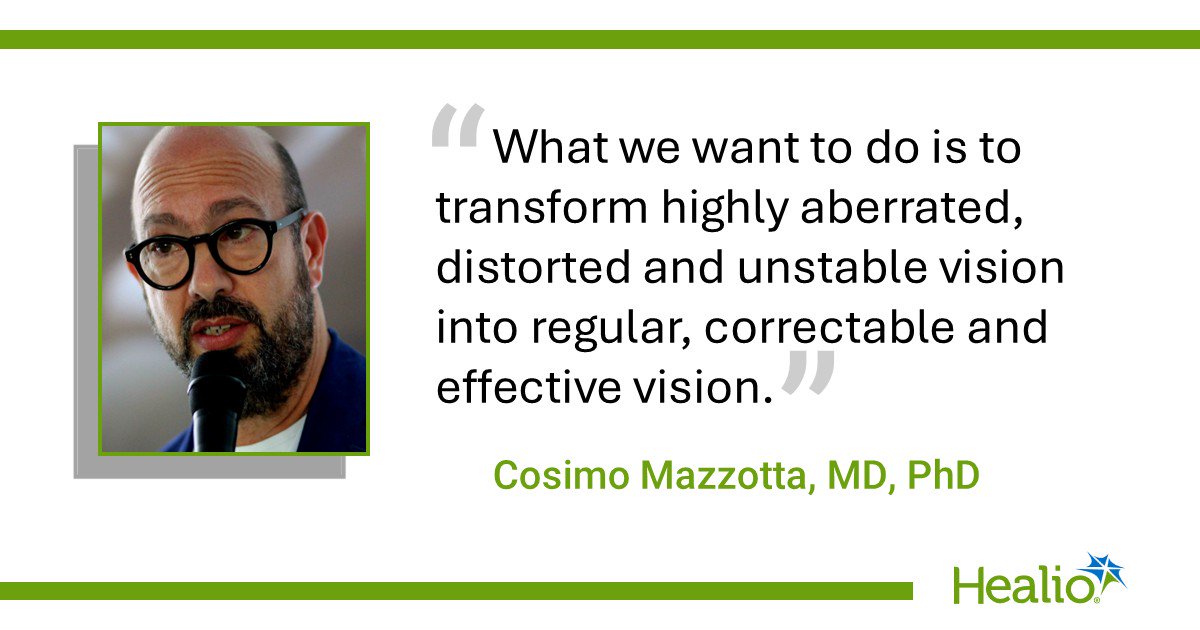
Importantly, refractive surgery for keratoconus does not aim at eliminating or reducing spectacle dependence, which is often the goal of refractive correction in normal eyes. What we want to do is to transform highly aberrated, distorted and unstable vision into regular, correctable and effective vision.
Another important and often underestimated advantage of refractive surgery is that refractive corneal remodeling redistributes biomechanical stress, shifting it from the center, where the thin and weak apex of keratoconus is located, to the structurally stronger periphery. This contributes to increasing the structural and functional stability of the cornea in synergy with the effects of CXL. Refractive surgery therefore not only corrects the refractive error but actively participates in the biomechanical reorganization of the tissue.
Healio: For many years when laser treatment has been used in these eyes, the preferred terminology has been phototherapeutic keratectomy or therapeutic PRK. Does this label still make sense?
Mazzotta: Using the word “therapeutic” has been a kind of reassuring strategy, useful to avoid medicolegal issues and unrealistic expectations. It also served the purpose of differentiating the target of this surgery from that of refractive surgery for common refractive errors. The concept of “therapeutic” surgery in keratoconus remains valid, as these procedures have historically been performed with the primary aim of minimizing tissue consumption, often without predictive aberrometric calculations of the final refractive outcome. In such cases, the visual result may be inherently suboptimal and less predictable.
The advent of ray tracing-guided approaches has significantly reshaped this paradigm. Today, it is possible to achieve the same goal of tissue preservation while simultaneously relying on advanced mathematical modeling to optimize the refractive outcome. This results in a level of predictability and visual quality that is markedly superior, both quantitatively and qualitatively.
The original terminology can create the false impression that we are not touching refraction, while we are indeed influencing it with meticulous calculations and sophisticated, advanced software. Today, using the word “refractive” for this surgery is correct because an intervention is always refractive if it changes the wavefront, reduces optical aberrations, or transforms a less correctable aberration (ie, a higher-order aberration) into a more correctable aberration (ie, a lower-order aberration). This is exactly what we do when we reduce the coma and trefoil in keratoconus — make refraction more regular, more stable and easier to correct with spectacles or soft contact lenses.
Our patients today are well informed. Continuing to conceal the word “refractive” surgery in keratoconus does not protect the patient or safeguard the surgeon, and it is not scientifically correct.
For more information:
Cosimo Mazzotta, MD, PhD, of Kore University of Enna, Italy, can be reached at cosimogiuseppe.mazzotta@unikore.it.
Sources/Disclosures
Source:
Healio Interviews
References:
- Awwad ST, et al. J Refract Surg. 2021;doi:10.3928/1081597X-20201124-01.
- D’Oria F, et al. Surv Ophthalmol. 2024;doi:10.1016/j.survophthal.2023.09.005.
- Kanellopoulos AJ. J Refract Surg. 2019;doi:10.3928/1081597X-20190627-01.
- Mazzotta C, et al. Cornea. 2024;doi:10.1097/ICO.0000000000003380.
- Mazzotta C, et al. Graefes Arch Clin Exp Ophthalmol. 2025;doi:10.1007/s00417-025-06968-6.
- Roberts CJ, et al. Ophthalmol Sci. 2023;doi:10.1016/j.xops.2023.100373.
Disclosures:
Mazzotta reports consulting for FB Vision, Fidia, Glaukos, iVis Technologies and OcuMedicalVISION.

Ask a clinical question and tap into Healio AI’s knowledge base.
- PubMed, enrolling/recruiting trials, guidelines
- Clinical Guidance, Healio CME, FDA news
- Healio’s exclusive daily news coverage of clinical data
<














Leave a Reply