
January 23, 2026
2 min read
Key takeaways:
- Patients who participated in yoga sessions alongside usual care reached withdrawal stabilization 4.4 times faster.
- They also experienced improvements in heart rate variability, anxiety, sleep and pain measures.
Patients with opioid use disorder who received yoga as an adjuvant therapy experienced improved autonomic regulation and accelerated withdrawal recovery, according to a two-arm, randomized clinical trial published in JAMA Psychiatry.
“Over 90% of participants completed at least eight of 10 [yoga] sessions, demonstrating feasibility even during acute withdrawal when cognitive therapies like CBT may be difficult to initiate due to high distress and impaired concentration,” study author Hemant Bhargav, MD, PhD, associate professor at the National Institute of Mental Health and Neurosciences in Bengaluru, India, told Healio.

Between April 30, 2023, and March 31, 2024, Bhargav and colleagues followed 59 patients with mild to moderate withdrawal symptoms from opioid use disorder at the Centre for Addiction Medicine, an inpatient treatment facility in India. The participants were all men aged 18 to 50 years, with an average age of 25.6 years.
In addition to receiving treatment as usual, which included buprenorphine, a group of 30 patients were assigned to 10 guided 45-minute yoga sessions over a period of 14 days. A control group of 29 patients received the standard buprenorphine treatment only.
Assessors blind to group allocation evaluated patients on days 1 and 15, measuring their withdrawal recovery with the Clinical Opiate Withdrawal Scale. Patients who participated in the yoga sessions recovered faster than those in the control group (HR = 4.4; 95% CI, 2.4-8.07), and their median stabilization time was 5 days (95% CI, 4-6 days). The control group stabilized after a median 9 days (95% CI, 7-13 days).
“Mediation analysis confirmed that increases in parasympathetic activity accounted for 23% of the treatment effect of yoga, suggesting this is a neurobiologically informed intervention addressing core regulatory processes beyond symptom management,” Bhargav said.
The yoga group also experienced improved autonomic regulation, seen through improved heart rate variability (P < .001), as well as reduced anxiety measured with the Hamilton Anxiety Rating Scale (P < .001), sleep latency (P= .008) and pain rated by the Visual Analog Scale (P = .004).
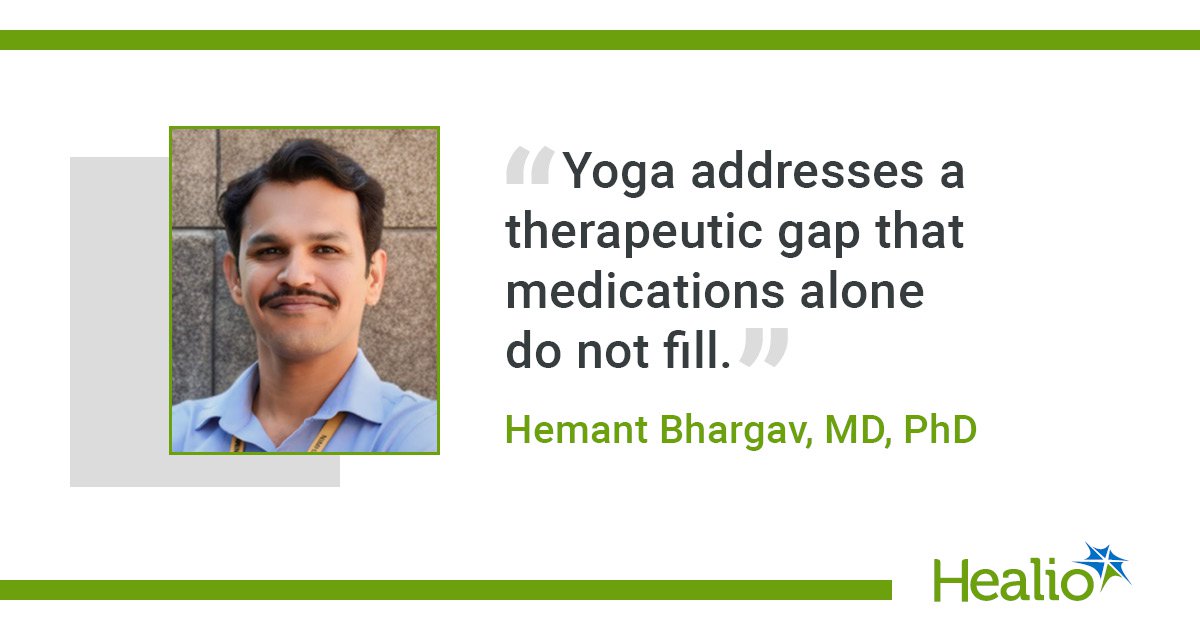
“Yoga addresses a therapeutic gap that medications alone do not fill,” Bhargav said. “By incorporating mindfulness in asanas, slowing breathing and relaxation techniques, yoga directly activates the parasympathetic nervous system and helps the body shift out of constant ‘stress mode’ into a state that supports healing.”
The researchers noted several study limitations, including the short intervention duration and limited generalizability due to the single-center design and all-male sample.
According to Bhargav, these limitations underscore the need for further research exploring the impact of yoga on opioid withdrawal in larger, diverse populations. He also highlighted the need to evaluate yoga’s impact on withdrawal recovery in fentanyl-dependent populations, as the sample population largely consisted of tapentadol-dependent patients.
Bhargav said that integrating yoga into inpatient and residential treatment programs is feasible.
“Sessions can be conducted in yoga halls or at bedside to accommodate individual needs, making it adaptable to various clinical environments,” he told Healio. “The potential economic benefits of shorter stabilization times (5 vs. 9 days) could make this attractive to healthcare systems and support a case for including yoga-based interventions under insurance coverage.”
For more information:
Hemant Bhargav, MD, PhD, can be reached at drbhargav.nimhans@gmail.com.

Ask a clinical question and tap into Healio AI’s knowledge base.
- PubMed, enrolling/recruiting trials, guidelines
- Clinical Guidance, Healio CME, FDA news
- Healio’s exclusive daily news coverage of clinical data
<













Leave a Reply