
January 26, 2026
3 min read

Key takeaways:
- Adults assigned 15 mg VK2735 lost 14.7% of their body weight at 13 weeks.
- The most common adverse events were nausea, constipation and vomiting.
- The drug will be assessed in a pair of phase 3 trials.
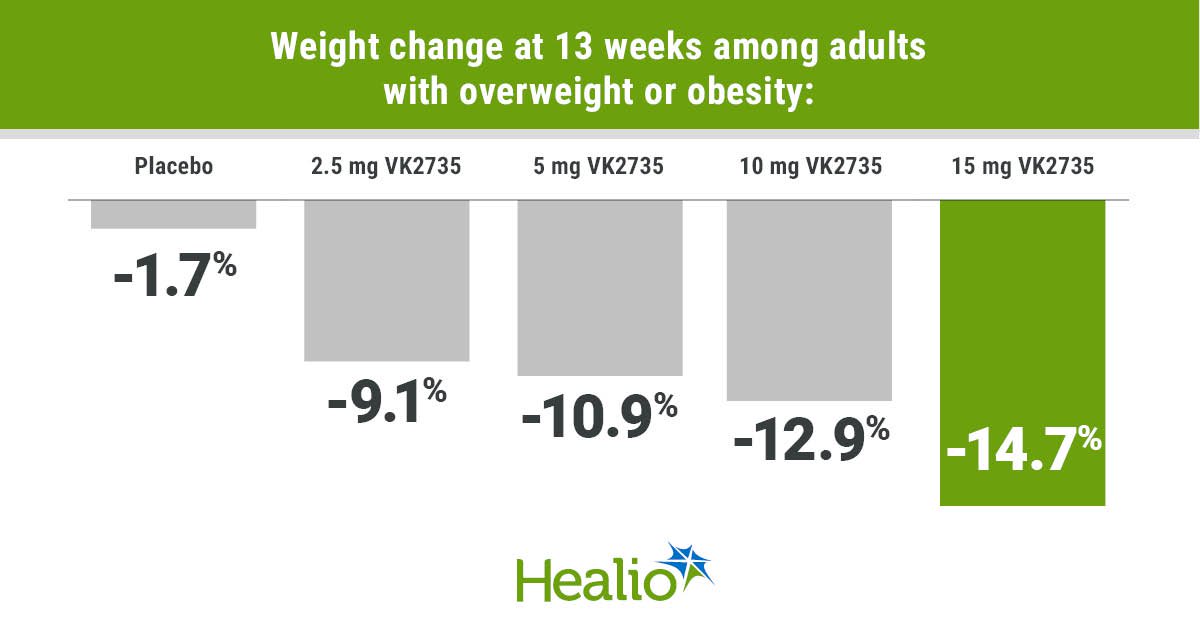
A once-weekly injectable glucose-dependent insulinotropic polypeptide/GLP-1 dual agonist conferred up to 14.7% weight loss at 13 weeks for adults with overweight or obesity, according to findings from the VENTURE trial published in Obesity.
As Healio previously reported, VK2735 (Viking Therapeutics) was associated with weight loss of up to 7.8% at 28 days in a phase 1 study. In new data from a phase 2 dose-ranging trial, researchers found weight loss continued to increase up to 13 weeks for adults with overweight or obesity.

Data were derived from Bays HE, et al. Obesity. 2026;doi:10.1002/oby.70106.
“The efficacy of VK2735 was robust with no indication of a plateau at week 13, suggesting that weight reduction efficacy might continue with longer treatment,” Harold E. Bays, MD, MFOMA, FTOS, FACC, FNLA, FASPC, DABOM, medical director at Louisville Metabolic and Atherosclerosis Research Center, Monroe Biomedical Research and clinical associate professor at University of Louisville School of Medicine, told Healio. “The treatment was also durable, with a subgroup of patients followed for several weeks after dosing stopped, demonstrating persistence with their weight reduction.”

Harold E. Bays
Researchers enrolled 176 adults with obesity or overweight plus one weight-related comorbidity. After a 4-week screening period, participants were randomly assigned, 1:1:1:1:1, to once-weekly 2.5 mg, 5 mg, 10 mg or 15 mg VK2735 or placebo for 13 weeks. A 6-week safety period occurred after the 13-week treatment period. The primary endpoint was change in body weight from baseline to 13 weeks.
Study outcomes
All four VK2735 groups had greater reductions in body weight at 13 weeks than the placebo group. Body weight change from baseline to 13 weeks was 14.7% with 15 mg VK2735, 12.9% with 10 mg VK2735, 10.9% with the 5 mg dose and 9.1% with the 2.5 mg dose vs. 1.7% with placebo.
Bays described the weight loss observed with VK2735 as “promising,” noting that the 14.7% weight loss at 13 weeks with the highest dose compared favorably to data observed with two FDA-approved obesity drugs.
“While this study was not a head-to-head clinical trial comparison, it may be relevant that at week 12 of a weekly dosing regimen, some studies suggest that participants treated with semaglutide (Wegovy, Novo Nordisk) had an approximately 6% decrease from baseline in body weight, whereas those treated with tirzepatide (Zepbound, Eli Lilly) had an approximately 8% decrease from baseline in body weight at the same time period,” Bays said.
Of the participants, 80.8% of the 2.5 mg VK2735 group, 97% of the 5 mg dose group, 93.8% of the 10 mg VK2735 group and 100% of the 15 mg dose group lost 5% or more body weight at 13 weeks. A weight reduction of 15% or more at 13 weeks was achieved by 31.2% of those receiving 10 mg VK2735 and 41.5% of adults receiving the 15 mg dose.
Of adults receiving VK2735 who had prediabetes at baseline, 78% had normal glycemia at 13 weeks, and no participants developed diabetes. There were decreases in multiple lipid markers from baseline to 13 weeks among those receiving the study drug. Adults receiving VK2735 had greater declines in total cholesterol vs. placebo from baseline to 13 weeks, but there were no differences between the study drug and placebo groups for other cardiometabolic markers.
Safety data
During study participation, at least one treatment-emergent adverse event occurred among 81.1% of participants regardless of causality, with 68.6% reporting at least one drug-related adverse event. The most common drug-related adverse events were nausea, constipation and vomiting. Of the study group, 9.1% stopped taking VK2735 due to an adverse event. Severe adverse events occurred among 4.6% of participants, with 10 of 12 severe adverse events deemed unrelated to the drug. The two severe drug-related adverse events were atrial fibrillation and dehydration occurring in one participant assigned VK2735 5 mg, leading to discontinuation.
Most gastrointestinal adverse events were mild or moderate in nature, and no grade 4 or grade 5 gastrointestinal adverse events were observed.
In a press release, Viking Therapeutics announced two phase 3 trials are currently ongoing to assess VK2735. The VANQUISH-1 trial enrolled approximately 4,650 adults with overweight or obesity without diabetes, and the VANQUISH-2 trial is currently enrolling about 1,100 adults with type 2 diabetes plus overweight or obesity. Both trials will assess once-weekly VK2735 over 78 weeks, with participants being randomly assigned to 7.5 mg, 12.5 mg or 17.5 mg of the study drug or placebo.
For more information:
Harold E. Bays, MD, MFOMA, FTOS, FACC, FNLA, FASPC, DABOM, can be reached at hbaysmd@outlook.com.
Sources/Disclosures
Source:
Bays HE, et al. Obesity. 2026;doi:10.1002/oby.70106.
Reference:
Disclosures:
The study was funded by Viking Therapeutics. The authors are either employees of Viking Therapeutics or principal site investigators for the trial whose institutions were remunerated by Viking Therapeutics.

Ask a clinical question and tap into Healio AI’s knowledge base.
- PubMed, enrolling/recruiting trials, guidelines
- Clinical Guidance, Healio CME, FDA news
- Healio’s exclusive daily news coverage of clinical data
<












Leave a Reply