
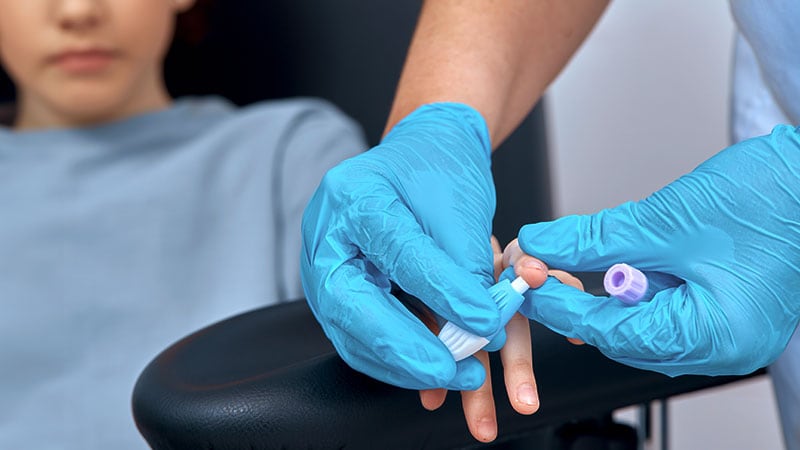
A UK study has shown that routine childhood screening for type 1 diabetes (T1D) is feasible and could prevent thousands of children being diagnosed during a medical emergency.
The first phase of the ELSA study, launched in 2022, involved 17,283 children aged 3-13 years. It was led by the University of Birmingham and co-funded by Diabetes UK and Breakthrough T1D.
Results published in The Lancet Diabetes & Endocrinology showed that finger-prick blood tests for diabetes-related autoantibodies could reliably identify children at risk of developing T1D years before symptoms appear.
Autoantibodies and Future Risk
The risk of developing T1D rises sharply with the number of autoantibodies detected.
Children without autoantibodies are unlikely to develop the condition. Those with one autoantibody have a 15% chance of developing T1D within 10 years. Having two or more autoantibodies indicates that the immune system has already begun attacking pancreatic insulin-producing cells, a stage known as early T1D. These children are almost certain to require insulin therapy in the future.
Among the children screened, at the time of analysis:
- 75 had one autoantibody, indicating increased future risk.
- 160 had two or more autoantibodies but did not yet require insulin, consistent with early-stage T1D.
- Seven had undiagnosed T1D and needed to start insulin immediately.
Experts said the findings could lead to a “step change” in how T1D is diagnosed and managed and could lay the groundwork for a UK-wide childhood screening programme.
A new approach could reduce emergency diagnoses, allow families to prepare, and give children access to immunotherapies that may delay the need for insulin for years, Diabetes UK said.
A new screening programme could prevent children from “crash landing” into a diagnosis, said Parth Narendran, lead researcher and professor of diabetes medicine at the University of Birmingham.
Education, Monitoring, and Early Treatment
T1D affects up to 400,000 people in the UK. More than one quarter of children are not diagnosed until they present with diabetic ketoacidosis.
In the ELSA study, families of children found to have early-stage T1D received tailored education and ongoing support. This was designed to help them recognise symptoms, prepare for insulin treatment, and reduce the risk for emergency admission. Children with a single autoantibody also received ongoing support and monitoring.
Some families were offered teplizumab, the first immunotherapy shown to delay the onset of insulin dependence in early-stage T1D by about 3 years. The drug was licensed by the Medicines and Healthcare products Regulatory Agency last year but is not yet routinely available on the NHS.
Expanding Screening Across the NHS
The second phase of the study, ELSA2, will expand screening to children aged 2-17 years, with a focus on those aged 2-3 years and 14-17 years. It will assess how screening could be scaled across the NHS and evaluate cost-effectiveness.
ELSA2 will also establish early-stage T1D clinics at 20 sites across the UK, supported for 4 years. These clinics will provide clinical and psychological support; education; and a clear pathway from screening to diagnosis, monitoring, and treatment.
“The idea is that they would get regular support and advice on when to test their glucose, what symptoms to watch out for, just so they can start this insulin early and in a timely fashion,” Narendran said. “Once they’re on insulin, they’ll just flow naturally, with the same healthcare team, into the normal type one clinic.”
Dr Elizabeth Robertson, director of research and clinical at Diabetes UK, said families would gain time to prepare, avoid emergency hospital admissions, and access treatments that could delay insulin therapy.
“This is about rewriting the story of type 1 diabetes for thousands of families,” said Rachel Connor, director of research partnerships at Breakthrough T1D. “Instead of a devastating emergency, we can offer time, choices, and hope.”
Rob Hicks is a retired National Health Service doctor. A well-known TV and radio broadcaster, he has written several books and has regularly contributed to national newspapers, magazines, and online publications. He is based in the United Kingdom.
<








Leave a Reply