
April 15, 2026
1 min read
Key takeaways:
- Presenters described how a South Korean hospital ended a 34-month C. auris outbreak in the PICU.
- Surveillance, cleaning and relocating patients were key to ending the outbreak.
CHICAGO — A combination of surveillance, enhanced cleaning and relocating colonized patients was the formula for ending a nearly 3-year-long Candida auris outbreak in a pediatric ICU in South Korea.
In a poster presentation at SHEA Spring, Hye-Jin Ki, RN, BSN, detailed how staff at Yonsei University College of Medicine’s Severance Hospital ended a 34-month C. auris outbreak in the 10-bed PICU.

From January 2023 through June 2025, clinicians identified 28 C. auris isolates from 27 patients in the pediatric ICU, all of which were resistant to fluconazole and amphotericin B.
Most of the isolates (n = 20) were detected in urine, five were detected in blood (including four cases of candidemia) and three were detected through swabs or other sources. Out of the 20 urine isolates, 85% were associated with Foley catheters, and all five blood isolates were associated with central venous catheters.
There were two peaks in incidence density — the first in October 2023 (16.95 per 1,000 patient-days) and the second in June 2025 (13.89 per 1,000 patient-days). During the second peak, hospital staff employed a three-pronged approach to control the outbreak, which involved surveillance, cleaning and source control.
Surveillance efforts included point prevalence surveys, environmental culturing of medical devices and whole genome sequencing of isolates to determine whether the fungus was spreading through different units.
The researchers discovered that medical devices were still contaminated after routine cleaning, so the hospital increased the number of cleaning staff and had them clean three times daily with 5,000 ppm sodium hypochlorite to disinfect devices. The staff were monitored for their compliance with the enhanced cleaning.
Source control efforts involved relocating colonized patients to general wards to decrease patient density in the PICU. The researchers noted that relocating patients did not lead to any secondary transmission outside the PICU.
After implementing increased surveillance and prevention strategies, the hospital spent 5 months with zero cases and declared the C. auris outbreak over in October 2025.
Perspective
Back to Top

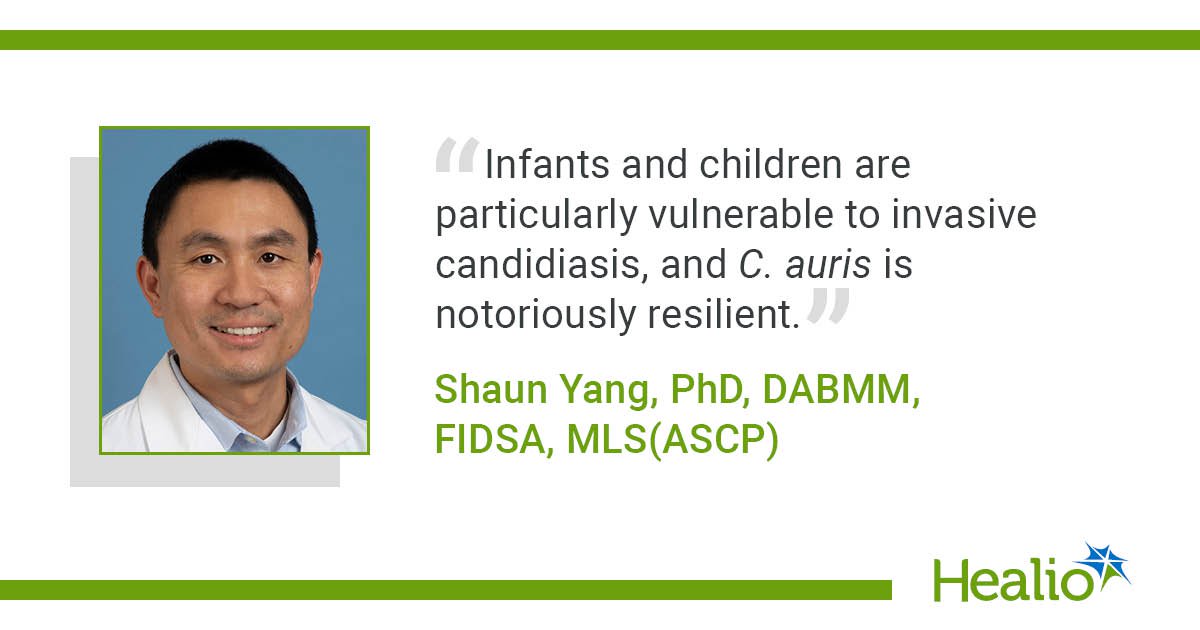
Shaun Yang, PhD, DABMM, FIDSA, MLS(ASCP)
Disclosures: Yang reports no relevant financial disclosures.
Sources/Disclosures
Source:
Ki HJ, et al. Poster 221. Controlling a Candida auris Outbreak in a Pediatric ICU: Impact of Genomic Surveillance, Disinfection, and Unit-Level Source Control. Presented at: SHEA Spring; April 7-10, 2026; Chicago.
Disclosures:
Ki reports no relevant financial disclosures.

Ask a clinical question and tap into Healio AI’s knowledge base.
- PubMed, enrolling/recruiting trials, guidelines
- Clinical Guidance, Healio CME, FDA news
- Healio’s exclusive daily news coverage of clinical data
<











Leave a Reply