
April 17, 2026
3 min read
Key takeaways:
- A 1-standard deviation increase in optimism reduced the risk for dementia in older adults.
- Optimism may lower dementia risk by contributing to healthier immune responses and more psychosocial resources.
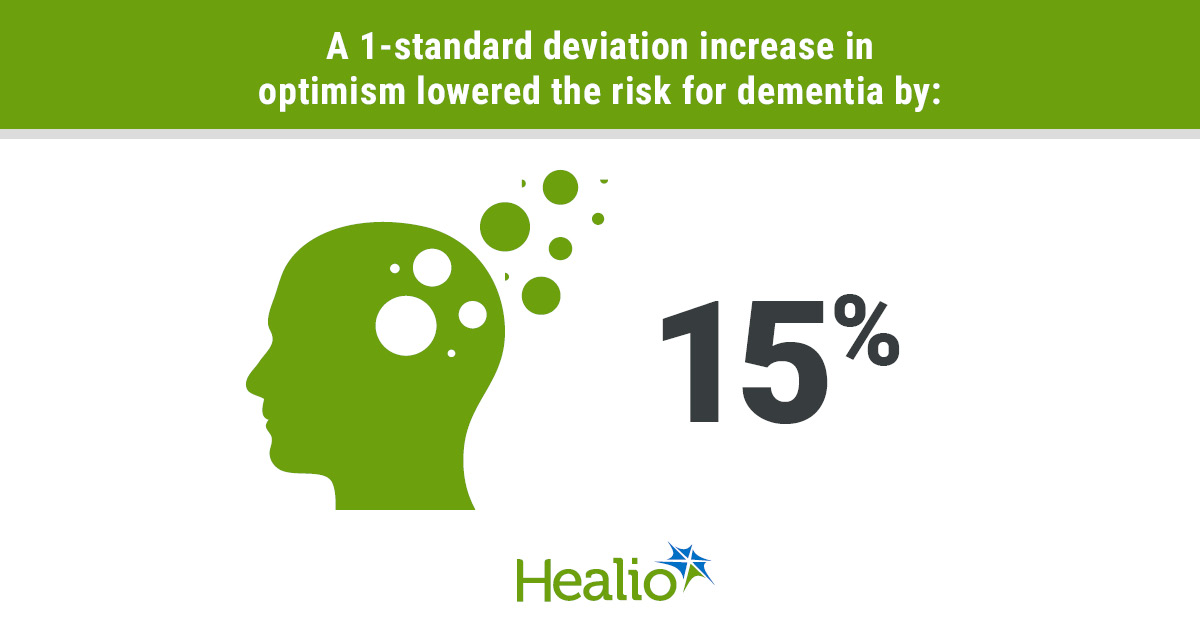
Greater optimism may lower the risk for developing dementia by 15%, according to a study published in the Journal of the American Geriatrics Society.
The data are important “because [they highlight] that our personal emotional and social resources, like how hopeful and positive we feel about the future, may be related to keeping our brains healthy as we age,” Säde Stenlund, MD, PhD, a postdoctoral research fellow at Harvard T.H. Chan School of Public Health, told Healio.

Data derived from Stenlund S, et al. J Am Geriatr Soc. 2026;doi:10.1111/jgs.70392.
“Since there are social conditions that can increase the likelihood that people will feel more optimistic as well as individual-level tools that can help people to change their level of optimism, our findings might add to the strategies we can use to prevent dementia.”
According to Stenlund, prior studies have tied optimism “to healthier aging trajectories, including better cognitive function. However, many earlier studies had relatively short followup periods, raising concerns about reverse causation — that is, whether early, subtle symptoms of dementia might reduce optimism rather than optimism influencing dementia risk.”
Stenlund and colleagues assessed the potential effects of optimism among a cohort of 9,071 older adults (mean age, 74 years; 57% women; 79% white) from the Health and Retirement Study who were free of dementia.
Self-reported optimism was measured through the Life Orientation Test-Revised, while dementia was identified through an algorithm “that was trained with data from gold-standard neuropsychological testing,” the researchers wrote.
During the 14-year follow-up period, 3,027 participants developed dementia.
The researchers reported that a 1-standard deviation increase in optimism was tied to lower risk for dementia (HR = 0.85; 95% CI, 0.82-0.88) after they adjusted for several factors including sex, age, education, race and ethnicity, depression and major health conditions.
“This finding carefully considered multiple sources of bias or confounding, such as whether optimistic people also had better health habits in general,” Stenlund said.
Stenlund and colleagues pointed out that similar associations were seen among non-Hispanic white (HR = 0.84; 95% CI, 0.81-0.88) and Black (HR = 0.81; 95% CI, 0.74-0.88) subpopulations when they stratified by race and ethnicity.
But case numbers for the non-Hispanic Black subpopulation were smaller “and thus estimates were less precise with wider CIs,” they wrote.
Stenlund told Healio it “was reassuring to see this association persisted over such long follow-up times. The fact that responses to six simple questions could inform us about someone’s risk of developing dementia many years later is pretty striking.”
“Our additional analyses considering factors that could provide alternative explanations for the findings also did not weaken the results,” she said. “While the findings are in line with earlier work, the consistency and robustness of the findings in a broad sample were compelling and strengthen the idea that optimism may be a valuable resource for brain health across different population groups.”
The researchers said that several direct and indirect mechanisms, some of which are biological, may explain the association.
“Prior work has found optimism is associated with healthier immune responses and higher levels of plasma antioxidants,” they wrote. “Such health-promoting processes could buffer against immune dysregulation, which can contribute to the emergence of Alzheimer-related dementia.”
They added that optimism also helps with “having more psychosocial resources such as stronger social networks, and lower levels of stress, factors also associated with healthier trajectories of cognitive aging.”
Stenlund and colleagues acknowledged that residual or unmeasured confounding was possible, while “it is not possible to rule out reverse causation.”
Stenlund said that clinicians “can first validate that psychosocial factors, such as optimism, play an important role in healthy aging, beyond just cognitive health. If a patient appears hopeless or has low optimism about the future, clinicians can support problem solving by, for example, connecting them with relevant resources (eg, social workers). This is one way to help enhance the patient’s sense of hope for the future. We know that optimism can be increased,” she told Healio.” “For example, gratitude is one way to cultivate optimism in daily life. For example, writing down three things to be grateful for each day can help people foster a more positive view of the future.
For more information:
Säde Stenlund, MD, PhD, can be reached at sstenlund@hsph.harvard.edu.

Ask a clinical question and tap into Healio AI’s knowledge base.
- PubMed, enrolling/recruiting trials, guidelines
- Clinical Guidance, Healio CME, FDA news
- Healio’s exclusive daily news coverage of clinical data
<









Leave a Reply