
April 17, 2026
2 min read

Key takeaways:
- Adults diagnosed with acromegaly had 28% higher risk for any type of cancer compared with matched controls.
- Risk for all-cause mortality, but not cancer mortality, was higher in the acromegaly group.
Adults with acromegaly may have increased risk for some cancers compared with the general population, according to data from Sweden published in The Journal of Clinical Endocrinology & Metabolism.
“Several types of cancer were more common in patients with acromegaly compared to matched controls, which was seen even years before the diagnosis of acromegaly,” Bertil Ekman, MD, PhD, associate professor in the departments of endocrinology and health medicine and caring sciences at Linköping University in Sweden, and colleagues wrote. “Persistent elevated [insulin-like growth factor I] was not significantly associated with an increased adjusted hazard ratio for cancer, indicating an effect beyond growth hormone hypersecretion.”

Data were derived from Tsatsaris E, et al. J Clin Endocrinol Metab. 2026;doi:10.1210/clinem/dgag137.
Researchers conducted an observational study of adults aged at least 18 years diagnosed with acromegaly from 1991 to 2018. Each person with acromegaly was matched with 10 control adults without acromegaly. Cancer data were obtained from the Swedish Cancer Register beginning 5 years before acromegaly diagnosis and continuing until the end of the study.
The study group included 1,035 adults with acromegaly and 10,261 people in the control group. Of the study group, 16.2% of those with acromegaly and 13.2% of controls were diagnosed with any cancer. Among the acromegaly group, 2.1% of those diagnosed with cancer after developing acromegaly and 2.5% of adults who had cancer before their acromegaly diagnosis later developed a second cancer.
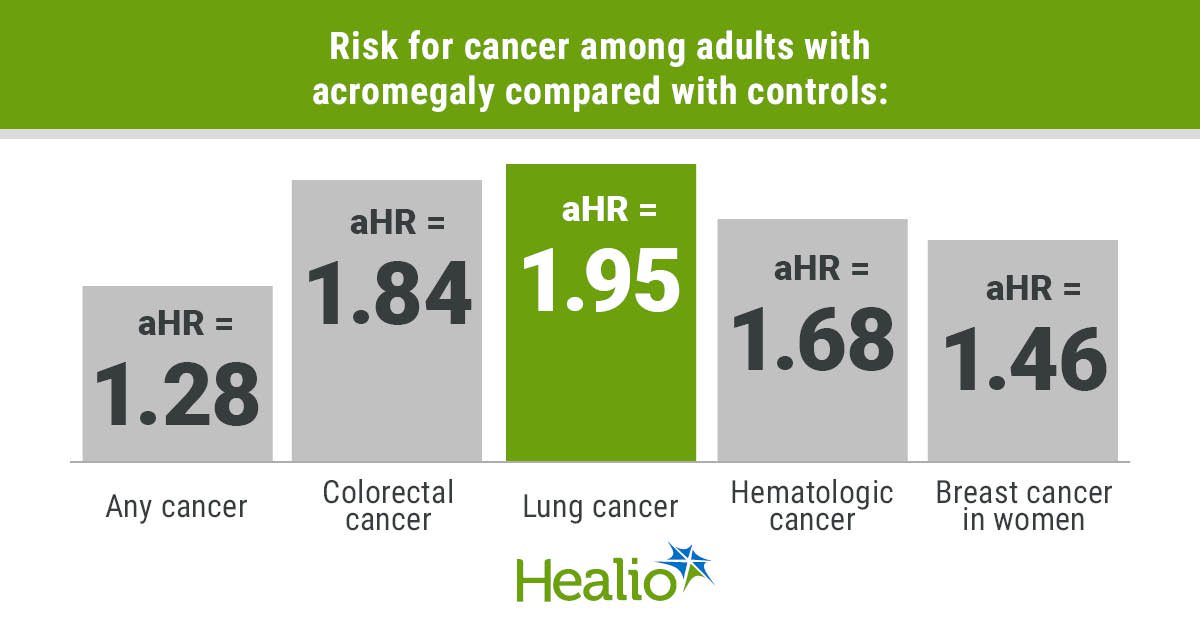
Adults with acromegaly had higher risk for any cancer (adjusted HR = 1.28; 95% CI, 1.11-1.49), colorectal cancer (aHR = 1.84; 95% CI, 1.28-2.64), lung cancer (aHR = 1.95; 95% CI, 1.22-3.11), hematologic cancer (aHR = 1.68; 95% CI, 1.03-2.73) and breast cancer for women (aHR = 1.46; 95% CI, 1.02-2.11) compared with controls.
Adults with acromegaly had higher all-cause mortality risk than controls (aHR = 1.19; 95% CI, 1.03-1.37). Risk for death due to cardiovascular disease was increased for the acromegaly group compared with controls (aHR = 1.76; 95% CI, 1.22-2.53). Risk for cancer-specific death among adults aged 40 to 60 years was increased for those with acromegaly compared with controls (aHR = 1.54; 95% CI, 1.04-2.28) but not in other age groups. Adults with acromegaly and persistently high IGF-I levels had higher all-cause mortality risk than controls (HR = 1.4; 95% CI, 1.15-1.71).
The Kaplan-Meier curves showed cancer risk among adults with acromegaly was increased prior to acromegaly diagnosis, revealing the importance of early cancer screening, because higher IGF-I and GH levels due to acromegaly may further raise cancer risk, Ekman and colleagues wrote.
“Our findings support attention for symptoms of specific cancers immediately after the diagnosis of acromegaly and also calls for patients to participate in national cancer screening programs,” the researchers wrote.

Ask a clinical question and tap into Healio AI’s knowledge base.
- PubMed, enrolling/recruiting trials, guidelines
- Clinical Guidance, Healio CME, FDA news
- Healio’s exclusive daily news coverage of clinical data
<










Leave a Reply