
April 29, 2026
2 min watch

Key takeaways:
- The real-world observational study included 293 patients.
- The lens is designed to extend range of vision, minimize dysphotopsias and maximize tolerance to residual refractive error.
WASHINGTON — The Tecnis PureSee extended depth of focus IOL provides good distance and intermediate vision, according to a real-world study presented at the American Society of Cataract and Refractive Surgery meeting.
Brian Schwam, MD, said the PureSee extended depth of focus IOL (Johnson & Johnson) has a purely refractive design that helps patients extend their range of vision while minimizing dysphotopsias and maximizing tolerance to residual refractive error.

Data were derived from Real-world quality of vision outcomes in patients implanted with a purely refractive extended depth of focus IOL. Presented at: American Society of Cataract and Refractive Surgery meeting; April 10-13, 2026; Washington.
“The lens has a continuous changing curvature along the posterior surface,” he said during a presentation. “The anterior surface is designed like other Tecnis lenses with the wavefront-designed aspheric surface to reduce corneal spherical aberration.”
Schwam and colleagues conducted a real-world, observational, single-arm study of 293 patients who underwent bilateral implantation with Tecnis PureSee toric or non-toric IOLs. Visual acuity and visual symptoms were assessed at a 3-month postoperative visit.
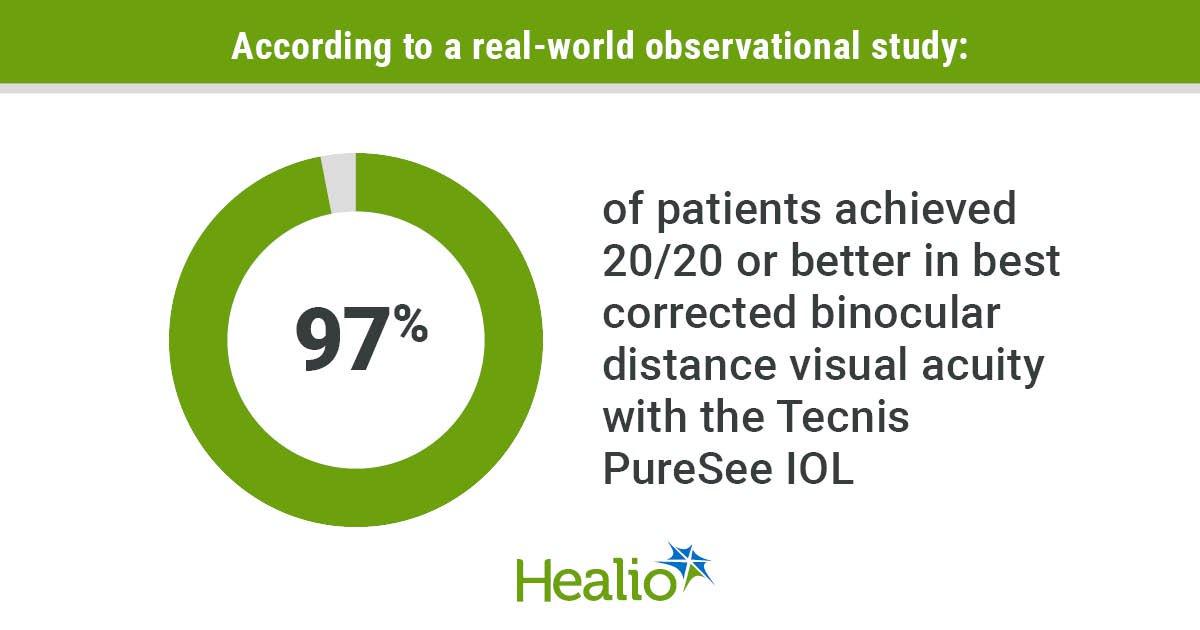
Mean monocular best corrected distance visual acuity and mean binocular best corrected distance visual acuity were 20/19 and 20/17, respectively. Schwam said 97% of patients achieved 20/20 or better in best corrected binocular distance visual acuity. Additionally, mean binocular distance corrected and uncorrected intermediate visual acuity were both 20/26, according to the presentation.
In this Healio Video Perspective, Brian Schwam, MD, shares results from the real-world observational study investigating the Tecnis PureSee extended depth of focus IOL.
Schwam said that patients reported low levels of bothersome visual symptoms. Overall, 4.1% of patients experienced glare, 3.8% experienced halos and 4.8% experienced starburst “very often,” while 3.1%, 1.4% and 2.7%, respectively, reported that they were “very bothered” by these symptoms.
Schwam said the study results show that the PureSee IOL gives patients high-quality vision in a real-world setting.
“It’s always important to see how a lens performs in a very highly controlled study,” he said. “But how does it perform in the real world of surgeons who have more choice on perhaps the patients they need to put these lenses in? This is why this data ends up being extremely important.”
Sources/Disclosures
Source:
Schwam B, et al. Real-world quality of vision outcomes in patients implanted with a purely refractive extended depth of focus IOL. Presented at: American Society of Cataract and Refractive Surgery meeting; April 10-13, 2026; Washington.
Disclosures:
Schwam reports being an employee of Johnson & Johnson.

Ask a clinical question and tap into Healio AI’s knowledge base.
- PubMed, enrolling/recruiting trials, guidelines
- Clinical Guidance, Healio CME, FDA news
- Healio’s exclusive daily news coverage of clinical data
<









Leave a Reply