

Key takeaways:
- Women with autoimmune hepatitis appear at greater risk for cervical dysplasia, HPV infection and subsequent colposcopy.
- Immunosuppression and HPV-related pathways may mediate these findings.
CHICAGO — Women with autoimmune hepatitis appear more likely to develop cervical dysplasia and HPV infection than those without the condition, according to research presented at Digestive Disease Week.
They also appeared more likely to have abnormal pap smear results and undergo colposcopy, data showed.

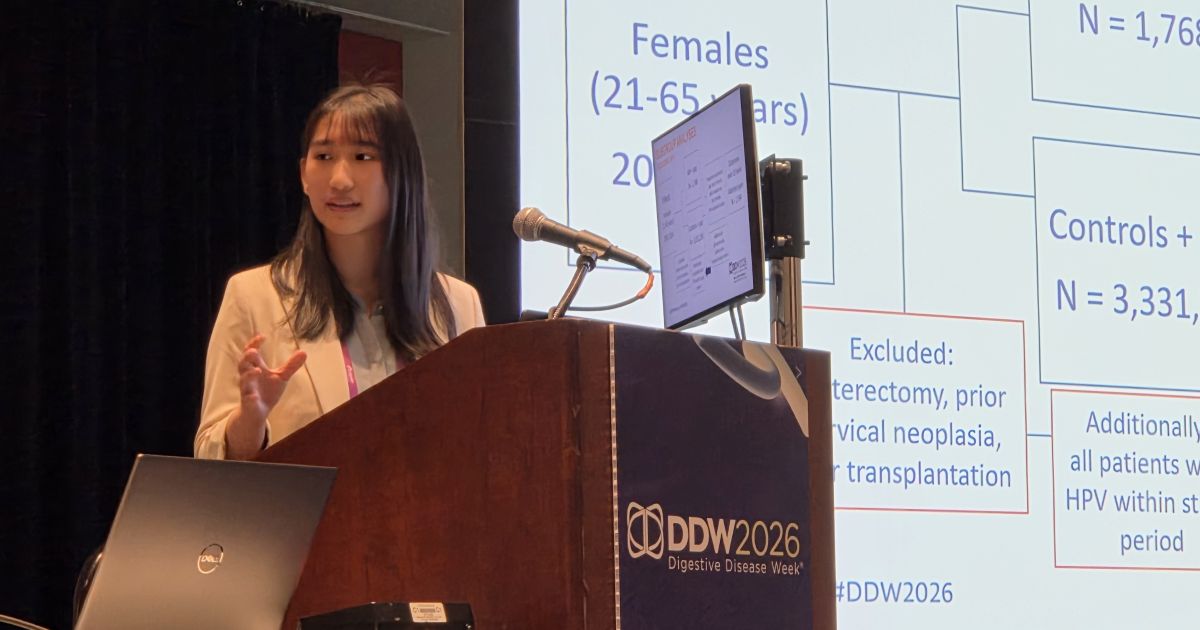
Kai-Lou C. Yue, MD, presents research at Digestive Disease Week. Image: Octavia Feliciano.
Autoimmune hepatitis (AIH) has previously been associated with an elevated risk for intrahepatic and extrahepatic malignancies and is four times more prevalent among women than men.
“A cornerstone of AIH treatment is immunosuppression, and HPV infection can play a large role in cervical cancer development,” presenting author Kai-Lou C. Yue, MD, internal medicine resident at University of Massachusetts Chan Medical School, said at the meeting. “Given this, our goal was to identify whether females with autoimmune hepatitis are at increased risk of developing cervical cancer or its precursors.”
Using TriNetX U.S. Collaborative Network data from 2005 to 2025, Yue and colleagues identified more than 3.6 million women aged 21 to 65 years who had at least one pap smear encounter.
Researchers matched individuals by age, race, BMI, HIV and HPV infection status and other variables to create two balanced cohorts — one with AIH and one without AIH (n = 1,982 each; mean age, 42 years; 64.4% white; 71.1% non-Hispanic).
Individuals with AIH were more likely to develop HPV infection (OR = 1.59; 95% CI, 1.19-2.14) than those without AIH. They also were significantly more likely to have abnormal cytologic pap smear findings (OR = 1.46; 95% CI, 1.21-1.75), develop cervical dysplasia (OR = 1.83; 95% CI, 1.42-2.36) and undergo colposcopy (OR = 1.68; 95% CI, 1.31-2.15).
“There were also trends toward increased odds of cervical cancer in situ and cervical cancer in the AIH cohort, but these were not significant within our analyses,” Yue said.
Yue and colleagues conducted a secondary analysis that excluded HPV positive patients and matched for use of immunosuppressive therapies — including glucocorticoids, azathioprine and mycophenolate mofetil — to isolate the effect of AIH on cervical cancer and its precursors.
“After matching for immunosuppression, the associations across all outcomes attenuated and were no longer statistically significant,” Yue said. “This suggests that the observed effect was largely driven by immunosuppressive therapy, rather than an independent effect of AIH.”
During her presentation, Yue noted how limitations of the TriNetX database impacted the research.
“We are unable to longitudinally assess HPV status and cervical cancer or cervical screening outcomes over time, such as the pathway from abnormal pap smear to dysplasia and cancer,” she said. “This limits our ability to fully examine the pathway from AIH to cervical neoplasia and to fully determine whether observed effects are driven by HPV persistence or the direct effects of immunosuppression.”
Yue emphasized that these results highlight the importance of routine cervical cancer screening for women with AIH and suggests more frequent screening may be beneficial for this patient population, particularly if they are on an immunosuppressive therapy.
Sources/Disclosures
Source:
Yue KC, et al. Risk of cervical cancer and its precursors in females with autoimmune hepatitis. Presented at: Digestive Disease Week; May 2-5, 2026; Chicago.
Disclosures:
Yue reports no relevant financial disclosures. Please see the study for all other authors’ relevant financial disclosures.

Ask a clinical question and tap into Healio AI’s knowledge base.
- PubMed, enrolling/recruiting trials, guidelines
- Clinical Guidance, Healio CME, FDA news
- Healio’s exclusive daily news coverage of clinical data
<









Leave a Reply