
January 30, 2026
2 min read

Key takeaways:
- Associations between age and relapse rate, change in eGFR and time to first remission were evaluated.
- The researchers said clinical profiles at age 14 to 18 years or 19 to 25 years should be considered.
Adolescents and young adults aged 14 to 25 years with glomerular disease present with distinct clinical profiles compared with pediatric or adult populations, according to study data published in Kidney360.
The adolescent and young adult population living with kidney disease is increasing, and these patients face unique challenges, including medication adherence and navigating the health care system, according to Andrew Vissing, MD, assistant professor of medicine in the division of nephrology and hypertension at Northwestern University Feinberg School of Medicine, and colleagues. Despite these unique sets of challenges, adolescent and young adult patients with glomerular disease are often grouped with pediatric or adult populations, the researchers wrote.

“Prior studies in kidney transplant patients show adolescents and young adults have worse outcomes,” Vissing told Healio. “However, there is limited data on outcomes for young adults with glomerular disease, which is why we decided to study this.”
The researchers evaluated data from the Cure Glomerulonephropathy Network prospective cohort of 1,868 patients with biopsy-proven glomerular disease, including minimal change disease, focal segmental glomerulosclerosis (FSGS) and immunoglobulin A nephropathy (IgAN). The cohort was divided into three age groups: pediatric (30%; aged 13 years), adolescent/young adult (21%; aged 14-25 years) or adult (49%; aged 26 years).
The primary outcomes were associations between age and relapse rate, change in eGFR and time to first observed remission. Median follow-up time was 4.9 years.
Results differed based on disease type.
Minimal change disease was the most common glomerular disease in pediatric patients (50%) while IgAN was most common for adolescent/young adult (44%) and adult populations (42%).
Adults with minimal change disease reported fewer relapses (incidence rate ratio [IRR] = 0.61; 95% CI, 0.41-0.91) compared with adolescent/young adult patients with minimal change disease. No significant differences were reported between pediatric and adolescent/young adult patients with minimal change disease. However, pediatric patients with minimal change disease had their first observed remission earlier than adolescent/young adult patients with minimal change disease (HR = 2.18; 95% CI, 1.03-4.63).
No significant differences in relapse rates were found for FSGS. However, adolescents/young adults with FSGS reported faster decline in kidney function compared with pediatric patients (1.7 mL/min/1.73 m² per year vs. 0.3 mL/min/1.73 m²).
For those with IgAN, adults had fewer relapses than adolescents/young adults with IgAN (IRR = 0.55; 95% CI, 0.33-0.94) and were slower to reach first observed remission (HR = 0.58; 95% CI, 0.37-0.91). Adolescents/young adults with IgAN had a significantly faster decline in kidney function compared with pediatric patients with IgAN (1.5 mL/min/1.73 m² per year vs. 0.1 mL/min/1.73 m²).
“Our hypothesis was that adolescents and young adults with glomerular disease would have worse outcomes; however, I was surprised to see that this was not always the case,” Vissing said.
Overall, the results showed adolescents/young adults with glomerular diseases present with distinct clinical profiles compared with pediatric and adult populations, according to the researchers.
“From my personal experience caring for this group, adolescent and young adult care needs to be tailored in a way that is different from how nephrologists are used to caring for older or younger patients,” Vissing said.
Future research could explore more distinct age profiles, such as groups aged 14 to 18 years and aged 19 to 25 years, to better understand these differences, according to Vissing.
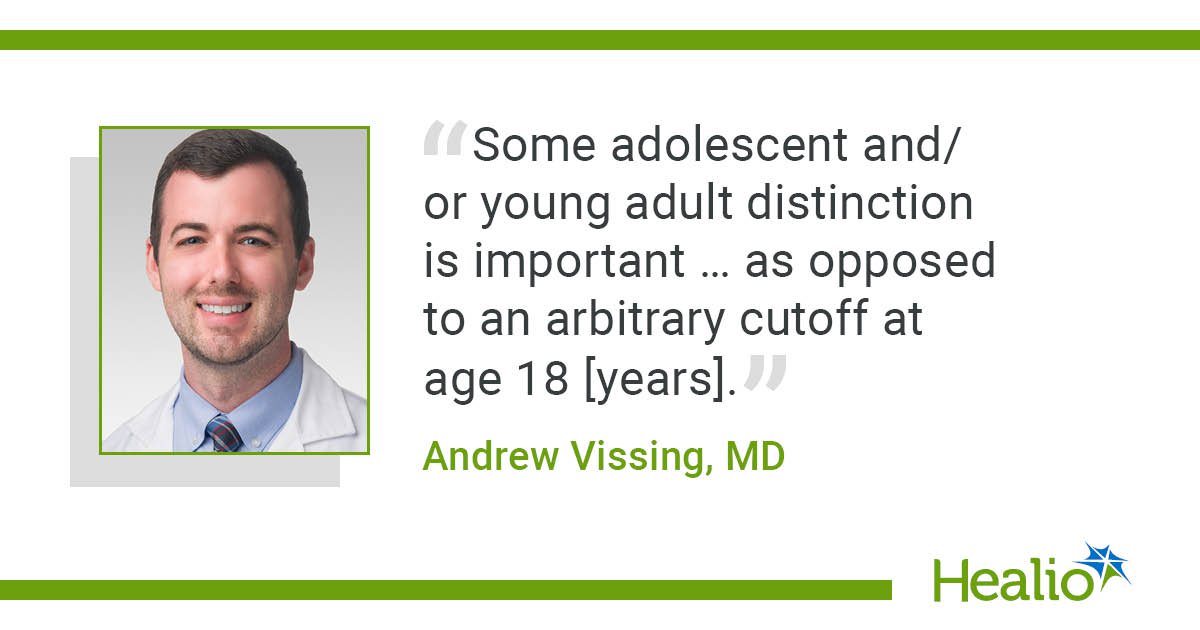
“I believe some adolescent and/or young adult distinction is important in clinical and research settings as opposed to an arbitrary cutoff at age 18 [years],” he said.
For more information:
Andrew Vissing, MD, can be reached at nephrology@healio.com.
Perspective
Back to Top

Darcy K. Weidemann, MD, MHS, FAAP
Disclosures: Weidemann reports no relevant financial disclosures.

Ask a clinical question and tap into Healio AI’s knowledge base.
- PubMed, enrolling/recruiting trials, guidelines
- Clinical Guidance, Healio CME, FDA news
- Healio’s exclusive daily news coverage of clinical data
<











Leave a Reply