

If the state is going to invest €250,000 in training a doctor, it is not unreasonable to ask for a modest period of service in return, writes Terence Cosgrave
‘Medical education does not exist to provide students with a way of making a living, but to ensure the health of the community.’
Rudolf Virchow
For all its faults, the European Union has been a huge success in advancing the rights and freedoms of its members. Perhaps its greatest achievement is that it has opened countries to the culture and debates of other countries, expanding the level of debate in each political sphere.
It has opened opportunities for Irish people in other EU countries, and many EU citizens have made lives here that weren’t possible in their origin countries. In the field of education, this transnational ability to study abroad has allowed Irish people to gain opportunities that simply aren’t available here. And that’s a fantastic thing. For those interested in high fashion, cost-effective infrastructure building, professional curling and bullfighting, better opportunities exist elsewhere.
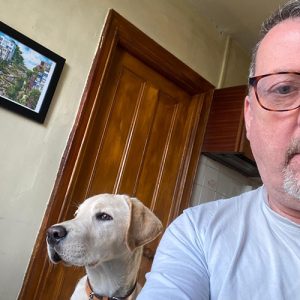
Terence Cosgrave and pup
It’s the same as it ever was. We are an island nation with people coming and going all the time. No wonder we have been such a success at ‘Europe’.
But ‘the times, they are a-changin’. And in medicine, and in particular in medical education, we have to examine if we are doing the right thing for students, for Irish medicine, and for the population who will depend on these future doctors.
There are roughly 1,000 places available in medical schools in Ireland every year, and in 2024 14,000 students competed for those places. This means that a lot of capable young people are being refused the chance to study in Ireland, and some go abroad to study in countries such as Hungary, Czechia, Slovakia, Poland, Latvia and Romania, and the number at any one time is reckoned by organisations working in the area to be around 5,000.
At the same time the majority of the Irish graduates are going abroad to work. In 2022, 442 Irish doctors were issued temporary work visas for Australia, compared with around 725 doctors who graduated in Ireland in 2021 — indicating a high outward flow relative to the number trained.
Around 80 per cent of UCC medical graduates of 2021 were working in Australia in 2022 and about 70 per cent of 2021 UCG graduates were based in the Antipodes a year later.
What this means, when you pause long enough to let the numbers stop rattling around your head like loose change in a tumble dryer, is that Ireland has achieved something quite remarkable. We have managed to create a medical education system that is simultaneously ferociously competitive, eye-wateringly expensive, and astonishingly ineffective at producing doctors who actually practise medicine here. It is, in its own way, a work of art.
The shortage of doctors in Ireland is not a new phenomenon. It has been talked about for so long that it has acquired a kind of geological permanence, like the Burren or the Cliffs of Moher. Every few years a report emerges, thick with charts and earnest prose, to tell us that we are short of consultants, short of GPs, short of junior doctors, short of everyone except people writing reports about shortages. The reports are nodded at gravely, placed on shelves, and never seen again.
Meanwhile, hospitals stagger on heroically, powered by goodwill, caffeine, and a workforce that increasingly regards emigration not as a life choice but as a rite of passage. For many young doctors, going to Australia is less a bold adventure than an administrative inevitability, like filling out a tax return or learning to pronounce G’Day. They go because the hours are better, the training is clearer, the pay is higher, the accommodation is attainable, and nobody seems surprised that doctors might want to sleep occasionally.
This might all be less alarming if the education of a doctor were a trivial expense, like a box of paperclips. Unfortunately, it is not. Training a medical student is one of the most expensive things the Irish state does that doesn’t involve concrete or tribunals. Depending on how you count it — and governments are famously creative counters — the cost to the taxpayer of training a single doctor in Ireland is estimated at somewhere between €200,000 and €300,000 by the time we account for undergraduate education, clinical placements, internship and early postgraduate training. That is a quarter of a million euro per head, give or take the price of a small cottage in Leitrim.
Multiply that by roughly 1,000 graduates a year and you begin to glimpse the scale of the investment. Then consider that a very large proportion of those graduates will be working in Perth, Brisbane or Melbourne within a year or two, and you start to wonder whether the Department of Health is, in fact, secretly sponsored by Qantas.
To be clear, no one sensible is arguing that doctors should be chained to hospital radiators or forced to sign loyalty oaths in blood. Freedom of movement is a good thing, and many doctors quite reasonably want to experience other systems, broaden their skills and see a bit of the world. Ireland has benefited enormously from doctors trained abroad, and long may that continue. The problem is not that doctors leave. The problem is that we have built a system that virtually guarantees that they will.
There are, remarkably, almost no meaningful incentives for Irish-trained doctors to stay in Ireland, and even fewer disincentives to leaving. We spend hundreds of thousands educating them, then wave cheerfully as they depart, like indulgent parents watching a child leave for college, except this child has taken the family car, the dog, and a large chunk of the national health budget.
Other countries manage this differently. Some attach conditions to publicly-funded medical education, such as a requirement to work for a period in the public health system, particularly in under-served areas. Others offer loan forgiveness, housing supports, structured career progression, or guaranteed training posts that don’t involve a decade of uncertainty and rotational misery. Ireland, by contrast, offers young doctors the thrilling prospect of overcrowded hospitals, unstable contracts, eye-watering rents and the vague promise that things might improve once several people retire or die.
It is often said that medicine is a vocation, which is a lovely sentiment, and a terrible policy foundation. Vocations are wonderful things, but they do not pay rent, secure childcare or reduce burnout. Expecting an entire workforce to absorb systemic dysfunction out of a sense of moral duty is not a strategy; it is a form of magical thinking.
So what might a grown-up approach look like?
For a start, Ireland could be honest about the return on investment it expects from publicly-funded medical education. If the state is going to invest €250,000 in training a doctor, it is not unreasonable to ask for a modest period of service in return — say, five years in the Irish public system, with flexibility around timing and specialty. This would not be unprecedented, radical or cruel. It would simply recognise that public money carries public expectations.
Such a policy would need to be paired with real improvements in working conditions, because compelling people to stay in a system they find intolerable is unlikely to end well. That means predictable training pathways, limits on unsafe working hours, adequate staffing levels and a serious approach to housing. Offering subsidised accommodation for junior doctors near major hospitals would probably cost less than the annual bill for locum cover and would do wonders for morale.
Second, Ireland could expand medical school places in line with population needs, rather than treating them as a scarce luxury item. The fact that 14,000 people compete for 1,000 places each year is not a sign of excellence; it is a sign of misalignment. We already know that thousands of capable Irish students are studying medicine abroad. Creating more domestic places would keep more of that talent at home.
Third, the state could develop structured ‘return pathways’ for doctors who do go abroad. Many Irish doctors would happily come back after a few years if there were clear routes into consultant or GP posts, recognition of overseas experience, and some certainty about where they might end up. At present, returning can feel like trying to re-enter a building through a door marked ‘Fire Exit — Alarm Will Sound’.
Finally, we might consider whether the current model — in which Ireland effectively subsidises the healthcare systems of wealthier countries — is really the best use of public funds. International mobility is valuable, but it should be a two-way street, not a conveyor belt.
None of this requires abandoning European ideals or closing borders. It simply requires recognising that good intentions do not automatically produce good outcomes, and that systems designed for a smaller, poorer, younger country… may need updating. Ireland has changed dramatically in the past few decades. Our medical education and workforce policies, alas, have not kept pace.
If we do nothing, the situation will continue much as it is: shortages will persist, costs will rise, and newly-minted Irish doctors will keep boarding planes southward, sunscreen in hand, while we congratulate ourselves on our commitment to mobility and wonder why the emergency department is still short-staffed.
The European Union has given Ireland extraordinary opportunities, and we have used them well. But openness does not absolve us of responsibility for our own systems. Training doctors we cannot keep is not enlightened internationalism — it is an expensive habit we can no longer afford.
At some point, someone will have to ask the unfashionable question: not whether doctors should be free to leave, but whether the Irish state should continue paying so handsomely for them to do so. 
<








Leave a Reply