
April 24, 2026
5 min read

Key takeaways:
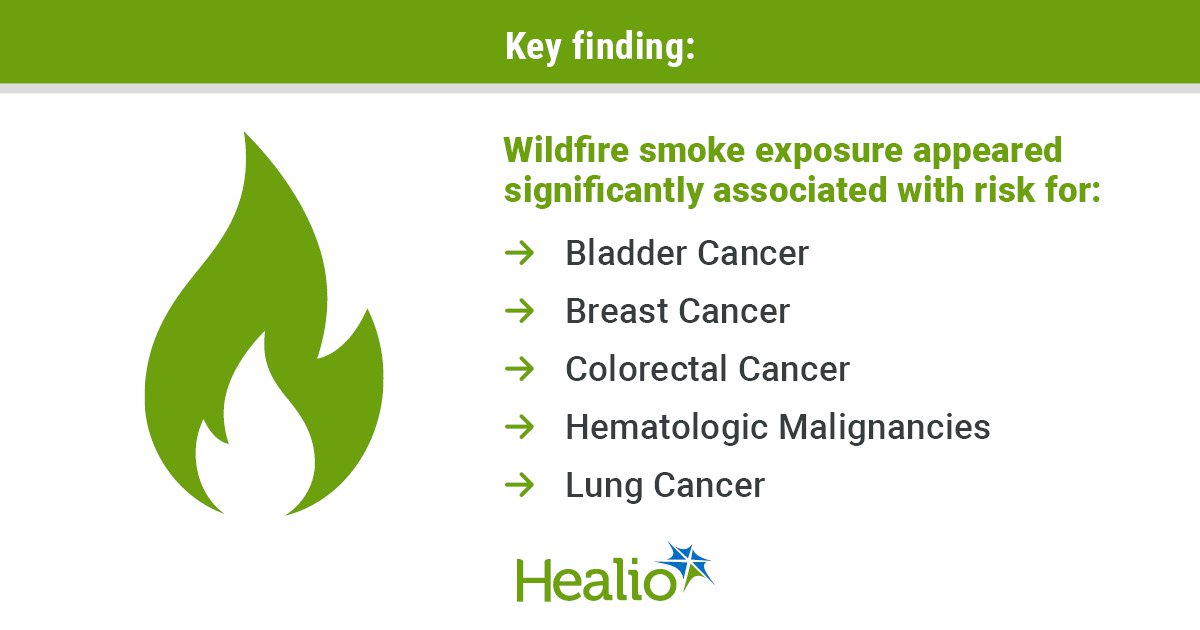
- Exposure to wildfire smoke appeared linked to significantly higher risk for bladder, blood, breast, colorectal and lung cancers.
- The findings are important due to increasing wildfire frequency and intensity.
Exposure to wildfire smoke may raise risk for several types of cancer, according to an analysis of data from a large trial.
The elevated risk — observed for five cancer types — may occur after only relatively low levels of exposure experienced by large segments of the general population, findings presented at American Association for Cancer Research Annual Meeting showed.

Data derived from Wu Q, et al. Abstract 6252. Presented at: American Association for Cancer Research Annual Meeting; April 17-22, 2026; San Diego.

Shuguang Leng
“Wildfires are becoming more common and more intense,” Shuguang Leng, MBBS, PhD, associate professor at The University of New Mexico Comprehensive Cancer Center, told Healio. “It is important to increase public awareness that wildfire smoke is not transient. We are seeing chronic exposure that can lead to very harmful health outcomes.”
Beyond ‘burning sites’
Extreme wildfires more than doubled in frequency between 2003 and 2023, according to a report by Cunningham and colleagues published in Nature Ecology & Evolution. The largest increases occurred in temperate coniferous forests in the western United States, as well as boreal forests in Russia and northern North America.
In 2023, smoke from record-setting wildfires in Canada blanketed much of North America and even reached Europe.
“Some people live in areas that have what are known as wildfire ‘seasons’ — it may not happen every day, but it happens intermittently for extended periods,” Leng said. “However, these fires do not just affect people who live near burning sites. Smoke can travel hundreds of miles, with acute exposure causing respiratory exacerbation and cardiovascular events.”
Wildfire smoke — which carries a broad range of carcinogens and proinflammatory toxins — has become a key source of ambient air pollution, Leng said. It is a major source of fine particulate matter (PM2.5), which can penetrate deep into the lungs and pose risks to human health.
However, the chronic health effects caused by wildfire smoke and its role in cancer risk are not well characterized.
Leng and colleagues aimed to clarify the impact of long-term exposure to wildfire smoke on cancer risk by using data from the Prostate, Lung, Colorectal, and Ovarian (PLCO) Cancer Screening Trial, a longitudinal study that examined the impact of screening on cancer-related mortality among U.S. adults aged 55 to 74 years recruited from 10 centers across the country.
PLCO trial participants enrolled between 1993 and 2001, with follow-up continuing through 2018. Investigators identified 91,460 participants evaluable for wildfire smoke exposure.
Researchers used what Leng described as “a state-of-the-art approach” to examine whether long-term exposure correlates with cancer risk in the general population.
They used ground-level air pollution data from trial participants’ residential areas to assess PM2.5 and black carbon levels. They used satellite images starting in 2006 to link PM2.5 and black carbon data with wildfire smoke exposure events and calculate plume-day counts, which measure the number of days each trial participant’s area of residence had been exposed to wildfire smoke plumes.
Investigators tracked monthly wildfire smoke exposure for each trial participant until their first cancer diagnosis or final study contact.
Broad impacts
Leng and colleagues calculated 36-month moving averages of key variables between 2006 and 2018.
They reported a median wildfire smoke PM2.5 level of 0.349 g/m3 nationwide, with median levels reaching above 1 g/m3 in the West and Midwest. They reported a median black carbon level of 0.008 g/m3 and a median monthly plume-day count of 2.44.
The researchers identified 8,258 total cases of seven malignancies during follow-up: lung cancer (n = 1,758), breast cancer (n = 1,739), blood cancer (n = 1,696), melanoma (n = 1,127), bladder cancer (n = 896), colorectal cancer (n = 800) and ovarian cancer (n = 242).
Statistical analyses showed a significant association between wildfire smoke exposure and five of those malignancies — bladder, blood, breast, colorectal and lung cancers — with consistent linear dose-response relationships for all.
Each additional 1 g/m3 of PM2.5 exposure in the 36-month moving average appeared linked to higher risks for blood cancer (HR = 1.62; 95% CI, 1.02-2.6), lung cancer (HR = 1.92; 95% CI, 1.17-3.14), breast cancer (HR = 2.09; 95% CI, 1.34-3.25), colorectal cancer (HR = 2.31; 95% CI, 1.11-4.81) and bladder cancer (HR = 3.48; 95% CI, 1.65-7.33).
Investigators reported similar relationships between higher plume-day counts and increased risk for blood, breast, colorectal and lung cancers. Increases in black carbon exposure only appeared significant associated with bladder and breast cancers.
Analyses also showed associations between wildfire PM2.5 levels and risk for multiple cancer subtypes, with the highest risks observed for luminal breast cancer (HR = 2.75; 95% CI, 1.54-4.9), leukemia (HR = 3.11; 95% CI, 1.3-7.4), proximal colorectal cancer (HR = 4.34; 95% CI, 1.82-10.35) and muscle-invasive bladder cancer (HR = 19.42; 95% CI, 5.62-67.1).
“I was not surprised to see increased risk for lung cancer but, at least initially, it was puzzling to see higher risks for other cancers — particularly the strong association with bladder cancer,” Leng said. “But these carcinogens, which are deposited in the lungs, can be absorbed into the bloodstream and reach distant organs. They eventually are excreted through the urinary system, and we think that exposure is why we see the magnitude of association for bladder cancer.”
More research needed
Leng and colleagues acknowledged study limitations, including lack of satellite image data prior to 2006. Also, location-based analyzes assumed participants had been in their residential area during every exposure period analyzed, and analyzes did not distinguish between time spent outdoors vs. indoors.
Still, the findings support the possibility that wildfire smoke could become “a major driver” of cancer in the U.S. if the frequency and intensity of these fires continue to increase, Leng said.
Efforts are needed to educate the public and scientific community about the potential long-term health impacts of wildfire smoke, Leng said. Better understanding of the mechanisms of how wildfire smoke contributes to cancer risk, the impact of different compounds that may be present in wildfires across different regions, and whether the chemical composition of smoke changes as it drifts, potentially altering its effects, also is needed, he added.
The data emphasize the importance of identifying strategies to minimize wildfires sparked by natural and non-natural causes to reduce their health impacts, Leng said.
“This is something each individual can play a role in, but it rises to the organizational and societal levels,” Leng said. “It is very important that we recognize that we all need to work together to make this happen.”
For more information:
Shuguang Leng, MBBS, PhD, can be reached at sleng@salud.unm.edu.
Perspective
Back to Top

Disclosures: Erhunmwunsee reports no relevant financial disclosures.
Sources/Disclosures
Source:
Wu Q, et al. Abstract 6252. Presented at: American Association for Cancer Research Annual Meeting; April 17-22, 2026; San Diego.
References:
Disclosures:
NIH funded this study. Leng reports no relevant financial disclosures. Please see the study for all other authors’ relevant financial disclosures.

Ask a clinical question and tap into Healio AI’s knowledge base.
- PubMed, enrolling/recruiting trials, guidelines
- Clinical Guidance, Healio CME, FDA news
- Healio’s exclusive daily news coverage of clinical data
<













Leave a Reply