
April 24, 2026
4 min read
Key takeaways:
- In addition to moderate to severe eosinophilic asthma, KT-621 has received this FDA designation for atopic dermatitis.
- KT-621 works intracellularly, whereas biologics work outside the cell.
The FDA granted fast track designation to KT-621 for treating patients with moderate to severe eosinophilic asthma, according to a press release from Kymera Therapeutics.
The release outlined that KT-621 (Kymera Therapeutics) is a first-in-class oral STAT6 degrader taken once a day that has also received fast track designation for treating moderate to severe atopic dermatitis.

Fast track designation is intended to ease the development path and expedite the review of novel therapeutic drugs that meet an unmet, urgent medical need to address rare or serious conditions. Any therapy that receives this designation will likely be eligible for more frequent discourse with the FDA, which subsequently may expedite the process for priority review.
In the phase 1b BroADen trial focused on patients with AD, researchers found that patients with comorbid asthma receiving KT-621 had decreased fractional exhaled nitric oxide and improved scores on the five-item Asthma Control Questionnaire, according to the release.
Healio spoke with Jared Gollob, MD, chief medical officer at Kymera Therapeutics, to learn more about the development of KT-621, how it works and the phase 2b trials currently investigating the therapy.
Healio: Why was KT-621 developed?
Gollob: With many immunological conditions, there remains a significant gap between the number of patients who could benefit from advanced systemic therapies and those who actually receive them.
Across the U.S., E.U. and Japan, we estimate roughly 50 million patients have moderate to severe type 2 inflammatory diseases, yet only about 2 million are treated with advanced systemic therapies. This gap reflects limitations of current options including safety concerns with some oral therapies (eg, JAK inhibitors, oral corticosteroids) and the treatment burden and accessibility challenges associated with injectable biologics.
KT-621 is designed to address these barriers by offering the potential for an effective, safe and convenient oral therapy, with the opportunity to be among the first of its kind in this space. If successful, it could expand access to advanced treatment, enable earlier intervention and help shift the treatment paradigm for millions of patients.
Healio: How does KT-621 work?
Gollob: KT-621 is an oral small molecule degrader designed to selectively remove STAT6, a central driver of type 2 inflammation and allergic disease. It leverages targeted protein degradation (TPD), a novel therapeutic approach that harnesses the cell’s natural protein recycling and cellular homeostasis machinery, the ubiquitin proteasome system, to selectively remove disease-causing proteins. Unlike traditional small molecule inhibitors that rely on continuous occupancy-based binding, degraders act catalytically, enabling efficient and sustained removal of the target protein, offering a potentially transformative approach to treating disease with oral medicines.
STAT6 is the specific and obligate transcription factor in the IL-4/IL-13 signaling pathway, which is well established in allergic diseases like asthma and AD. STAT6 is also genetically validated, with human gain-of-function mutations linked to severe allergic disease and loss-of-function variants associated with reduced type 2 inflammation. This pathway is clinically validated by blockbuster injectable therapies such as dupilumab, but STAT6 itself has historically been difficult to drug with conventional approaches. By removing STAT6 through TPD, KT-621 has the potential to deliver complete and continuous pathway blockade similar to a biologic, while offering the convenience of an oral therapy. Kymera was the first company to advance a STAT6-targeted agent into the clinic.
Healio: What sets it apart from biologics like dupilumab?
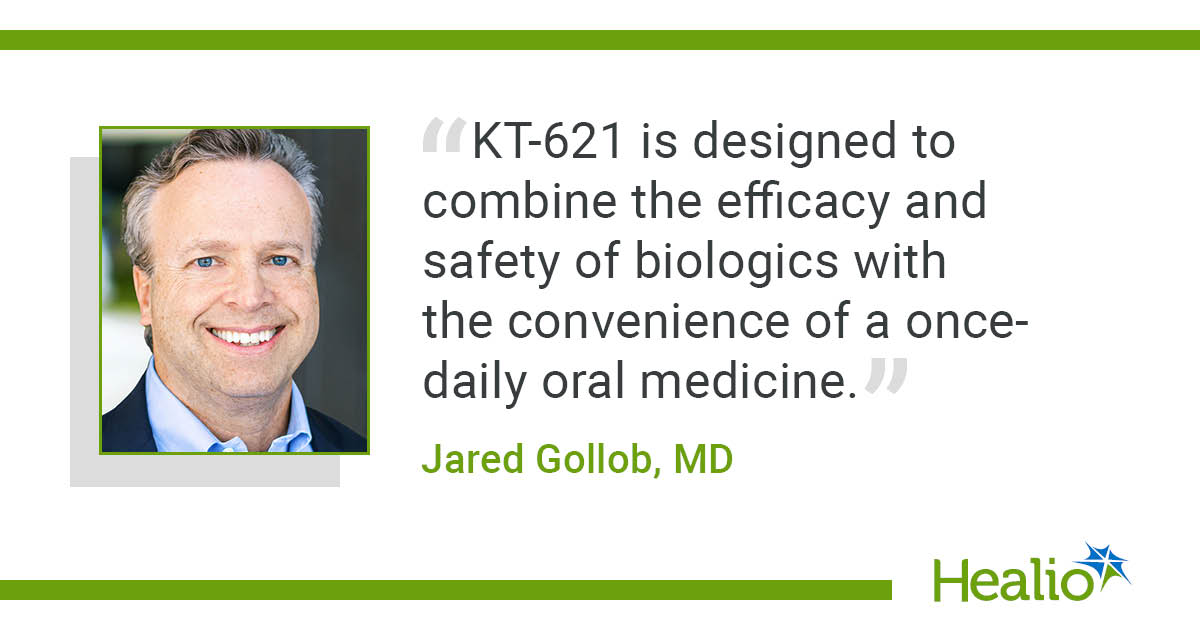
Gollob: KT-621 is designed to combine the efficacy and safety of biologics with the convenience of a once-daily oral medicine.
Mechanistically, biologics like dupilumab work outside the cell by blocking IL-4/IL-13 signaling at the cytokine receptor level. KT-621 works intracellularly by removing STAT6, the key downstream transcription factor that mediates the type 2 inflammatory response. Once STAT6 is tagged for degradation by KT-621, it is eliminated, and the molecule can go on to remove additional copies.
This catalytic mechanism enables deep and continuous target degradation and IL-4/13 pathway inhibition with KT-621 dosed orally once-daily that phenocopies the activity of biologics without the burden of repeated injections. In contrast, sustained pathway blockade is difficult to achieve with traditional oral small molecule inhibitors, as their activity requires continuous target engagement that is dependent on maintaining high levels of drug exposure.
Healio: What are the primary endpoints of the phase 2b studies?
Gollob: KT-621 is currently being evaluated in two global, randomized, placebo-controlled phase 2b trials designed to assess efficacy and safety and enable phase 3 dose selection.
The BROADEN2 trial includes patients with moderate to severe AD. The primary endpoint is percent change from baseline in Eczema Area and Severity Index score at week 16. The study includes adolescents and adults. Data are expected to be reported by mid-2027.
The BREADTH trial includes patients with moderate to severe eosinophilic asthma. The primary endpoint is change from baseline in pre-bronchodilator FEV1 over 12 weeks. Data are expected to be reported in late 2027.
Across both studies, secondary endpoints will evaluate a range of additional safety, efficacy and quality of life measures. Both trials are dose-ranging and intended to inform dose selection for subsequent phase 3 development in AD, asthma and multiple additional type 2 inflammatory diseases.
Healio: What do you hope to find through these studies?
Gollob: We aim to demonstrate that KT-621 can deliver clinically meaningful improvements in disease measures in AD and asthma with a favorable safety profile. More broadly, we’re also looking to show that targeted degradation of STAT6 can achieve deep and sustained IL-4/13 pathway blockade with an oral small molecule drug dosed once daily.
If successful, this could represent a meaningful step forward in how these diseases are treated and increase patient access to transformative therapies that address the root cause of their inflammation.
For more information:
Jared Gollob, MD, can be reached at media@kymeratx.com.
Sources/Disclosures
Source:
Press Release
Disclosures:
Gollob reports having employment with Kymera Therapeutics.

Ask a clinical question and tap into Healio AI’s knowledge base.
- PubMed, enrolling/recruiting trials, guidelines
- Clinical Guidance, Healio CME, FDA news
- Healio’s exclusive daily news coverage of clinical data
<












Leave a Reply