
April 24, 2026
3 min read

Key takeaways:
- South Asian adults have higher risk for adverse CV outcomes compared with other racial-ethnic groups.
- Coronary calcium scans should be conducted for South Asian adults at age 40 to 45 years, regardless of BMI.
LAS VEGAS — South Asian adults have increased cardiovascular risk compared with other racial-ethnic groups and should undergo screening as early as age 40 years, according to a speaker.
Multiple studies have found South Asian adults have increased risk for outcomes such as coronary artery disease, myocardial infarction and CV mortality, said Rachna Relwani, MD, an endocrinologist and founder of DesiDil in Atlanta. Additionally, Relwani said CV outcomes tend to occur earlier in South Asian adults than other racial-ethnic groups. During a talk at the American Association of Clinical Endocrinology Annual Scientific and Clinical Conference, Relwani explained why health care professionals should account for South Asian ethnicity during CV risk assessment and outlined steps they can take to detect risk for future adverse CV outcomes.

Infographic content were derived from Relwani R. Cracking the code: Uncovering hidden metabolic risk in South Asian hearts. Presented at: American Association of Clinical Endocrinology Annual Scientific and Clinical Conference; April 22-24, 2026; Las Vegas.
“The American Heart Association itself has recognized those of South Asian ethnicity as an independent risk factor,” Relwani said during a presentation. “This is not a lifestyle failure. We need to change the conversation that we have with our patients.”
Data published in the Journal of the American Heart Association in February revealed some of the increased risks South Asian adults in the U.S. face. In an analysis of data from the MASALA study and MESA, South Asian adults aged 45 to 55 years had higher prevalence of hypertension than white, Chinese and Hispanic adults. Additionally, South Asian men had higher rates of dyslipidemia than white, Chinese and Black men; and dyslipidemia was more common for South Asian women than Chinese and Black women.
Relwani said South Asian adults tend to have higher amounts of visceral fat at lower BMIs than other racial-ethnic groups. That increased visceral fat is linked to higher insulin resistance, which then leads to dyslipidemia, higher triglycerides and low HDL cholesterol.
Laboratory values to watch
Most CV risk stratification systems tend to underpredict CV risk for South Asian adults, Relwani said.
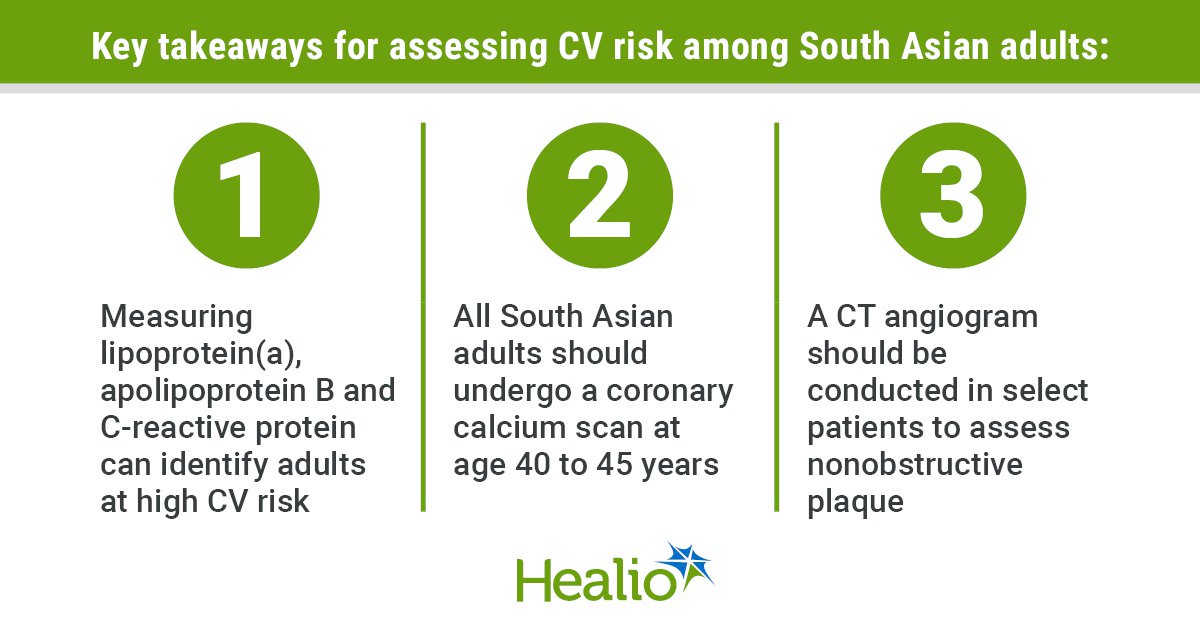
She said health care professionals have focused on LDL cholesterol as a biomarker for CV risk, but there are limitations to that approach. Relwani highlighted three other biomarkers — lipoprotein(a) — or Lp(a) — apolipoprotein B and C-reactive protein — that may be stronger predictors for CV risk in South Asian adults because they tend to have higher Lp(a) and ApoB levels than adults of other racial-ethnic groups.
“All three of these are simple blood tests,” Relwani said. “You can pretty much walk into any lab … and they cost $20 to $30, so they’re fairly easy to order. They all also can significantly impact your management, and they all have therapies targeted directly to them.”
Relwani recommended that health care professionals assess all three biomarkers in addition to triglyceride-to-HDL cholesterol ratio and fasting insulin or homeostasis model of insulin resistance for South Asian adults.
Imaging recommendations
In addition to assessing laboratory values, health care professionals should consider a coronary calcium scan for South Asian adults, Relwani said, adding that the assessment can better detect subclinical CVD than a stress test. A study published in JACC: Advances reported that 60% of South Asian men had a coronary artery calcium (CAC) score of more than 0 Agatston units at age 55 years.
“It does have some limitations,” Relwani said of CAC score. “A score of 0 does not mean no risk. They may still have nonobstructive plaque, and so they recommend repeating the scan in about 5 years.”
Relwani said a CT angiogram can be used to assess nonobstructive plaque. A small study published in the Journal of the American College of Cardiology in 2023 revealed South Asian adults had higher amounts of total plaque, calcified plaque and noncalcified plaque than white adults.
“One of the takeaways from this is that if patients have calcified plaque on their coronary score, they also have noncalcified plaque,” Relwani said. “That’s something to be aware of. If you have calcified plaque, even if it’s a small amount, you have coronary artery disease.”
Based on current evidence, Relwani said South Asian adults should be screened for CV risk with at least a CAC score by age 40 to 45 years, regardless of BMI, with a CT angiogram being conducted in select cases.
Sources/Disclosures
Source:
Relwani R. Cracking the code: Uncovering hidden metabolic risk in South Asian hearts. Presented at: American Association of Clinical Endocrinology Annual Scientific and Clinical Conference; April 22-24, 2026; Las Vegas.
References:
Disclosures:
Healio could not confirm Relwani’s relevant financial disclosures at the time of publication.

Ask a clinical question and tap into Healio AI’s knowledge base.
- PubMed, enrolling/recruiting trials, guidelines
- Clinical Guidance, Healio CME, FDA news
- Healio’s exclusive daily news coverage of clinical data
<











Leave a Reply