
April 24, 2026
2 min read
Key takeaways:
- Patients with type 2 diabetes who use GLP-1 analogs survived long enough to developed cognitive impairment.
- This protection against mortality was only seen among patients with an A1c of 6.5% or higher.
CHICAGO — Although GLP-1 analogs were associated with increased risks for cognitive impairment, they had a larger, protective effect for mortality, according to speaker at the American Academy of Neurology Annual Meeting.
“Cerebrovascular diseases, diabetes and obesity rank among the top threats to public health,” Isaac Thorman, MSc, a rising fourth-year medical student at New York Medical College, said during his presentation.

Data derived from Thorman IB, et al. Long-term risk of cognitive impairment with GLP-1 analogues in older adults with type 2 diabetes mellitus. Presented at: American Academy of Neurology Annual Meeting; April 5-9, 2025; San Diego.
The burdens of cognitive impairment and dementia also will increase with the aging population. Further, he said, the long-term vascular effects of GLP-1 analogs among patients who use them for diabetes and obesity are unclear.

Isaac Thorman
Thorman also noted that although the phase 3 Evoke randomized controlled trial found improvements in biomarkers related to Alzheimer’s disease with semaglutide among older adults with mild cognitive impairment or Alzheimer’s disease, the progression of Alzheimer’s disease was not delayed.
“For this reason, our objective was to assess the long-term risk of cognitive impairment associated with GLP-1 analog use in older adults with type 2 diabetes,” Thorman said.
Using the TriNetX Research Network, the researchers matched 64,530 patients aged 50 years and older with type 2 diabetes using GLP-1 analogs with those who were not using these drugs and followed them for up to 10 years.
“GLP-1 analog use was associated with an increased risk of cognitive impairment,” Thorman said. “However, this appeared to be secondary to the more significant decreased risk of mortality.”
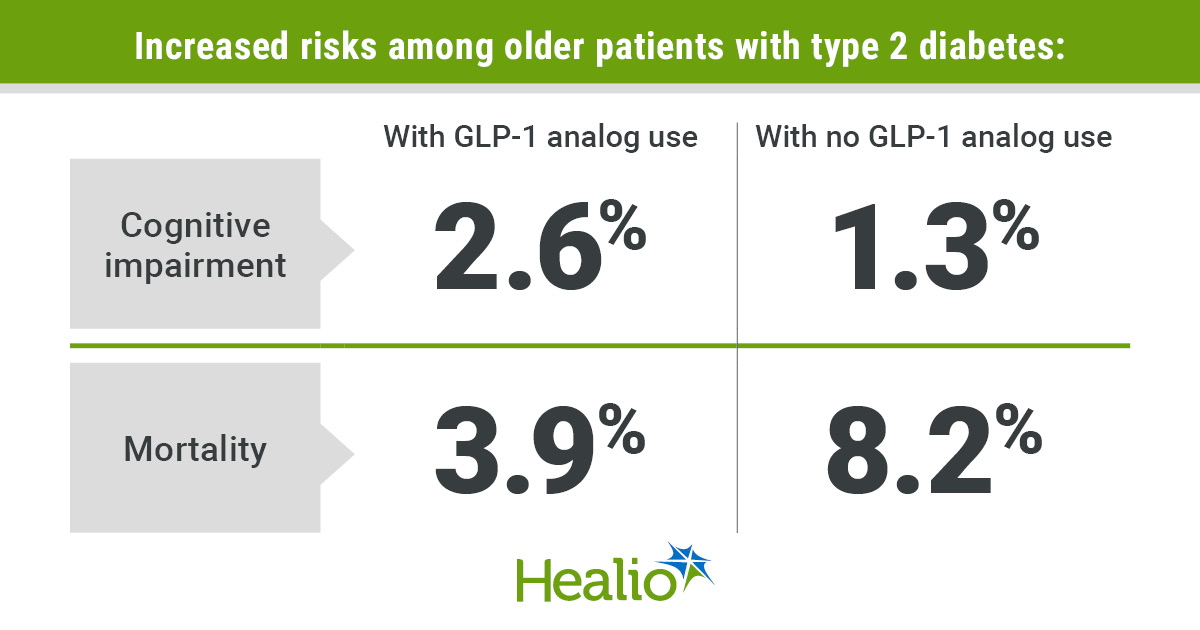
Risks for cognitive impairment increased 2.6% for those on GLP-1 analogs and 1.3% for those not on them (HR = 2.74; P < .0001). Risks for mortality increased by 3.9% for those on GLP-1 analogs and 8.2% for those not on them (HR = 0.68; P < .0001).
“On creation of a compound outcome to assess the competing risk of these two outcomes against one another, we found no significant change,” Thorman said. “We interpret this to mean that GLP-1 analog recipients lived significantly longer than non-recipients, but they lived long enough to develop cognitive impairment.”
However, Thorman noted specific caveats emerging from the stratified analysis.
“By age, we found no protective effect among patients in their 80s, while patients in their 50s had no change in the risk of cognitive impairment,” he said.
Also, patients with BMI of 50 and higher did not have any changes in their risks.
“By sex, we found the increased risk of cognitive impairment was greater among female patients than among male patients,” Thorman continued.
Increased risks for cognitive impairment for women were balanced by the mortality benefit of treatment, he said, but the mortality benefit outweighed risks for cognitive impairment among men.
“And by A1c, we found that the mortality protection was only observed in patients with an A1c of at least 6.5%,” Thorman said.
Based on this data, Thorman concluded that the association between GLP-1 analog use and cognitive impairment was secondary to the drugs’ protective effect against mortality, with specific patient factors driving outcomes.
“We interpret this as an overall favorable profile for GLP-1 analogs,” he said.
Also, this survival paradox, the study’s sample size and its long-term follow-up may explain the lack of significance found in randomized controlled trials, Thorman said, but he did recommend caution in interpreting these results.
“Causality cannot be inferred in this retrospective analysis,” he said. “Prospective randomized trials remain essential.”
For more information:
Isaac Thorman, MSc, can be reached at ithorman@student.nymc.edu.
Sources/Disclosures
Source:
Thorman IB, et al. Long-term risk of cognitive impairment with GLP-1 analogues in older adults with type 2 diabetes mellitus. Presented at: American Academy of Neurology Annual Meeting; April 5-9, 2025; San Diego.
Disclosures:
The authors report no relevant financial disclosures.

Ask a clinical question and tap into Healio AI’s knowledge base.
- PubMed, enrolling/recruiting trials, guidelines
- Clinical Guidance, Healio CME, FDA news
- Healio’s exclusive daily news coverage of clinical data
<










Leave a Reply